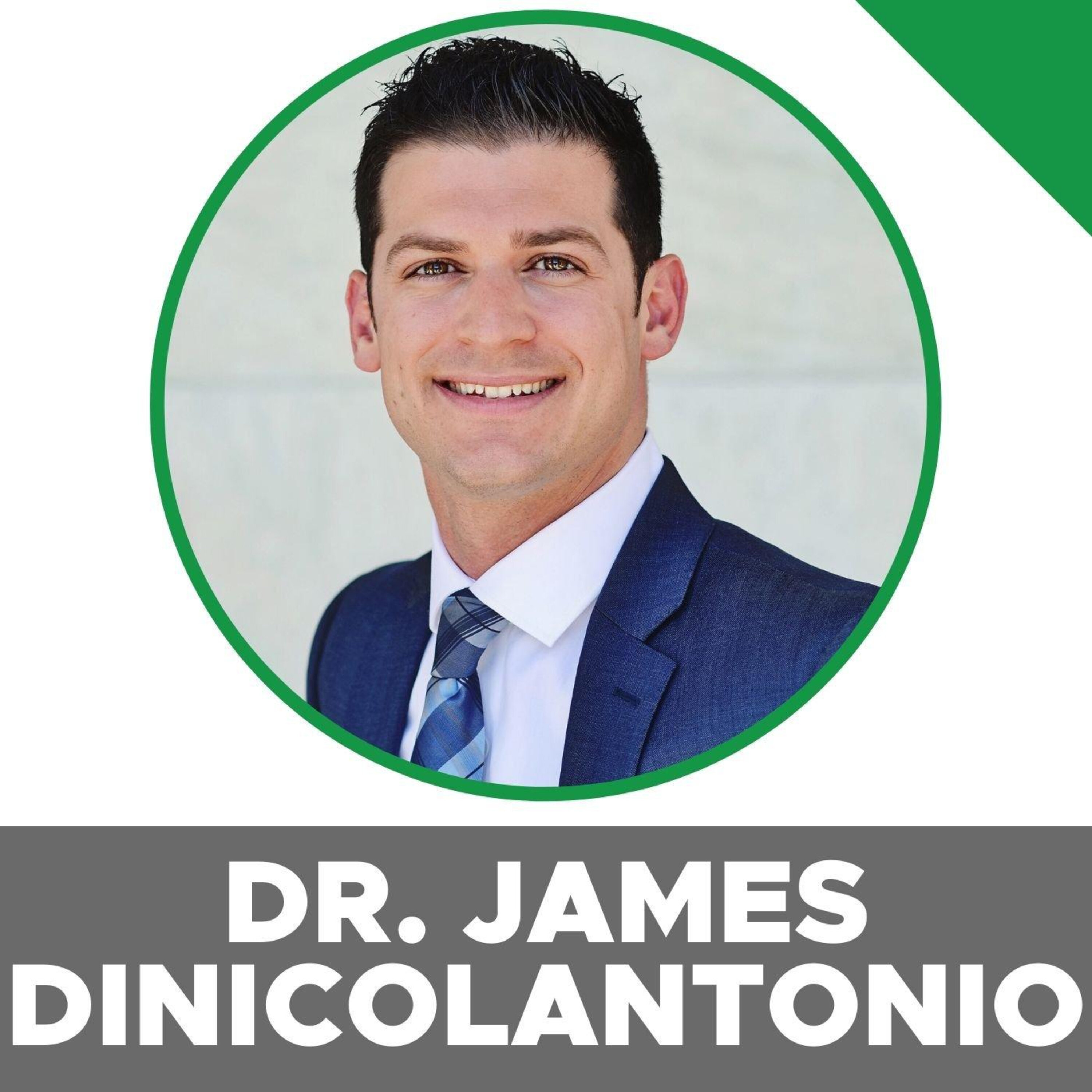
Why You're Probably Mineral Deficient If You Eat A "Healthy" Diet, How Coffee & Ketosis Affect Your Mineral Status, Is Himalayan Salt Toxic, The Best Bottled Waters & More: The Mineral Fix With James DiNicolantonio.
Micronutrient deficiencies are widespread across the globe in both developed and developing countries. These deficiencies pose a serious threat to long-term health and longevity. Deficiencies in key minerals, such as magnesium and potassium, increase the risk of chronic diseases, including cardiovascular disease and diabetes. It is estimated that 1 out of 3 people in the United States has at least 10 minerals in which they are deficient: potassium, manganese, magnesium, calcium, zinc, iron, copper, selenium, chromium, molybdenum, and boron.
The Mineral Fix: How to Optimize Your Mineral Intake for Energy, Longevity, Immunity, Sleep and More is a new book on this matter—a comprehensive guide about the role of essential minerals in the human diet. It includes information on all 17 of the essential minerals that humans need for proper physiological function and survival as well as the 5 possibly essential minerals that also have an important role in overall health.
The author of The Mineral Fix and my guest on this podcast, Dr. James DiNicolantonio, is a Doctor of Pharmacy and a cardiovascular research scientist. A well-respected and internationally known scientist and an expert on health and nutrition, Dr. DiNicolantonio has contributed extensively to health policy and has testified in front of the Canadian Senate regarding the harms of added sugars.
You can follow Dr. DiNicolantonio on YouTube, Instagram, Twitter, and Facebook.
You can also visit his website at drjamesdinic.com.
During this discussion, you'll discover: -Why adding salt might be a good thing...09:23 -Why healthy people might be more mineral deficient...09:55 -Why glycine may help mitigate negative effects of damage...12:50 -Why Ben puts a teaspoon of salt in his coffee...15:45 -What makes the 17 essential minerals essential..21:00 -Mineral replenishment for adrenal fatigue and exercise recovery...23:35 -The importance of getting a full spectrum of essential minerals and sodium intake...27:05 -The best way to test for all 17 essential minerals...28:30 -Why drinking soft water might make you mineral deficient...33:05 -The top commercial mineral water products...38:00 -James' go-to salt brands...44:30 -Practical ways to fix mineral deficiencies...50:00 -Bicarbonates and electrolyte balance...55:20 -And much more... Episode sponsors: Do you have questions, thoughts, or feedback for James or me? Leave your comments at https://bengreenfieldfitness.com/mineralfix and one of us will reply!See omnystudio.com/listener for privacy information.
Available Results
Generated results are saved to your library for reuse and search.
Choose Template
Pick the result you want. You can review provider and model before generating.
A concise first-pass summary for understanding the episode quickly.
A comprehensive, source-grounded extraction of the reusable knowledge in an episode.
A comprehensive extraction focused on health practices, protocols, claims, and safety caveats.
A dedicated analysis of warnings, limitations, trade-offs, weak evidence, and uncertainty.
Repeatable methods, frameworks, mental models, processes, and systems.
Scientific findings, mechanisms, studies, hypotheses, and the limits of the evidence discussed.
A concise first-pass summary for understanding the episode quickly.
A detailed readable summary organized by chapter or topic.
A navigable map of subjects, topic flow, and suggested chapters.
A comprehensive, source-grounded extraction of the reusable knowledge in an episode.
Reusable atomic knowledge units extracted from the episode.
A comprehensive extraction focused on health practices, protocols, claims, and safety caveats.
A comprehensive extraction focused on opportunities, strategy, markets, and company building.
Explicit actions, next steps, habits, recommendations, and things to avoid.
A dedicated inventory of concrete resources named in the episode.
A dedicated analysis of warnings, limitations, trade-offs, weak evidence, and uncertainty.
A concise first-pass summary for understanding the episode quickly.
A detailed readable summary organized by chapter or topic.
A navigable map of subjects, topic flow, and suggested chapters.
A comprehensive, source-grounded extraction of the reusable knowledge in an episode.
Reusable atomic knowledge units extracted from the episode.
A comprehensive extraction focused on health practices, protocols, claims, and safety caveats.
A comprehensive extraction focused on opportunities, strategy, markets, and company building.
Scientific findings, mechanisms, studies, hypotheses, and the limits of the evidence discussed.
Technologies, AI models, technical methods, capabilities, limitations, and adoption implications.
Investment theses, assets, catalysts, valuation reasoning, time horizons, and risks.
Chronologies, actors, causes, consequences, turning points, and competing historical interpretations.
Policies, proposals, stakeholders, arguments, implementation constraints, and predicted effects.
Career paths, skills, hiring signals, workplace decisions, transitions, and limitations of the advice.
Behavioral mechanisms, biases, motivation, habits, emotions, interventions, and evidence limitations.
Economic mechanisms, incentives, indicators, market structure, forecasts, and uncertainty.
Leadership principles, team systems, organizational design, culture, feedback, and failure modes.
Audience, positioning, messaging, acquisition, retention, experiments, metrics, and failed approaches.
Teaching methods, learning strategies, practice, feedback, assessment, and effectiveness evidence.
Theses, premises, arguments, objections, values, thought experiments, and unresolved questions.
Communication patterns, conflict, boundaries, expectations, repair methods, and contextual limitations.
Books, papers, authors, courses, and other learning resources mentioned in the episode.
Repeatable methods, frameworks, mental models, processes, and systems.
Explicit actions, next steps, habits, recommendations, and things to avoid.
Memorable statements and important claims with attribution and source context.
A dedicated inventory of concrete resources named in the episode.
A dedicated analysis of warnings, limitations, trade-offs, weak evidence, and uncertainty.