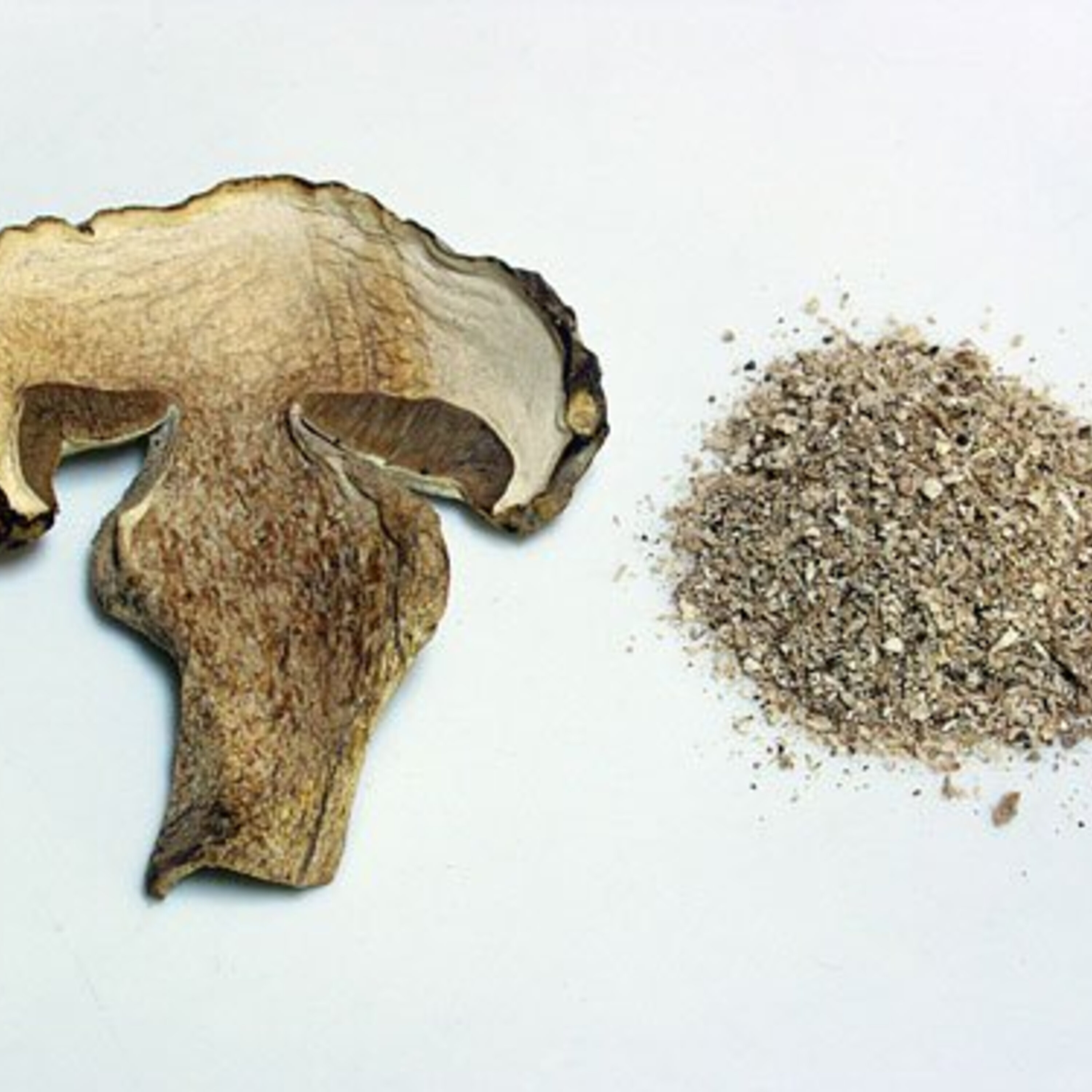
Cracking The Code On Nature's Best Kept Secret: Medicinal Mushrooms.
Before I recorded today's podcast, I skipped my usual morning dark, black cup of aero-pressed coffee, and instead opted for something called "mushroom coffee", which is a powdered blend of arabica coffee, chaga mushroom and cordyceps extract.
So could drinking a tea made out of a specific mushroom lower your stress levels? Or even choosing to top your risotto with champions help prevent you from cancer? Out of the 150,000 known species of fungi about 300 have shown a wide variety of medicinal properties. Some “‘shrooms” have a hormonal balancing effect and some enhance the immune system, just to give a few examples. So today, with Tero Isokauppila, the Co-Founder and President of Four Sigma Foods, we take a deep dive into these type of medicinal mushroom extracts, and you'll discover... -The story behind Four Sigma Foods and how Tero got so interested in mushrooms... -The important difference between a medicinal mushrooms and a regular mushroom... -How big pharmaceutical companies use mushrooms (and the mistake they make)... -The best mushroom extract to use for stress... -The best mushroom extract to use for immune system... -The best mushroom extract to use for balancing blood sugar... -The best mushroom extract to use for liver detox... -The crazy story of where cordyceps mushroom extract actually comes from... -Why most mushroom products are ineffective because they are grown on grain or rice and are simply full of starch rather than the beneficial bioactive compounds... -Whether you should take mushroom extracts on an empty stomach or take with a meal... -If adaptogens and mushrooms are safe for kids... -The process via which a mushroom is harvested and then turned into something like a powdered extract or a tea... -Whether you need to heat mushroom extract, or if you can simply add it to cold water...
Tero Isokauppila is the Co-Founder and President of Four Sigma Foods. Four Sigma Foods is a startup dedicated to democratizing the healing powers of mushrooms by making them accessible to everyone. The company currently sells superfood teas, mushroom-infused coffees and mushroom chocolates, and you can use discount code "ben-greenfield” to get 15% off anything from Four Sigma Foods.
Do you have questions, comments or feedback about medicinal mushrooms, Four Sigma Foods extract, or any of the other topics that Tero and I discuss? Leave your thoughts at BenGreenfieldFitness.com!
See omnystudio.com/listener for privacy information.
Available Results
Generated results are saved to your library for reuse and search.
Choose Template
Pick the result you want. You can review provider and model before generating.
A concise first-pass summary for understanding the episode quickly.
A comprehensive, source-grounded extraction of the reusable knowledge in an episode.
A comprehensive extraction focused on health practices, protocols, claims, and safety caveats.
A dedicated analysis of warnings, limitations, trade-offs, weak evidence, and uncertainty.
Repeatable methods, frameworks, mental models, processes, and systems.
A comprehensive extraction focused on opportunities, strategy, markets, and company building.
A concise first-pass summary for understanding the episode quickly.
A detailed readable summary organized by chapter or topic.
A navigable map of subjects, topic flow, and suggested chapters.
A comprehensive, source-grounded extraction of the reusable knowledge in an episode.
Reusable atomic knowledge units extracted from the episode.
A comprehensive extraction focused on health practices, protocols, claims, and safety caveats.
A comprehensive extraction focused on opportunities, strategy, markets, and company building.
Explicit actions, next steps, habits, recommendations, and things to avoid.
A dedicated inventory of concrete resources named in the episode.
A dedicated analysis of warnings, limitations, trade-offs, weak evidence, and uncertainty.
A concise first-pass summary for understanding the episode quickly.
A detailed readable summary organized by chapter or topic.
A navigable map of subjects, topic flow, and suggested chapters.
A comprehensive, source-grounded extraction of the reusable knowledge in an episode.
Reusable atomic knowledge units extracted from the episode.
A comprehensive extraction focused on health practices, protocols, claims, and safety caveats.
A comprehensive extraction focused on opportunities, strategy, markets, and company building.
Scientific findings, mechanisms, studies, hypotheses, and the limits of the evidence discussed.
Technologies, AI models, technical methods, capabilities, limitations, and adoption implications.
Investment theses, assets, catalysts, valuation reasoning, time horizons, and risks.
Chronologies, actors, causes, consequences, turning points, and competing historical interpretations.
Policies, proposals, stakeholders, arguments, implementation constraints, and predicted effects.
Career paths, skills, hiring signals, workplace decisions, transitions, and limitations of the advice.
Behavioral mechanisms, biases, motivation, habits, emotions, interventions, and evidence limitations.
Economic mechanisms, incentives, indicators, market structure, forecasts, and uncertainty.
Leadership principles, team systems, organizational design, culture, feedback, and failure modes.
Audience, positioning, messaging, acquisition, retention, experiments, metrics, and failed approaches.
Teaching methods, learning strategies, practice, feedback, assessment, and effectiveness evidence.
Theses, premises, arguments, objections, values, thought experiments, and unresolved questions.
Communication patterns, conflict, boundaries, expectations, repair methods, and contextual limitations.
Books, papers, authors, courses, and other learning resources mentioned in the episode.
Repeatable methods, frameworks, mental models, processes, and systems.
Explicit actions, next steps, habits, recommendations, and things to avoid.
Memorable statements and important claims with attribution and source context.
A dedicated inventory of concrete resources named in the episode.
A dedicated analysis of warnings, limitations, trade-offs, weak evidence, and uncertainty.