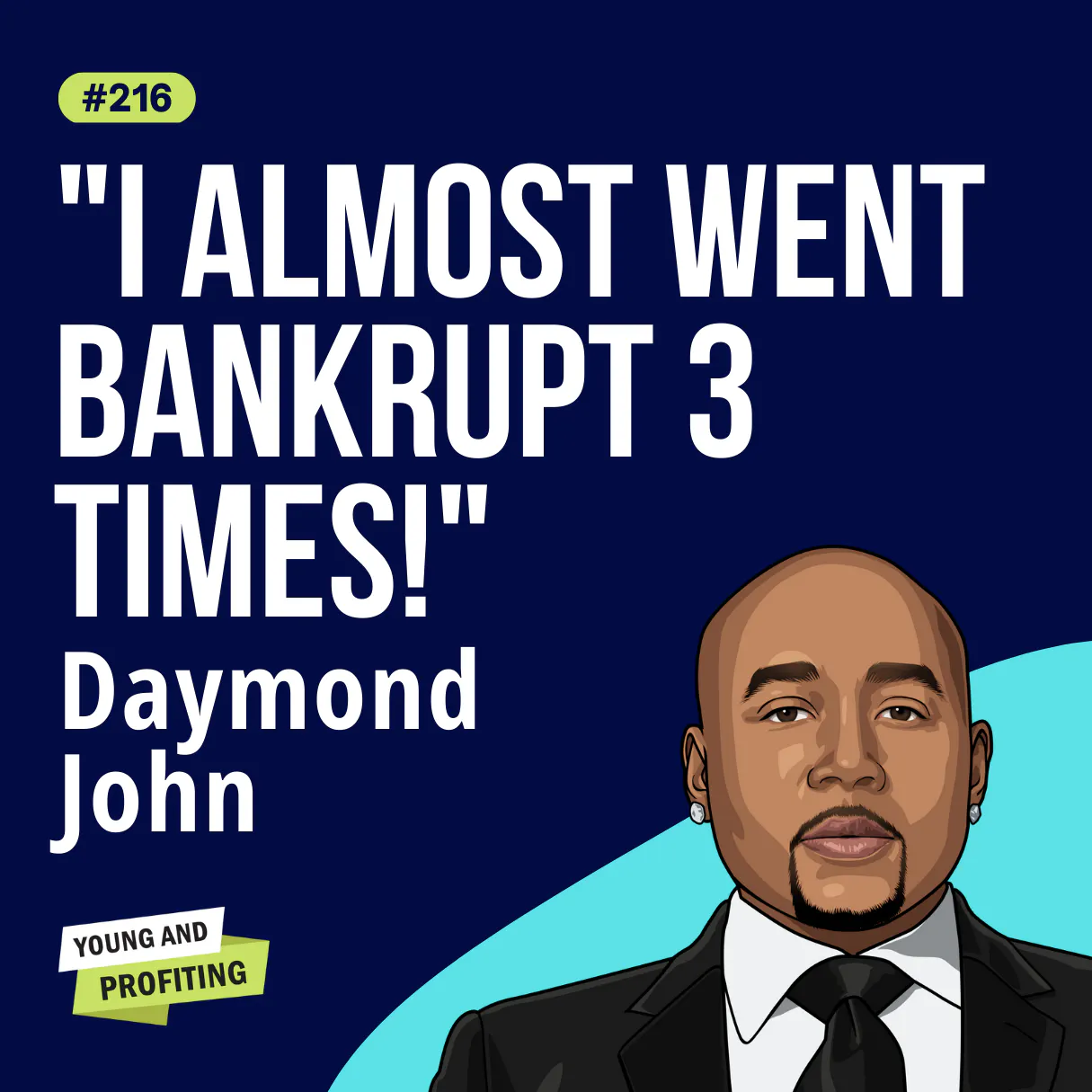
Daymond John: Learn to Earn, How The People's Shark is Raising a New Generation of Financially-Savvy People | Entrepreneurship | E216
Growing up in Queens, New York, Daymond John had big dreams and an early knack for entrepreneurship. He sold everything from pencils to reconditioned cars, and while working full-time at Red Lobster, he started his clothing brand FUBU. Because of the tenacity instilled in him by his mother, FUBU eventually became a multi-billion dollar global clothing and lifestyle brand. In this episode, Daymond will share his rags-to-riches story and the lessons he has learned as a seasoned investor on Shark Tank. Daymond will break down his latest book, Little Daymond Learns to Earn, a kid's book written to instill financial and entrepreneurial literacy in younger generations. Daymond will also share how we can instill hope in our youth!
Daymond John is a New York Times bestselling author and the CEO and founder of FUBU, the $6 billion global lifestyle brand created to represent overlooked communities. He is also a star and original member of ABC’s four-time Emmy Award–winning TV show Shark Tank, where he invests and helps entrepreneurs grow their own businesses.
In this episode, Hala and Daymond will discuss:
- Daymond’s early entrepreneurial itch
- How Daymond’s side hustle became the global brand FUBU
- Common Sense marketing tactics
- What Daymond learned from Jay Abraham
- Daymond’s mother’s influence on his life
- Becoming a Shark on the hit show Shark Tank
- Why most of America does not have financial literacy
- How to teach financial intelligence to our kids
- Daymond’s 3-dollar rule
- Why kids need new national role models
- How to take your parent hat off and think like a kid
- And other topics…
Daymond John was born with a passion for entrepreneurship. Daymond is CEO and founder of FUBU, the $6 billion global lifestyle brand created to represent overlooked communities. He is also a star and original member of ABC’s four-time Emmy Award–winning TV show Shark Tank, helping entrepreneurs and business owners grow their own businesses. His work as an entrepreneur has been recognized by Barack Obama who named him a Presidential Ambassador for Global Entrepreneurship, and he has won four Webby Awards for his work in creating, producing, and hosting Black Entrepreneurs Day.
He continues to work with a number of philanthropic organizations to educate and empower future generations, including My Brother’s Keeper, the Network for Teaching Entrepreneurship, and the NAACP, to name a few. Daymond is a New York Times bestselling author, and Little Daymond Learns to Earn is his first book for children. Of all of his accomplishments, Daymond is most proud of his role as a dad to his daughters.
Win 15 minutes with Daymond John:
Go to littledaymond.com, purchase your bundle, and enter code ‘YAP’ at checkout!
Resources Mentioned:
Daymond’s Website: https://daymondjohn.com/
Daymond’s LinkedIn: https://www.linkedin.com/in/daymondjohn/
Daymond’s Twitter: https://twitter.com/thesharkdaymond
Daymond’s Instagram: https://www.instagram.com/thesharkdaymond/
Daymond’s Facebook: https://www.facebook.com/TheSharkDaymond/
Daymond’s Podcast Rise and Grind with Daymond John: Rise and Grind with Daymond John
Daymond’s Book Little Daymond Learns to Earn: https://www.amazon.com/Little-Daymond-Learns-Earn-John/dp/0593567277
LinkedIn Secrets Masterclass, Have Job Security For Life:
Use code ‘podcast’ for 30% off at yapmedia.io/course.
More About Young and Profiting
Download Transcripts - youngandprofiting.com
Get Sponsorship Deals - youngandprofiting.com/sponsorships
Leave a Review - ratethispodcast.com/yap
Watch Videos - youtube.com/c/YoungandProfiting
Follow Hala Taha
LinkedIn - linkedin.com/in/htaha/
Instagram - instagram.com/yapwithhala/
TikTok - tiktok.com/@yapwithhala
Twitter - twitter.com/yapwithhala
Learn more about YAP Media Agency Services - yapmedia.io/
Available Results
Generated results are saved to your library for reuse and search.
Choose Template
Pick the result you want. You can review provider and model before generating.
A concise first-pass summary for understanding the episode quickly.
A comprehensive, source-grounded extraction of the reusable knowledge in an episode.
A comprehensive extraction focused on opportunities, strategy, markets, and company building.
Explicit actions, next steps, habits, recommendations, and things to avoid.
Repeatable methods, frameworks, mental models, processes, and systems.
A dedicated inventory of concrete resources named in the episode.
A concise first-pass summary for understanding the episode quickly.
A detailed readable summary organized by chapter or topic.
A navigable map of subjects, topic flow, and suggested chapters.
A comprehensive, source-grounded extraction of the reusable knowledge in an episode.
Reusable atomic knowledge units extracted from the episode.
A comprehensive extraction focused on health practices, protocols, claims, and safety caveats.
A comprehensive extraction focused on opportunities, strategy, markets, and company building.
Explicit actions, next steps, habits, recommendations, and things to avoid.
A dedicated inventory of concrete resources named in the episode.
A dedicated analysis of warnings, limitations, trade-offs, weak evidence, and uncertainty.
A concise first-pass summary for understanding the episode quickly.
A detailed readable summary organized by chapter or topic.
A navigable map of subjects, topic flow, and suggested chapters.
A comprehensive, source-grounded extraction of the reusable knowledge in an episode.
Reusable atomic knowledge units extracted from the episode.
A comprehensive extraction focused on health practices, protocols, claims, and safety caveats.
A comprehensive extraction focused on opportunities, strategy, markets, and company building.
Scientific findings, mechanisms, studies, hypotheses, and the limits of the evidence discussed.
Technologies, AI models, technical methods, capabilities, limitations, and adoption implications.
Investment theses, assets, catalysts, valuation reasoning, time horizons, and risks.
Chronologies, actors, causes, consequences, turning points, and competing historical interpretations.
Policies, proposals, stakeholders, arguments, implementation constraints, and predicted effects.
Career paths, skills, hiring signals, workplace decisions, transitions, and limitations of the advice.
Behavioral mechanisms, biases, motivation, habits, emotions, interventions, and evidence limitations.
Economic mechanisms, incentives, indicators, market structure, forecasts, and uncertainty.
Leadership principles, team systems, organizational design, culture, feedback, and failure modes.
Audience, positioning, messaging, acquisition, retention, experiments, metrics, and failed approaches.
Teaching methods, learning strategies, practice, feedback, assessment, and effectiveness evidence.
Theses, premises, arguments, objections, values, thought experiments, and unresolved questions.
Communication patterns, conflict, boundaries, expectations, repair methods, and contextual limitations.
Books, papers, authors, courses, and other learning resources mentioned in the episode.
Repeatable methods, frameworks, mental models, processes, and systems.
Explicit actions, next steps, habits, recommendations, and things to avoid.
Memorable statements and important claims with attribution and source context.
A dedicated inventory of concrete resources named in the episode.
A dedicated analysis of warnings, limitations, trade-offs, weak evidence, and uncertainty.