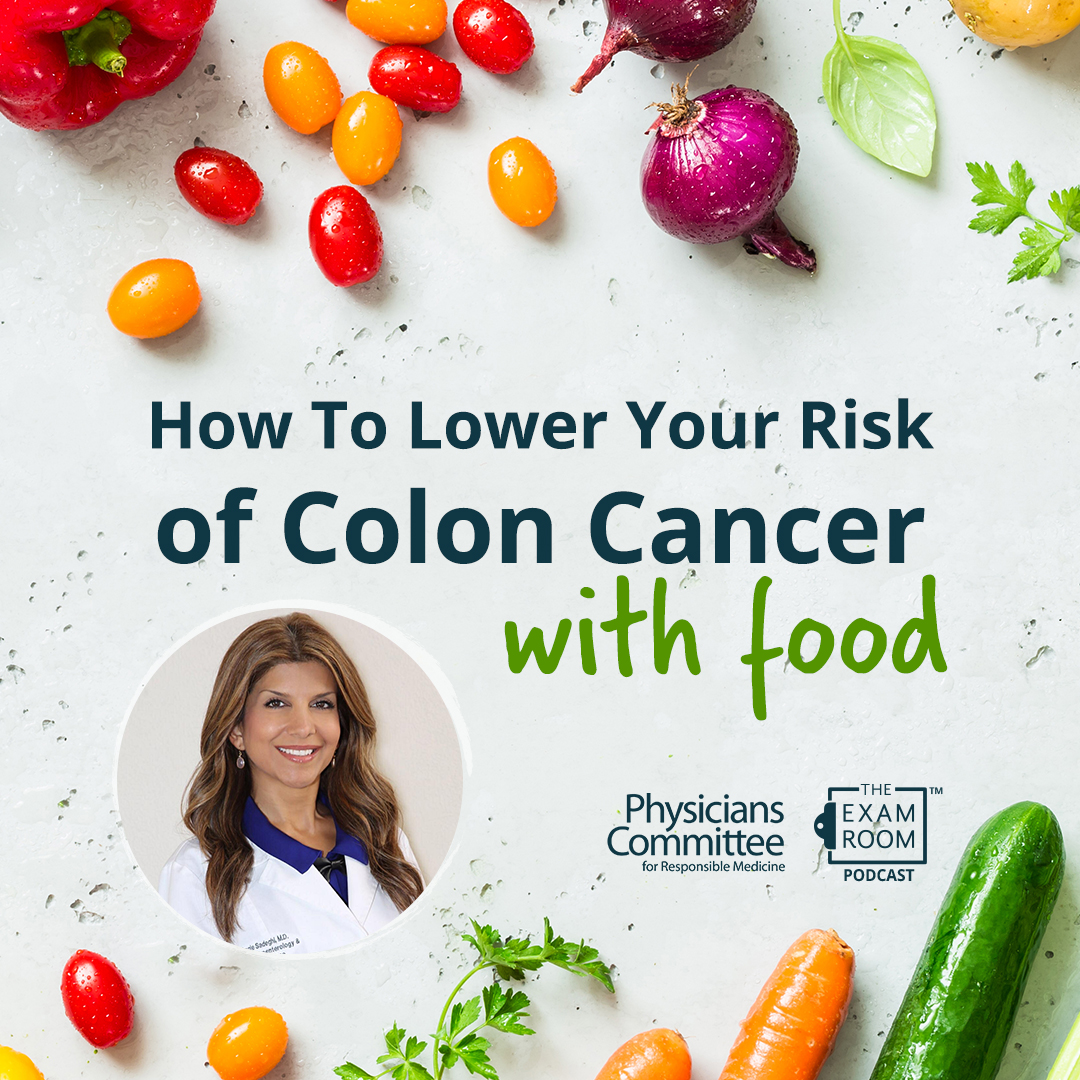
How To Lower Your Risk of Colon Cancer With Food
Colorectal cancer is one of the most common forms of cancer, and it's also one of the most preventable.
On this episode of The Exam Room™ podcast, you will learn how and why diet and lifestyle can play such an enormous role in determining whether or not you develop colon cancer. As Colorectal Cancer Awareness Month begins "The Weight Loss Champion" Chuck Carroll is joined by Newport Beach, California-based gastroenterologist Dr. Angie Sadeghi who says we will shed far fewer tears when we stop eating the SAD — Standard American Diet. She also shares why poor diets are leading to an increased number of cases among younger adults.
Dr. Sadeghi and Chuck also compare the number small number of cases related to genetics to the overwhelming majority that are driven by diet and lifestyle.
One of the keys to lowering the risk of colon cancer is to load up on fiber. So, dietician Lee Crosby joins the show to share her list of high fiber foods that everyone should be eating to help stay healthy!
Lee then shares the news that her mom, who lost 100 pounds after adopting a plant-based diet, is now teaching Food For Life classes in the Washington, DC area. Registration is now open!
Find a Food For Life class near you.
** High Fiber Foods **
- Split Peas, cooked (1 cup): 16.3g
- Lentils, cooked (1 cup): 15g
- Cannellini Beans, cooked (1 cup): 10g
- Raspberries (1 cup): 8 g
- Blackberries (1 cup): 7.63 g
- Sweet potato (1 cup): 6.6 g
- Broccoli (1 cup): 5.1 g
- Pear (1 whole): 5 g
- Apple (1 medium): 4.37 g
- Blueberries (1 cup): 3.55 g
— — —
Dr. Angie Sadeghi
IG: @angie.sadeghi
Web: https://drangiehealth.com
Phone: 949-404-4444
— — —
6 Steps to Fight Colon Cancer
Read: http://bit.ly/2Tyq7zP
— — —
Mama Crosby's Food For Life Class
Register: http://bit.ly/38apQbw
— — —
Chuck Carroll
Twitter: @ChuckCarrollWLC
IG: @ChuckCarrollWLC
Facebook: https://wghtloss.cc/ChuckFacebook
— — —
Lee Crosby
Twitter: @Veggie_Quest
— — —
Physicians Committee
Twitter: @PCRM
Facebook: https://wghtloss.cc/PCRMFacebook
— — —
Share the Show
Please subscribe and give the show a 5-star rating on Apple Podcasts, Spotify or many other podcast providers. Don't forget to share it with a friend for inspiration!
Available Results
Generated results are saved to your library for reuse and search.
Choose Template
Pick the result you want. You can review provider and model before generating.
A concise first-pass summary for understanding the episode quickly.
A comprehensive, source-grounded extraction of the reusable knowledge in an episode.
A comprehensive extraction focused on health practices, protocols, claims, and safety caveats.
A dedicated analysis of warnings, limitations, trade-offs, weak evidence, and uncertainty.
Repeatable methods, frameworks, mental models, processes, and systems.
Chronologies, actors, causes, consequences, turning points, and competing historical interpretations.
A concise first-pass summary for understanding the episode quickly.
A detailed readable summary organized by chapter or topic.
A navigable map of subjects, topic flow, and suggested chapters.
A comprehensive, source-grounded extraction of the reusable knowledge in an episode.
Reusable atomic knowledge units extracted from the episode.
A comprehensive extraction focused on health practices, protocols, claims, and safety caveats.
A comprehensive extraction focused on opportunities, strategy, markets, and company building.
Explicit actions, next steps, habits, recommendations, and things to avoid.
A dedicated inventory of concrete resources named in the episode.
A dedicated analysis of warnings, limitations, trade-offs, weak evidence, and uncertainty.
A concise first-pass summary for understanding the episode quickly.
A detailed readable summary organized by chapter or topic.
A navigable map of subjects, topic flow, and suggested chapters.
A comprehensive, source-grounded extraction of the reusable knowledge in an episode.
Reusable atomic knowledge units extracted from the episode.
A comprehensive extraction focused on health practices, protocols, claims, and safety caveats.
A comprehensive extraction focused on opportunities, strategy, markets, and company building.
Scientific findings, mechanisms, studies, hypotheses, and the limits of the evidence discussed.
Technologies, AI models, technical methods, capabilities, limitations, and adoption implications.
Investment theses, assets, catalysts, valuation reasoning, time horizons, and risks.
Chronologies, actors, causes, consequences, turning points, and competing historical interpretations.
Policies, proposals, stakeholders, arguments, implementation constraints, and predicted effects.
Career paths, skills, hiring signals, workplace decisions, transitions, and limitations of the advice.
Behavioral mechanisms, biases, motivation, habits, emotions, interventions, and evidence limitations.
Economic mechanisms, incentives, indicators, market structure, forecasts, and uncertainty.
Leadership principles, team systems, organizational design, culture, feedback, and failure modes.
Audience, positioning, messaging, acquisition, retention, experiments, metrics, and failed approaches.
Teaching methods, learning strategies, practice, feedback, assessment, and effectiveness evidence.
Theses, premises, arguments, objections, values, thought experiments, and unresolved questions.
Communication patterns, conflict, boundaries, expectations, repair methods, and contextual limitations.
Books, papers, authors, courses, and other learning resources mentioned in the episode.
Repeatable methods, frameworks, mental models, processes, and systems.
Explicit actions, next steps, habits, recommendations, and things to avoid.
Memorable statements and important claims with attribution and source context.
A dedicated inventory of concrete resources named in the episode.
A dedicated analysis of warnings, limitations, trade-offs, weak evidence, and uncertainty.