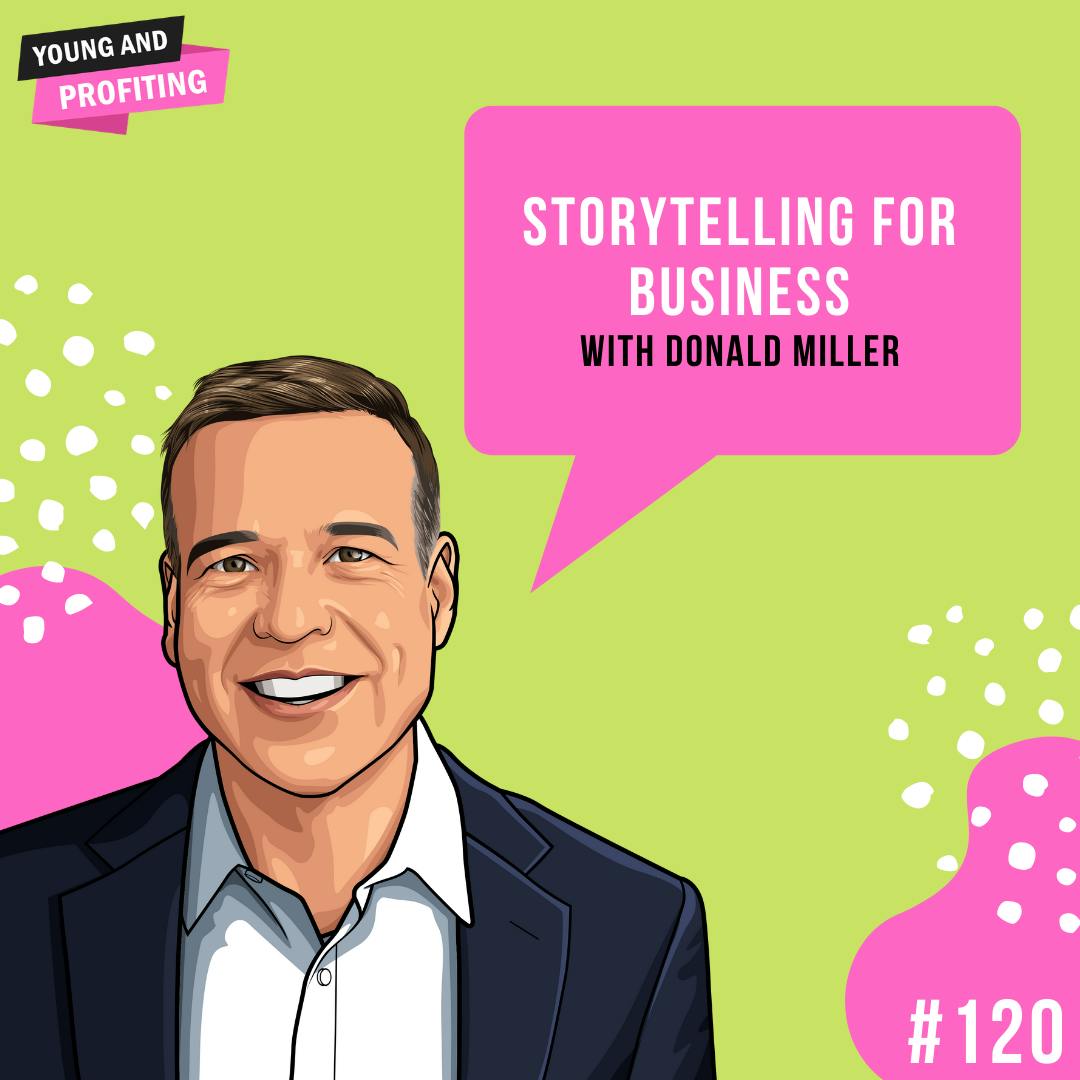
Donald Miller: Storytelling for Business | E120
Storytelling Made Simple!
In today’s episode, we are talking with Donald Miller, best-selling author, CEO, and podcast host. Donald is the CEO of Business Made Simple, an online platform that teaches business professionals everything they need to know to grow a business and enhance their personal value on the open market. He is also the host of the Business Made Simple Podcast and is the author of several books including the bestseller "Building a StoryBrand."
Donald is widely considered one of the most entertaining and informative speakers in the world. His audiences are challenged to lean into their own story, creatively develop and execute the story of their team, and understand the story of their customers so they can serve them with passion. Don's thoughts on story have deeply influenced leaders and teams for Pantene, Ford/Lincoln, Zaxby's, Chick-fil-A, Steelcase, Intel, Prime Lending and thousands more.
In this episode, we discuss Donald’s upbringing without a father figure, the power of storytelling, and why you should always aim to tell stories. We’ll also talk about the seven steps that happen in every story, the best call-to-actions, how customer testimonials can be important, and how to use storytelling in your social media.
Sponsored by -
- Save $15 off your first visit with a board-certified dermatologist at Apostrophe.com/YAP
- Visit capsule.com to get your prescription hand delivered today—for free
Social Media:
Follow YAP on IG: www.instagram.com/youngandprofiting
Reach out to Hala directly at Hala@YoungandProfiting.com
Follow Hala on Linkedin: www.linkedin.com/in/htaha/
Follow Hala on Instagram: www.instagram.com/yapwithhala
Follow Hala on ClubHouse: @halataha
Check out our website to meet the team, view show notes and transcripts: www.youngandprofiting.com
Timestamps:
01:05 - What Donald Was Like As A Child
04:19 -The Importance of Mentors
07:49 - Why Stories Are So Powerful
11:25 - Importance of Messaging Being Concise
16:05 - The Explanation of Story Loops
19:02 - Why You Need to Continuously Solve Problems
21:45 - Where the CEO Fits Within the Face of The Brand
27:04 - The Seven Steps That Happen in Every Story
31:25 - Details on How To Use the Seven Steps
32:44 - Best Call-To-Actions
35:49 - The Principle of Pricing in Storytelling
38:17 - Real Examples of 7 Soundbites
44:28 - Why Customer Testimonials Are So Impactful
45:43 - How Brand Elements Can Pass The ‘Grunt’ Test
51:11 - Best Practices for Storytelling in Social Media
52:28 - The Comparison of Business to An Airplane
59:13 - Donald’s Secret to Profiting in Life
Mentioned in the Episode:
Donald’s LinkedIn: https://www.linkedin.com/in/donald-miller-storybrand/
Donald’s Book, Business Made Simple: https://www.businessmadesimple.com/
Donald’s Company: https://storybrand.com/
StoryBrand’s Upcoming Marketing Workshop: https://storybrand.com/#register
Free 5-Minute Marketing Makeover: http://www.5minutemarketingmakeover.com/
Available Results
Generated results are saved to your library for reuse and search.
Choose Template
Pick the result you want. You can review provider and model before generating.
A concise first-pass summary for understanding the episode quickly.
A comprehensive, source-grounded extraction of the reusable knowledge in an episode.
A comprehensive extraction focused on opportunities, strategy, markets, and company building.
Explicit actions, next steps, habits, recommendations, and things to avoid.
Repeatable methods, frameworks, mental models, processes, and systems.
A dedicated inventory of concrete resources named in the episode.
A concise first-pass summary for understanding the episode quickly.
A detailed readable summary organized by chapter or topic.
A navigable map of subjects, topic flow, and suggested chapters.
A comprehensive, source-grounded extraction of the reusable knowledge in an episode.
Reusable atomic knowledge units extracted from the episode.
A comprehensive extraction focused on health practices, protocols, claims, and safety caveats.
A comprehensive extraction focused on opportunities, strategy, markets, and company building.
Explicit actions, next steps, habits, recommendations, and things to avoid.
A dedicated inventory of concrete resources named in the episode.
A dedicated analysis of warnings, limitations, trade-offs, weak evidence, and uncertainty.
A concise first-pass summary for understanding the episode quickly.
A detailed readable summary organized by chapter or topic.
A navigable map of subjects, topic flow, and suggested chapters.
A comprehensive, source-grounded extraction of the reusable knowledge in an episode.
Reusable atomic knowledge units extracted from the episode.
A comprehensive extraction focused on health practices, protocols, claims, and safety caveats.
A comprehensive extraction focused on opportunities, strategy, markets, and company building.
Scientific findings, mechanisms, studies, hypotheses, and the limits of the evidence discussed.
Technologies, AI models, technical methods, capabilities, limitations, and adoption implications.
Investment theses, assets, catalysts, valuation reasoning, time horizons, and risks.
Chronologies, actors, causes, consequences, turning points, and competing historical interpretations.
Policies, proposals, stakeholders, arguments, implementation constraints, and predicted effects.
Career paths, skills, hiring signals, workplace decisions, transitions, and limitations of the advice.
Behavioral mechanisms, biases, motivation, habits, emotions, interventions, and evidence limitations.
Economic mechanisms, incentives, indicators, market structure, forecasts, and uncertainty.
Leadership principles, team systems, organizational design, culture, feedback, and failure modes.
Audience, positioning, messaging, acquisition, retention, experiments, metrics, and failed approaches.
Teaching methods, learning strategies, practice, feedback, assessment, and effectiveness evidence.
Theses, premises, arguments, objections, values, thought experiments, and unresolved questions.
Communication patterns, conflict, boundaries, expectations, repair methods, and contextual limitations.
Books, papers, authors, courses, and other learning resources mentioned in the episode.
Repeatable methods, frameworks, mental models, processes, and systems.
Explicit actions, next steps, habits, recommendations, and things to avoid.
Memorable statements and important claims with attribution and source context.
A dedicated inventory of concrete resources named in the episode.
A dedicated analysis of warnings, limitations, trade-offs, weak evidence, and uncertainty.