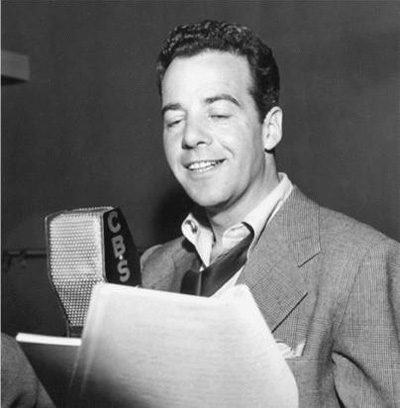
"Crime is a sucker's road..."
"I needed a drink, I needed a lot of life insurance, I needed a vacation, I needed a home in the country. What I had was a coat, a hat and a gun. I put them on and went out of the room." (Raymond Chandler, Farewell, My Lovely)
Raymond Chandler was thirty-nine when The Big Sleep, the first Philip Marlowe novel, was published and the world of detective fiction was never the same. It's Chandler who gives us the archetypal private eye as knight errant, working his way through a world of corruption and vice while he is guided by his own moral compass. Along with Dashiell Hammett, Chandler helped to invent the "hard-boiled" style of detective fiction, and his signature character proved to be one of the most popular detectives to solve cases during the Golden Age of Radio.
In the years between the publication of The Big Sleep and Marlowe's premiere on radio, Chandler's novels were adapted to the screen six times. Farewell, My Lovely and The High Window were retooled for other cinematic detectives (The Falcon and Michael Shayne, respectively); and Marlowe himself was played by four different actors in four films (Dick Powell in Murder, My Sweet; Humphrey Bogart in The Big Sleep; Robert Montgomery in Lady in the Lake; and George Montgomery - no relation - in The Brasher Doubloon).
Marlowe first came to radio in a regular series on June 17, 1947 as NBC's summer replacement for Bob Hope. MGM contract player and Academy Award winner Van Heflin starred as Marlowe, with scripts based on Chandler's own stories. Heflin prepared for the role by riding along with Los Angeles police officers before and during the run of the show. Heflin was a fine Marlowe, but he failed to win over Chandler. In a letter to fellow mystery writer Erle Stanley Gardner (creator of Perry Mason), Chandler described the series and Heflin as "thoroughly flat." The NBC series lasted thirteen weeks, and when the time came for more episodes, Heflin's film career prevented his participation.
It took nearly a year before Philip Marlowe returned to the airwaves in a regular series. Producer/director Norman Macdonnell, a veteran of Escape and other programs, oversaw the production of the new series, which premiered on CBS on September 26, 1948. Stepping into Marlowe's shoes was actor Gerald Mohr, a regular on Suspense, Escape, Our Miss Brooks, and The Whistler. Mohr brought a hard edge and a grim determination to Marlowe's voice; it was as different as night and day from Howard Duff's wry, sardonic take on Sam Spade. Gerald Mohr's Marlowe used his fists (and his .38 tucked away in shoulder holster) when necessary, and he marched through his world with a weary cynicism that came right out of Chandler's pages. And Mohr bellowed the show's legendary opening week after week:
"Get this and get it straight…crime is a sucker's road, and those who travel it wind up in the gutter, the prison, or the grave!"
The Adventures of Philip Marlowe was a hit, with scripts by Mel Dinelli, Robert Mitchell, and Gene Levitt. By 1949, the series was attracting 10.3 million listeners a week, and Gerald Mohr had been named Most Popular Male Actor by Radio and Television magazine.
Like Dashiell Hammett and The Adventures of Sam Spade, Chandler's name was all over the show (the broadcasts were billed as coming "from the pen of Raymond Chandler"), but the author had no involvement in the actual scripts or broadcast. He did, however, have praise for the show's star, declaring "Gerald Mohr's voice is absolutely tops. A voice like Gerald Mohr's gave you a personality which you fill out according to your fancy." Mohr's wasn't the only strong voice; he was backed up each week by members of Macdonnell's repertory company of actors, including John Dehner, Virginia Gregg, Jeff Corey, Larry Dobkin, Howard McNear, Parley Baer, Vivi Janiss, Georgia Ellis, and William Conrad. Many of those actors would join Macdonnell in Dodge City when he developed Gunsmoke, a program that grew out of CBS chairman William Paley's request to Macdonnell for a "Philip Marlowe in the Old West."
The Adventures of Philip Marlowe ran until September 29, 1950. It was revived for a brief run in July 1951, with Mohr slipping back into the role of Marlowe as if he'd never left it. Philip Marlowe left the airwaves the same way he arrived on them: as a summer replacement series. This time, Marlowe kept the time slot warm for Hopalong Cassidy.
Nearly all of the 114-episode Mohr series has survived in good condition, giving today's fans a chance to thrill to the rough and tumble exploits of Philip Marlowe as radio audiences did from 1948 to 1951.
Available Results
Generated results are saved to your library for reuse and search.
Choose Template
Pick the result you want. You can review provider and model before generating.
A concise first-pass summary for understanding the episode quickly.
A comprehensive, source-grounded extraction of the reusable knowledge in an episode.
A comprehensive extraction focused on health practices, protocols, claims, and safety caveats.
A dedicated analysis of warnings, limitations, trade-offs, weak evidence, and uncertainty.
Repeatable methods, frameworks, mental models, processes, and systems.
A comprehensive extraction focused on opportunities, strategy, markets, and company building.
A concise first-pass summary for understanding the episode quickly.
A detailed readable summary organized by chapter or topic.
A navigable map of subjects, topic flow, and suggested chapters.
A comprehensive, source-grounded extraction of the reusable knowledge in an episode.
Reusable atomic knowledge units extracted from the episode.
A comprehensive extraction focused on health practices, protocols, claims, and safety caveats.
A comprehensive extraction focused on opportunities, strategy, markets, and company building.
Explicit actions, next steps, habits, recommendations, and things to avoid.
A dedicated inventory of concrete resources named in the episode.
A dedicated analysis of warnings, limitations, trade-offs, weak evidence, and uncertainty.
A concise first-pass summary for understanding the episode quickly.
A detailed readable summary organized by chapter or topic.
A navigable map of subjects, topic flow, and suggested chapters.
A comprehensive, source-grounded extraction of the reusable knowledge in an episode.
Reusable atomic knowledge units extracted from the episode.
A comprehensive extraction focused on health practices, protocols, claims, and safety caveats.
A comprehensive extraction focused on opportunities, strategy, markets, and company building.
Scientific findings, mechanisms, studies, hypotheses, and the limits of the evidence discussed.
Technologies, AI models, technical methods, capabilities, limitations, and adoption implications.
Investment theses, assets, catalysts, valuation reasoning, time horizons, and risks.
Chronologies, actors, causes, consequences, turning points, and competing historical interpretations.
Policies, proposals, stakeholders, arguments, implementation constraints, and predicted effects.
Career paths, skills, hiring signals, workplace decisions, transitions, and limitations of the advice.
Behavioral mechanisms, biases, motivation, habits, emotions, interventions, and evidence limitations.
Economic mechanisms, incentives, indicators, market structure, forecasts, and uncertainty.
Leadership principles, team systems, organizational design, culture, feedback, and failure modes.
Audience, positioning, messaging, acquisition, retention, experiments, metrics, and failed approaches.
Teaching methods, learning strategies, practice, feedback, assessment, and effectiveness evidence.
Theses, premises, arguments, objections, values, thought experiments, and unresolved questions.
Communication patterns, conflict, boundaries, expectations, repair methods, and contextual limitations.
Books, papers, authors, courses, and other learning resources mentioned in the episode.
Repeatable methods, frameworks, mental models, processes, and systems.
Explicit actions, next steps, habits, recommendations, and things to avoid.
Memorable statements and important claims with attribution and source context.
A dedicated inventory of concrete resources named in the episode.
A dedicated analysis of warnings, limitations, trade-offs, weak evidence, and uncertainty.