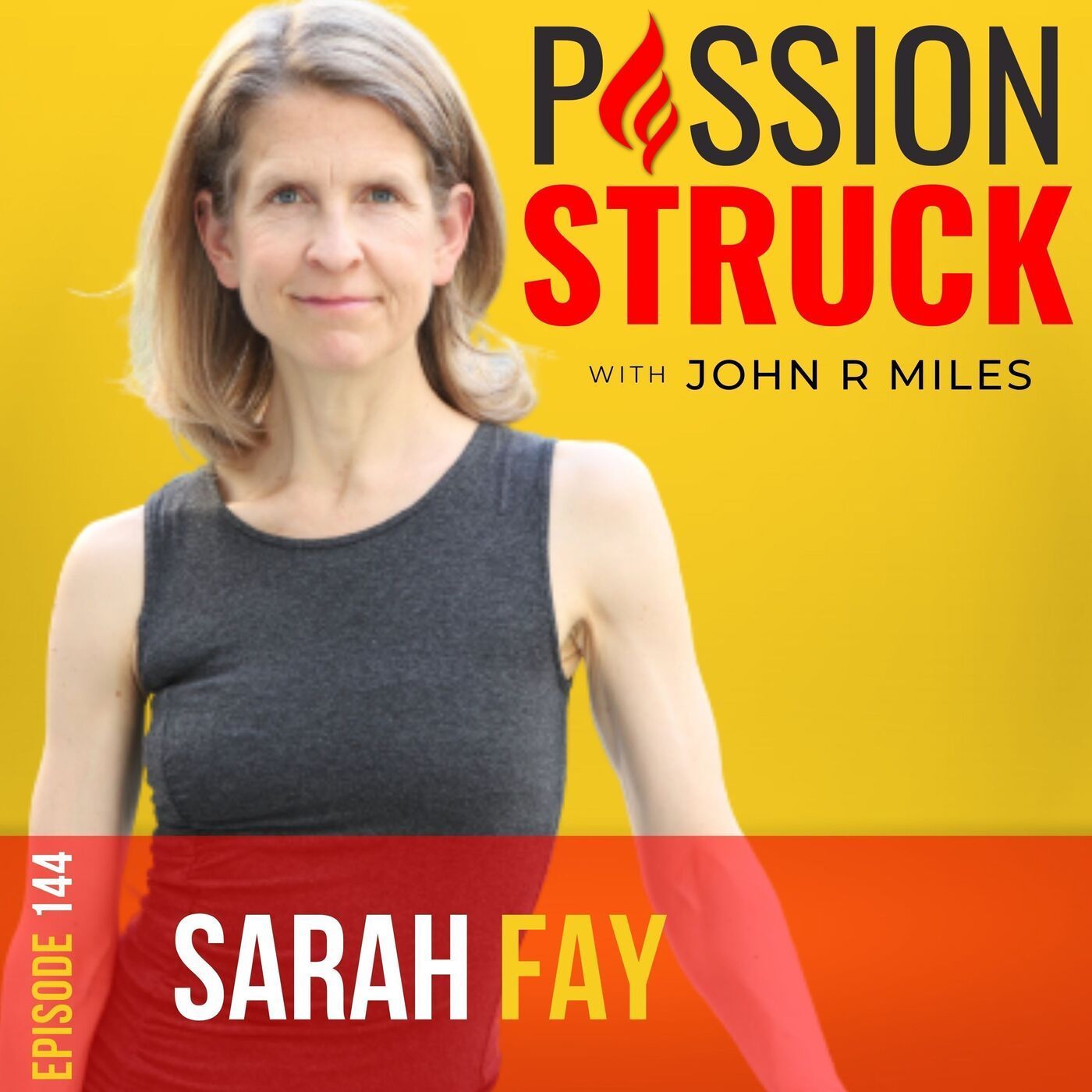
Sarah Fay on Pathological: The Dangers of Overidentifying With a Mental Health Diagnosis EP 144
Sarah Fay discusses her new book Pathological and how, by researching her six misdiagnoses, she concluded that the Diagnostic and Statistical Manual (DSM) is utterly inaccurate. | Brought to you by Masterworks (https://masterworks.io use code PASSION to start your journey). Sarah Fay (Ph.D., MFA) writes for many publications, including The New York Times, The Atlantic, Time, and The Paris Review. She's the recipient of the Hopwood Award for Literature and grants and fellowships from Yaddo, the Mellon Foundation, and the MacDowell Colony. She's on the faculty at Northwestern University and the founder of Pathological: The Movement. She is the author of the new book Pathological: The True Story of Six Misdiagnoses: https://amzn.to/3McFd7o (Amazon link). -- ► Click here for the entire show notes: https://passionstruck.com/sarah-fay-pathological/ --► Subscribe to My Channel Here: https://www.youtube.com/c/JohnRMiles --► Subscribe to the podcast: https://podcasts.apple.com/us/podcast/passion-struck-with-john-r-miles/id1553279283 *Our Patreon Page: https://www.patreon.com/passionstruck. This episode of Passion Struck with John R. Miles is brought to you by Masterworks: * Masterworks - 66% of Billionaires Collect Art, so Why Aren't You? Low Minimums, Simple and Exciting. You Can Use Art as an Alternative Investment to Diversify Your Portfolio—blue-Chip Artwork. Go to https://www.masterworks.io/ and use code passion to start. What I discuss with Sarah Fay: Almost one in five people (47.1 million) in the US have been diagnosed with a mental health condition. That number increased by about 1.5 million from last year. More may follow with a mounting sense of isolation in our fragmented country. But is a mental diagnosis the path to healing or a self-fulfilling prophecy? Sarah suffered from six mental illness diagnoses for almost thirty years, all labeled because of the DSM. She realized the DSM is seriously flawed, even useless, but it's all we have through that process. Time Stamps
- 0:00 Intro and announcements
- 2:41 Introducing Sarah Fay
- 5:07 Why Anorexia and Bipolar illness were defining moments
- 8:29 Why Pathological is eloquently written through the use of punctuation
- 11:47 How her mental illness diagnosis impacted Sarah
- 19:08 Why the DSM is seriously flawed, even useless
- 29:20 Why the DSM has no scientific validity
- 35:12 Why do we desperately want an answer and relief from our suffering
- 38:28 Why chronic loneliness is so rampant in the world today
- 43:53 Why suffering, grief, and loneliness are part of the human experience
- 46:00 Why the DSM can't define dysfunction
- 51:14 How her whole world disappeared because of her diagnoses
- 56:45 Overcoming withdrawal from psychological drugs
- 1:00:27 Why when she stopped considering herself sick she no longer was
- 1:05:27 The Cautionary Tale of the Dangers of Over-Identifying With a Mental Health Diagnosis
- 1:06:57 Show Wrap Up and Synthesis
Connect with John
- Pre-Order The Mattering Effect: https://matteringeffect.com/
- Book John to Speak: https://johnrmiles.com/speaking/
- Keynotes, books, podcast, and resources: https://linktr.ee/John_R_Miles
- Children’s Book — You Matter, Luma: https://youmatterluma.com/
- Substack: https://www.theignitedlife.net/
Support the Movement: https://startmattering.com/. Every human deserves to feel seen, valued, and like they matter. Wear it. Live it. Show it.
Disclaimer
The Passion Struck podcast is for educational and entertainment purposes only. The views and opinions expressed do not necessarily reflect those of Passion Struck or its affiliates. This podcast is not a substitute for professional medical or psychological advice.
Pre-Order The Mattering Effect: https://matteringeffect.com/. Take the 90-second diagnostic to see if you're disappearing.
Explore the Show: https://passionstruck.com/starter-packs/. New to Passion Struck? Start with the best episodes curated for you.
Connect with John
- Website: https://johnrmiles.com
- Book John to Speak: https://johnrmiles.com/speaking/
- Substack: https://www.theignitedlife.net/
- Children’s Book — You Matter, Luma: https://youmatterluma.com/
Support the Movement: https://startmattering.com/. Every human deserves to feel seen, valued, and like they matter. Wear it. Live it. Show it.
Passion Struck — #1 Alternative Health Podcast. 85M+ downloads.
Disclaimer
The Passion Struck podcast is for educational and entertainment purposes only. The views and opinions expressed do not necessarily reflect those of Passion Struck or its affiliates. This podcast is not a substitute for professional medical or psychological advice.
Hosted by Simplecast, an AdsWizz company. See pcm.adswizz.com for information about our collection and use of personal data for advertising.
Available Results
Generated results are saved to your library for reuse and search.
Choose Template
Pick the result you want. You can review provider and model before generating.
A concise first-pass summary for understanding the episode quickly.
A comprehensive, source-grounded extraction of the reusable knowledge in an episode.
A comprehensive extraction focused on health practices, protocols, claims, and safety caveats.
A dedicated analysis of warnings, limitations, trade-offs, weak evidence, and uncertainty.
Repeatable methods, frameworks, mental models, processes, and systems.
A comprehensive extraction focused on opportunities, strategy, markets, and company building.
A concise first-pass summary for understanding the episode quickly.
A detailed readable summary organized by chapter or topic.
A navigable map of subjects, topic flow, and suggested chapters.
A comprehensive, source-grounded extraction of the reusable knowledge in an episode.
Reusable atomic knowledge units extracted from the episode.
A comprehensive extraction focused on health practices, protocols, claims, and safety caveats.
A comprehensive extraction focused on opportunities, strategy, markets, and company building.
Explicit actions, next steps, habits, recommendations, and things to avoid.
A dedicated inventory of concrete resources named in the episode.
A dedicated analysis of warnings, limitations, trade-offs, weak evidence, and uncertainty.
A concise first-pass summary for understanding the episode quickly.
A detailed readable summary organized by chapter or topic.
A navigable map of subjects, topic flow, and suggested chapters.
A comprehensive, source-grounded extraction of the reusable knowledge in an episode.
Reusable atomic knowledge units extracted from the episode.
A comprehensive extraction focused on health practices, protocols, claims, and safety caveats.
A comprehensive extraction focused on opportunities, strategy, markets, and company building.
Scientific findings, mechanisms, studies, hypotheses, and the limits of the evidence discussed.
Technologies, AI models, technical methods, capabilities, limitations, and adoption implications.
Investment theses, assets, catalysts, valuation reasoning, time horizons, and risks.
Chronologies, actors, causes, consequences, turning points, and competing historical interpretations.
Policies, proposals, stakeholders, arguments, implementation constraints, and predicted effects.
Career paths, skills, hiring signals, workplace decisions, transitions, and limitations of the advice.
Behavioral mechanisms, biases, motivation, habits, emotions, interventions, and evidence limitations.
Economic mechanisms, incentives, indicators, market structure, forecasts, and uncertainty.
Leadership principles, team systems, organizational design, culture, feedback, and failure modes.
Audience, positioning, messaging, acquisition, retention, experiments, metrics, and failed approaches.
Teaching methods, learning strategies, practice, feedback, assessment, and effectiveness evidence.
Theses, premises, arguments, objections, values, thought experiments, and unresolved questions.
Communication patterns, conflict, boundaries, expectations, repair methods, and contextual limitations.
Books, papers, authors, courses, and other learning resources mentioned in the episode.
Repeatable methods, frameworks, mental models, processes, and systems.
Explicit actions, next steps, habits, recommendations, and things to avoid.
Memorable statements and important claims with attribution and source context.
A dedicated inventory of concrete resources named in the episode.
A dedicated analysis of warnings, limitations, trade-offs, weak evidence, and uncertainty.