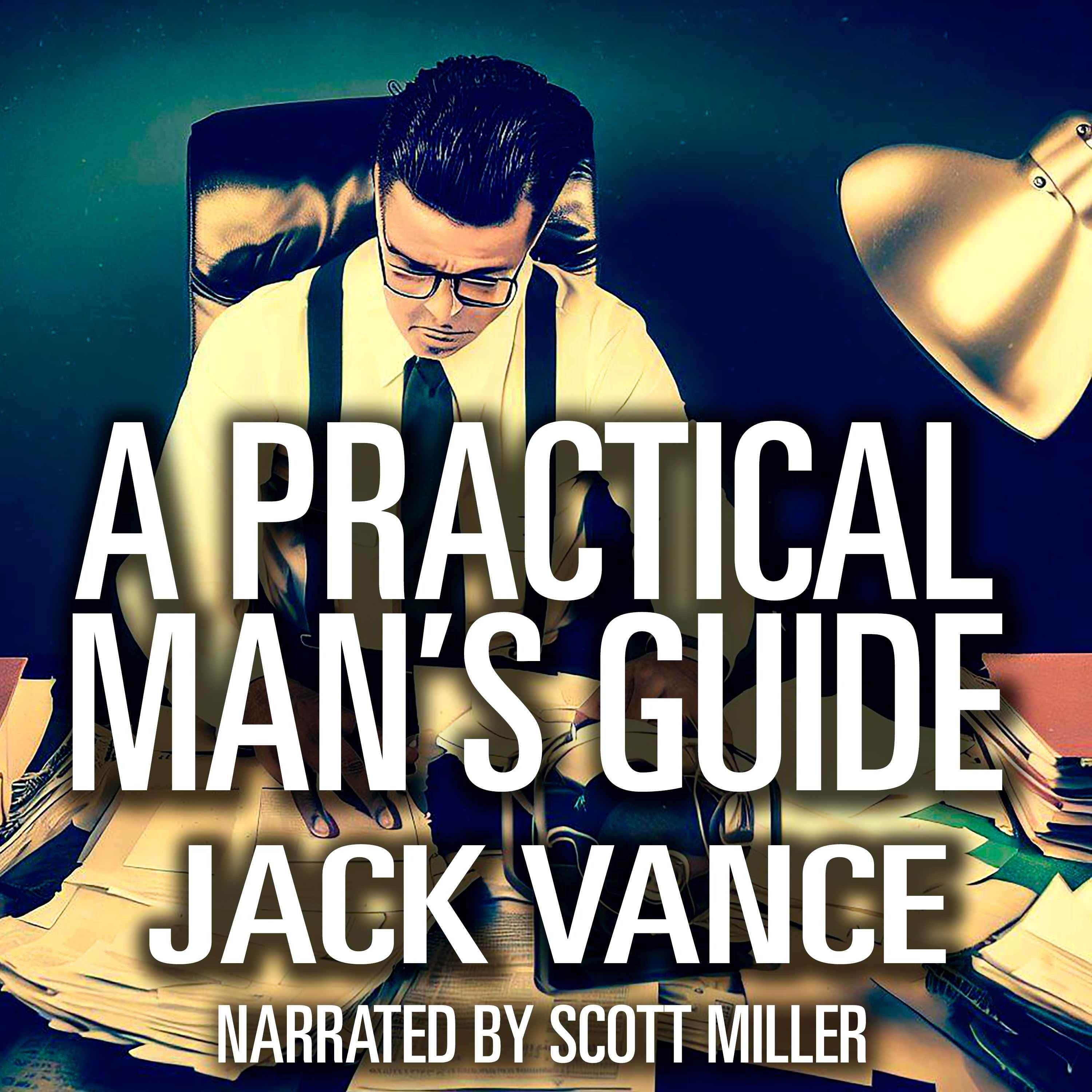
A Practical Man's Guide by Jack Vance - Scifi Audiobooks from the 1950s
Ralph Banks editor of Popular Crafts Monthly, was a short stocky man with a round pink face, a crisp crew cut, an intensely energetic manner.
When a letter from the Smithsonian Institute came across his desk it caught his attention, A Practical Man's Guide by Jack Vance, that’s next on The Lost Sci-Fi Podcast, with at least one lost vintage sci-fi short story in every episode.
Thanks to K Vomer for another 5-star rating and review on Apple Podcasts, “Very enjoyable! Lots of vintage sci-fi stories! Love the narrator’s voice. Also – he gives a little snippet about the history of the writer or what magazine it came from. It’s fun to hear what people have imagined for the future and what life on other planets would be like. Double thumbs up!” Thanks K Vomer! Your reviews and ratings are always appreciated.
John Holbrook Vance, better known as Jack Vance, was born and raised in California. Vance struggled to make ends meet as a young man and worked a number of jobs to survive, a bell-hop, in a cannery, and on a gold dredge, before entering the University of California, Berkeley where he studied mining engineering, physics, journalism and English. He worked for a while as an electrician in the naval shipyards at Pearl Harbor, Hawaii. He left that job about a month before the attack on Pearl Harbor on December 7th, 1941.
He started writing science fiction in the 1940s and his first published story was “The World-Thinker” in Thrilling Wonder Stories in the summer of 1945. He would go on to write about 50 short stories in the 40s, 50s and 60s and numerous novels.
One of his best-known titles, “The Dying Earth”, began as a collection of short stories in 1950 and eventually expanded to become a whole series of books set in a far-off future. He won numerous awards: among them three Hugo awards, a Nebula and a World Fantasy award for lifetime achievement. In 1997 he was made a Grand Master of sci-fi, by the ScienceFiction Writers of America.
A 2009 profile in the New York Times Magazine described Vance as "one of American literature’s most distinctive and undervalued voices."
Our story written by the highly acclaimed author is featured in the second edition of Space Science Fiction Magazine, Volume 1 Number 2 in August 1957. And there would be no more Space Science Fiction Magazine. Two issues and that’s it. If you’re interested, you can pick up a copy of the August 57 Space Science Fiction Magazine on Ebay for $35.
Turn to page 102 for A Practical Man's Guide by Jack Vance...
Next week on The Lost Sci-Fi Podcast, Wives always try to cure husbands of bad habits, even on lonely asteroids! The Addicts by William Morrison.
That’s next week onThe Lost Sci-Fi Podcast, with at least one lost vintage sci-fi short story in every episode.
Listen without commercials and enjoy exclusive bonus episodes every month with Lost Sci-Fi Premium—start your free 7-day trial today. https://lostscifi.supercast.com/
Hosted by Simplecast, an AdsWizz company. See pcm.adswizz.com for information about our collection and use of personal data for advertising.
Available Results
Generated results are saved to your library for reuse and search.
Choose Template
Pick the result you want. You can review provider and model before generating.
A concise first-pass summary for understanding the episode quickly.
A comprehensive, source-grounded extraction of the reusable knowledge in an episode.
A comprehensive extraction focused on opportunities, strategy, markets, and company building.
Explicit actions, next steps, habits, recommendations, and things to avoid.
Repeatable methods, frameworks, mental models, processes, and systems.
A dedicated inventory of concrete resources named in the episode.
A concise first-pass summary for understanding the episode quickly.
A detailed readable summary organized by chapter or topic.
A navigable map of subjects, topic flow, and suggested chapters.
A comprehensive, source-grounded extraction of the reusable knowledge in an episode.
Reusable atomic knowledge units extracted from the episode.
A comprehensive extraction focused on health practices, protocols, claims, and safety caveats.
A comprehensive extraction focused on opportunities, strategy, markets, and company building.
Explicit actions, next steps, habits, recommendations, and things to avoid.
A dedicated inventory of concrete resources named in the episode.
A dedicated analysis of warnings, limitations, trade-offs, weak evidence, and uncertainty.
A concise first-pass summary for understanding the episode quickly.
A detailed readable summary organized by chapter or topic.
A navigable map of subjects, topic flow, and suggested chapters.
A comprehensive, source-grounded extraction of the reusable knowledge in an episode.
Reusable atomic knowledge units extracted from the episode.
A comprehensive extraction focused on health practices, protocols, claims, and safety caveats.
A comprehensive extraction focused on opportunities, strategy, markets, and company building.
Scientific findings, mechanisms, studies, hypotheses, and the limits of the evidence discussed.
Technologies, AI models, technical methods, capabilities, limitations, and adoption implications.
Investment theses, assets, catalysts, valuation reasoning, time horizons, and risks.
Chronologies, actors, causes, consequences, turning points, and competing historical interpretations.
Policies, proposals, stakeholders, arguments, implementation constraints, and predicted effects.
Career paths, skills, hiring signals, workplace decisions, transitions, and limitations of the advice.
Behavioral mechanisms, biases, motivation, habits, emotions, interventions, and evidence limitations.
Economic mechanisms, incentives, indicators, market structure, forecasts, and uncertainty.
Leadership principles, team systems, organizational design, culture, feedback, and failure modes.
Audience, positioning, messaging, acquisition, retention, experiments, metrics, and failed approaches.
Teaching methods, learning strategies, practice, feedback, assessment, and effectiveness evidence.
Theses, premises, arguments, objections, values, thought experiments, and unresolved questions.
Communication patterns, conflict, boundaries, expectations, repair methods, and contextual limitations.
Books, papers, authors, courses, and other learning resources mentioned in the episode.
Repeatable methods, frameworks, mental models, processes, and systems.
Explicit actions, next steps, habits, recommendations, and things to avoid.
Memorable statements and important claims with attribution and source context.
A dedicated inventory of concrete resources named in the episode.
A dedicated analysis of warnings, limitations, trade-offs, weak evidence, and uncertainty.