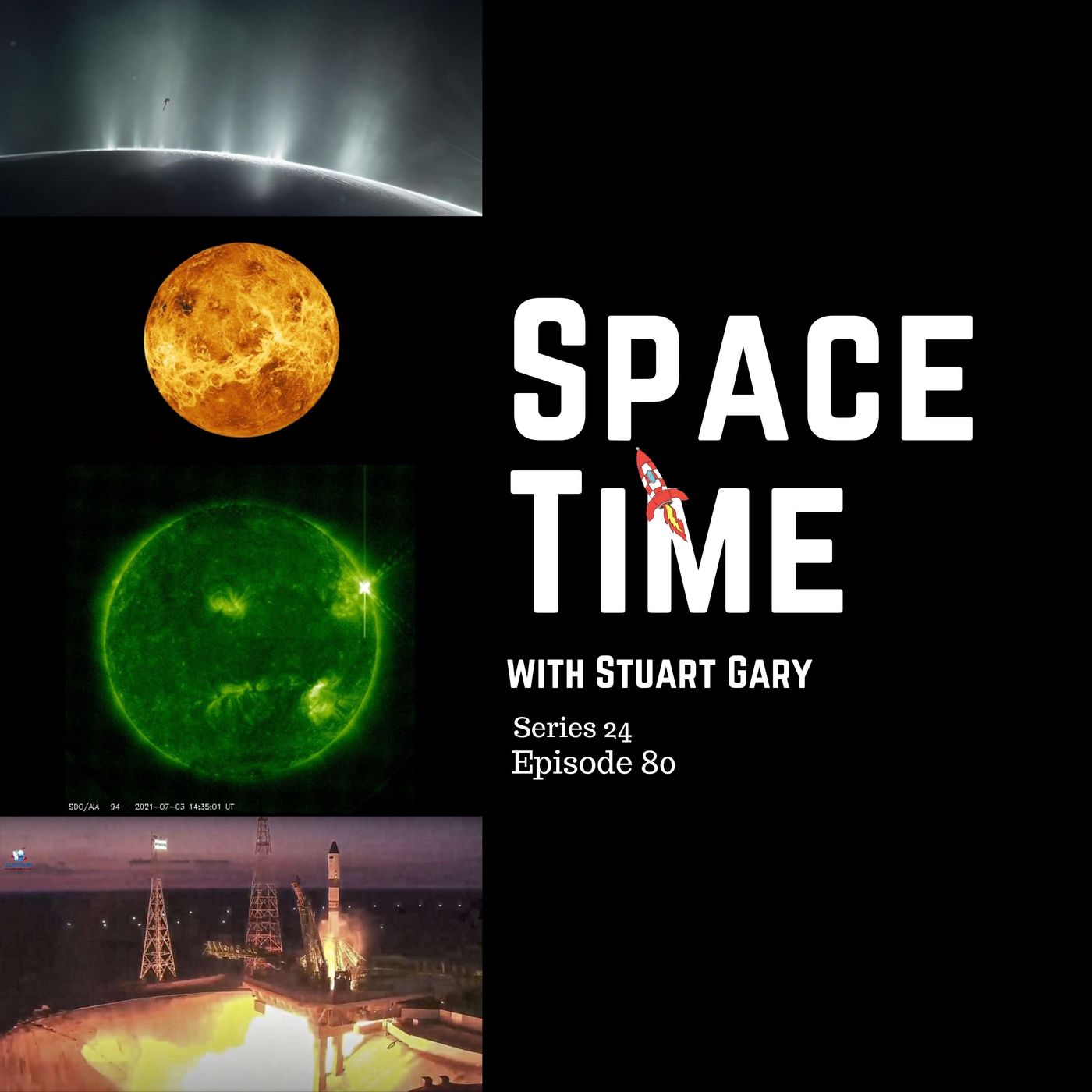
A Sign Of Life on Enceladus?
*Could mystery methane plumes discovered on Enceladus be a sign of life
A new study suggests that methane detected on the Saturnian ice moon Enceladus could be a sign of life.
*Plate tectonics on Venus
Astronomers may have finally detected evidence of plate tectonics on Venus.
*Earth hit by powerful X class solar flare
The Sun has emitted its first X-class solar flare of the new Solar Cycle 25. X class flares are the most powerful of all solar flare categories and are commonly responsible for the deepest radio blackouts and the most intense geomagnetic storms.
*Progress cargo ship docks with Space Station
A Russian Soyuz 2.1A rocket has successfully launched the 169th Progress cargo ship carrying almost two and a half tonnes of supplies to the International Space Station.
*The Science Report
A new record high temperature for the Antarctic of 18.3 degrees Celsius.
Lower levels of Ultraviolet B wavelength light has been linked with higher rates of bowel cancer.
Raytheon awarded a contract to develop a new air-launched, long-range cruise missile.
Huawei banned from Sweden’s 5g equipment rollout on grounds of national security.
Alex on Tech: Star Trek’s universal translator becomes reality.
For more SpaceTime and show links: https://linktr.ee/biteszHQ
This episode is bought to you by the new podcast 'I Know What Scares You' - Available via all good podcast apps including Apple Podcasts, Google Podcasts. Spotify or wherever you get your podcasts from For more details visit: https://www.airwavemedia.com/post/airwave-media-launches-new-podcast-i-know-what-scares-you
About I Know What Scares You
Hosted by science writer Brian Dunning, mentalist Jonathan Pritchard, anthropologist and comedian Natalia Reagan, and science expert Dr. Kiki Sanford—“I Know What Scares You” asks guests and listeners to tap into their deepest fears. Special guests relay personal stories of real-life paranormal, inexplicable, or simply terrifying experiences that actually happened to them. The show’s team of expert hosts then attempt to find a rational solution to the mysterious incidents. Each week the program hosts put their various expertise together to collectively come up with an explanation that checks all the boxes and, hopefully, gives a guest a new perspective on their unexplainable experience.
Become a supporter of this podcast: https://www.spreaker.com/podcast/spacetime-with-stuart-gary--2458531/support.
Available Results
Generated results are saved to your library for reuse and search.
Choose Template
Pick the result you want. You can review provider and model before generating.
A concise first-pass summary for understanding the episode quickly.
A comprehensive, source-grounded extraction of the reusable knowledge in an episode.
Scientific findings, mechanisms, studies, hypotheses, and the limits of the evidence discussed.
A dedicated analysis of warnings, limitations, trade-offs, weak evidence, and uncertainty.
Memorable statements and important claims with attribution and source context.
Technologies, AI models, technical methods, capabilities, limitations, and adoption implications.
A concise first-pass summary for understanding the episode quickly.
A detailed readable summary organized by chapter or topic.
A navigable map of subjects, topic flow, and suggested chapters.
A comprehensive, source-grounded extraction of the reusable knowledge in an episode.
Reusable atomic knowledge units extracted from the episode.
A comprehensive extraction focused on health practices, protocols, claims, and safety caveats.
A comprehensive extraction focused on opportunities, strategy, markets, and company building.
Explicit actions, next steps, habits, recommendations, and things to avoid.
A dedicated inventory of concrete resources named in the episode.
A dedicated analysis of warnings, limitations, trade-offs, weak evidence, and uncertainty.
A concise first-pass summary for understanding the episode quickly.
A detailed readable summary organized by chapter or topic.
A navigable map of subjects, topic flow, and suggested chapters.
A comprehensive, source-grounded extraction of the reusable knowledge in an episode.
Reusable atomic knowledge units extracted from the episode.
A comprehensive extraction focused on health practices, protocols, claims, and safety caveats.
A comprehensive extraction focused on opportunities, strategy, markets, and company building.
Scientific findings, mechanisms, studies, hypotheses, and the limits of the evidence discussed.
Technologies, AI models, technical methods, capabilities, limitations, and adoption implications.
Investment theses, assets, catalysts, valuation reasoning, time horizons, and risks.
Chronologies, actors, causes, consequences, turning points, and competing historical interpretations.
Policies, proposals, stakeholders, arguments, implementation constraints, and predicted effects.
Career paths, skills, hiring signals, workplace decisions, transitions, and limitations of the advice.
Behavioral mechanisms, biases, motivation, habits, emotions, interventions, and evidence limitations.
Economic mechanisms, incentives, indicators, market structure, forecasts, and uncertainty.
Leadership principles, team systems, organizational design, culture, feedback, and failure modes.
Audience, positioning, messaging, acquisition, retention, experiments, metrics, and failed approaches.
Teaching methods, learning strategies, practice, feedback, assessment, and effectiveness evidence.
Theses, premises, arguments, objections, values, thought experiments, and unresolved questions.
Communication patterns, conflict, boundaries, expectations, repair methods, and contextual limitations.
Books, papers, authors, courses, and other learning resources mentioned in the episode.
Repeatable methods, frameworks, mental models, processes, and systems.
Explicit actions, next steps, habits, recommendations, and things to avoid.
Memorable statements and important claims with attribution and source context.
A dedicated inventory of concrete resources named in the episode.
A dedicated analysis of warnings, limitations, trade-offs, weak evidence, and uncertainty.