The Problem With Paleo: Why It's OK To Eat Bread, Grains, Legumes, Cheese & Milk.
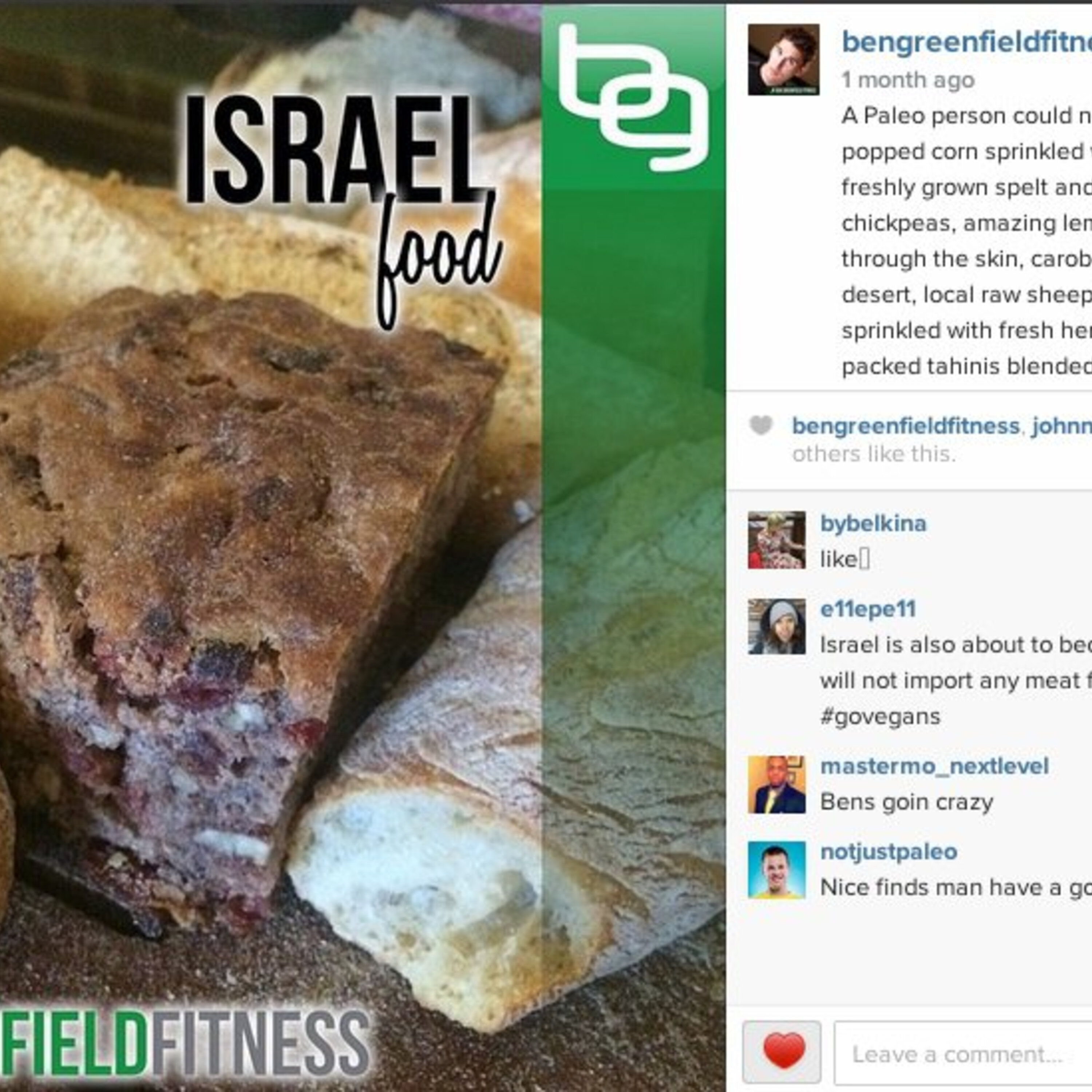
A few weeks ago, while I was in Israel, I posted the photo above to my Instagram page, with the comment that...
"A Paleo person could never survive in Israel - local popped corn sprinkled with moss from the rooftop, freshly grown spelt and rye, falafel with soaked chickpeas, amazing lemons and guavas you simply bite through the skin, carob picked straight out of the desert, local raw sheep’s cheese and goat milk cheese sprinkled with fresh herbs, and omega-6 fatty acid packed tahinis blended with beets, freshly pressed olive oil and cilantro. Oh well. More for me."
I have to admit that I stuffed my face with huge portions of nearly every food listed above when I visited a home in Galilee for a traditional weekly Jewish Shabbat feast. During that dinner, I sat next to Uri Mayer-Chissick (also known as "The Israeli Locavore"), who is a food historian and wild edible plant expert, and we had an interesting about traditional agricultural foods like bread and cheese, and the surge in popularity of the strict avoidance of these foods by those who adhere to a "hunter-gatherer" Paleo-esque diet. Uri and I delve deeply into this discussion today's audio podcast.
And this guy is the real deal. Not only does he cook amazing food, but he also leads hikes and tours of the Israeli countryside to find local wild edible plants, and he teaches outdoor cooking classes, gives food history lectures and prepares gourmet meals in nature, reconstructing historical recipes with wild plants. When he's not traipsing through the valley of springs in north-eastern Israel with a pot and pan in his hand, Uri lectures about food, the history of local food preservation, ways that ancient medicine used nutrition as a way to achieve balance, and the traditions of foraging, healing and cooking in the Mediterranean and Middle-East. During our discussion, you'll learn: -How a Paleo diet that adheres to the philosophy of no-bread, no-grains, little to no dairy, etc. has been received in a Mediterranean culture where it seems that bread, legumes, wheat, cheese, etc. are such staples... -How “traditionally prepared” bread is so much different than modern bread, and how you can find or make easy-to-digest bread... -How you can prepare things like lentils and chickpeas to make them more friendly to the human gut... -What it is it some dairy causes health problems, but some dairy is no nourishing and digestible... -Why a rise in celiac disease is due to a difference in the way wheat is grown... -And much more!
Resources: -Nourishing Traditions -The Art of Fermentation -Goat whey protein -Vertical gardening towers By the way, even though I'm not Paleo, you can click here to come hear me speak at PaleoFX 2015, which is a Who’s Who gathering of the ancestral food and exercise movement, with world-class speakers including best-selling authors, physicians, nutritionists, research scientists, professional athletes, trainers, sustainability and food activists, biohackers, and more. Question, comments or feedback about the problem with Paleo? Leave your thoughts at BenGreenfieldFitness.com!
See omnystudio.com/listener for privacy information.
Available Results
Generated results are saved to your library for reuse and search.
Choose Template
Pick the result you want. You can review provider and model before generating.
A concise first-pass summary for understanding the episode quickly.
A comprehensive, source-grounded extraction of the reusable knowledge in an episode.
A comprehensive extraction focused on health practices, protocols, claims, and safety caveats.
A dedicated analysis of warnings, limitations, trade-offs, weak evidence, and uncertainty.
Repeatable methods, frameworks, mental models, processes, and systems.
Scientific findings, mechanisms, studies, hypotheses, and the limits of the evidence discussed.
A concise first-pass summary for understanding the episode quickly.
A detailed readable summary organized by chapter or topic.
A navigable map of subjects, topic flow, and suggested chapters.
A comprehensive, source-grounded extraction of the reusable knowledge in an episode.
Reusable atomic knowledge units extracted from the episode.
A comprehensive extraction focused on health practices, protocols, claims, and safety caveats.
A comprehensive extraction focused on opportunities, strategy, markets, and company building.
Explicit actions, next steps, habits, recommendations, and things to avoid.
A dedicated inventory of concrete resources named in the episode.
A dedicated analysis of warnings, limitations, trade-offs, weak evidence, and uncertainty.
A concise first-pass summary for understanding the episode quickly.
A detailed readable summary organized by chapter or topic.
A navigable map of subjects, topic flow, and suggested chapters.
A comprehensive, source-grounded extraction of the reusable knowledge in an episode.
Reusable atomic knowledge units extracted from the episode.
A comprehensive extraction focused on health practices, protocols, claims, and safety caveats.
A comprehensive extraction focused on opportunities, strategy, markets, and company building.
Scientific findings, mechanisms, studies, hypotheses, and the limits of the evidence discussed.
Technologies, AI models, technical methods, capabilities, limitations, and adoption implications.
Investment theses, assets, catalysts, valuation reasoning, time horizons, and risks.
Chronologies, actors, causes, consequences, turning points, and competing historical interpretations.
Policies, proposals, stakeholders, arguments, implementation constraints, and predicted effects.
Career paths, skills, hiring signals, workplace decisions, transitions, and limitations of the advice.
Behavioral mechanisms, biases, motivation, habits, emotions, interventions, and evidence limitations.
Economic mechanisms, incentives, indicators, market structure, forecasts, and uncertainty.
Leadership principles, team systems, organizational design, culture, feedback, and failure modes.
Audience, positioning, messaging, acquisition, retention, experiments, metrics, and failed approaches.
Teaching methods, learning strategies, practice, feedback, assessment, and effectiveness evidence.
Theses, premises, arguments, objections, values, thought experiments, and unresolved questions.
Communication patterns, conflict, boundaries, expectations, repair methods, and contextual limitations.
Books, papers, authors, courses, and other learning resources mentioned in the episode.
Repeatable methods, frameworks, mental models, processes, and systems.
Explicit actions, next steps, habits, recommendations, and things to avoid.
Memorable statements and important claims with attribution and source context.
A dedicated inventory of concrete resources named in the episode.
A dedicated analysis of warnings, limitations, trade-offs, weak evidence, and uncertainty.