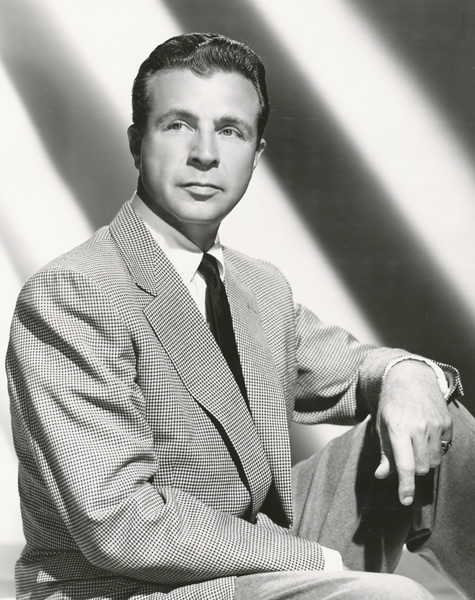
"Rogue speaking..."
Following his star turn as Philip Marlowe in Murder, My Sweet, Dick Powell found himself at a new stage of his career. With the acclaim he'd earned for his hard-boiled performance, Powell could finally shed the baby-faced crooner image that had defined his work up until that point. He used his clout and the momentum Marlowe brought him to approach the F.W. Fitch shampoo company with a proposal - a summer detective series to fill the weeks until their Fitch Bandwagon variety show returned to the air in the fall. Powell, a veteran of the Bandwagon, would headline the new series as a private detective cut from the Marlowe cloth. The result was Bandwagon Mysteries, Powell's first weekly dramatic series and the introduction of Richard Rogue, a radio shamus who would crack cases on radio over the next seven years.
Bandwagon Mysteries premiered on NBC on June 17, 1945 and ran for fourteen weeks. By the end of the run, there was a demand for the show to continue but the regular Fitch Bandwagon program was slated to return to NBC after its summer vacation. Fitch shopped the series, retitled Rogue's Gallery to other networks. It landed at Mutual and began a thirty-nine week run on September 27, 1945. When its Mutual season ended in June 1946, it returned to NBC as a summer replacement for Fitch Bandwagon. By this time, the show was so identified by its new title that it didn't revert to Bandwagon Mysteries; instead it aired for an additional fourteen episodes in the summer of 1946.
Powell's performance as Richard Rogue was similar to his take on Philip Marlowe (and it would be refined and perfected a few years later on Richard Diamond, Private Detective): tough, but glib, and more likely to come up with a quip than to squeeze off a round from his .38.
Aside from Powell's unique delivery, the signature element of the show was the inclusion of Rogue's impish "alter ego," Eugor (that's Rogue spelled backwards). Each week, usually following a shot to the head, Rogue would lose consciousness and take an otherworldly trip to "Cloud Eight." While there, he'd trade barbs with the cackling Eugor, and their conversations would usually shed light on a clue the gumshoe had overlooked during his investigation. Though never credited on the show, Eugor was played by veteran radio character actor Peter Leeds. Leeds could be heard in supporting roles on Suspense, Nero Wolfe, Escape and others. He was a member of the cast of Stan Freberg's legendary 1957 CBS radio series, and he provided several voices for Hanna-Barbera cartoons.
Dick Powell left the role after the 1946 series. Rogue's Gallery returned the following year for a summer run starring Barry Sullivan, who would later pinch hit as The Saint when Vincent Price was unavailable to record. Following that brief run, Richard Rogue left the air for three years. The Fitch company fell upon hard times following a complaint from the Federal Trade Commission over the company's claims that its shampoo could eradicate dandruff, and their sponsorship ended in 1947. In 1950, ABC resurrected the concept for a two year run. Actor Paul Stewart, a veteran of Orson Welles' Mercury Theatre, played Rogue on ABC. Elsewhere on the network, Dick Powell was crooning through crimes as Richard Diamond. He was working right alongside one of his earlier characters - one who helped pave the way for his future radio success. Diamond may be the more famous Richard, but it was Rogue who put Powell on the path to a career as a crime-solver extraordinaire.
Available Results
Generated results are saved to your library for reuse and search.
Choose Template
Pick the result you want. You can review provider and model before generating.
A concise first-pass summary for understanding the episode quickly.
A comprehensive, source-grounded extraction of the reusable knowledge in an episode.
A comprehensive extraction focused on opportunities, strategy, markets, and company building.
Explicit actions, next steps, habits, recommendations, and things to avoid.
Repeatable methods, frameworks, mental models, processes, and systems.
A dedicated inventory of concrete resources named in the episode.
A concise first-pass summary for understanding the episode quickly.
A detailed readable summary organized by chapter or topic.
A navigable map of subjects, topic flow, and suggested chapters.
A comprehensive, source-grounded extraction of the reusable knowledge in an episode.
Reusable atomic knowledge units extracted from the episode.
A comprehensive extraction focused on health practices, protocols, claims, and safety caveats.
A comprehensive extraction focused on opportunities, strategy, markets, and company building.
Explicit actions, next steps, habits, recommendations, and things to avoid.
A dedicated inventory of concrete resources named in the episode.
A dedicated analysis of warnings, limitations, trade-offs, weak evidence, and uncertainty.
A concise first-pass summary for understanding the episode quickly.
A detailed readable summary organized by chapter or topic.
A navigable map of subjects, topic flow, and suggested chapters.
A comprehensive, source-grounded extraction of the reusable knowledge in an episode.
Reusable atomic knowledge units extracted from the episode.
A comprehensive extraction focused on health practices, protocols, claims, and safety caveats.
A comprehensive extraction focused on opportunities, strategy, markets, and company building.
Scientific findings, mechanisms, studies, hypotheses, and the limits of the evidence discussed.
Technologies, AI models, technical methods, capabilities, limitations, and adoption implications.
Investment theses, assets, catalysts, valuation reasoning, time horizons, and risks.
Chronologies, actors, causes, consequences, turning points, and competing historical interpretations.
Policies, proposals, stakeholders, arguments, implementation constraints, and predicted effects.
Career paths, skills, hiring signals, workplace decisions, transitions, and limitations of the advice.
Behavioral mechanisms, biases, motivation, habits, emotions, interventions, and evidence limitations.
Economic mechanisms, incentives, indicators, market structure, forecasts, and uncertainty.
Leadership principles, team systems, organizational design, culture, feedback, and failure modes.
Audience, positioning, messaging, acquisition, retention, experiments, metrics, and failed approaches.
Teaching methods, learning strategies, practice, feedback, assessment, and effectiveness evidence.
Theses, premises, arguments, objections, values, thought experiments, and unresolved questions.
Communication patterns, conflict, boundaries, expectations, repair methods, and contextual limitations.
Books, papers, authors, courses, and other learning resources mentioned in the episode.
Repeatable methods, frameworks, mental models, processes, and systems.
Explicit actions, next steps, habits, recommendations, and things to avoid.
Memorable statements and important claims with attribution and source context.
A dedicated inventory of concrete resources named in the episode.
A dedicated analysis of warnings, limitations, trade-offs, weak evidence, and uncertainty.