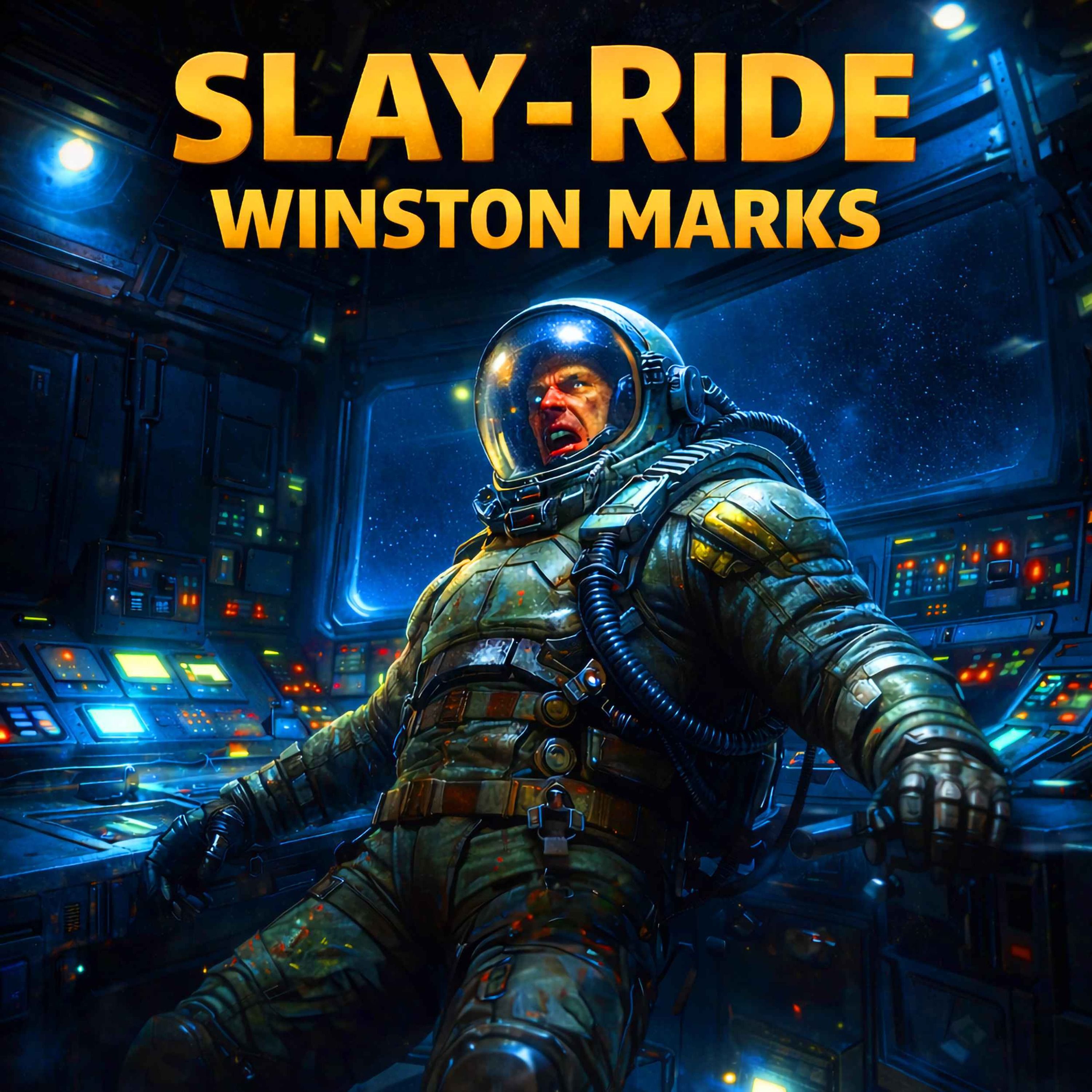
Slay-Ride by Winston Marks
Who ever thought that Frane Lewis—wholesale triggerman, spaceways pirate—would be the sweating victim of a simple, webbed, nylon garment known as spaceman's underwear? Slay-Ride by Winston Marks, that’s next on The Lost Sci-Fi Podcast, with at least one lost vintage sci-fi short story in every episode.
We get a lot of emails at scott@lostscifi.com and a lot of comments on our YouTube channel. Some of the more recent YouTube comments include this from “trevorwheatley4166” “Thank you for all your story telling. It's a fresh breath of life to hear, also extremely MELLO.”
Thanks Trevor, I’m guessing MELLO is good!
This from “sleepywilliams6381” who commented on “Let’s Get Together by Isaac Asimov” “Another great story by a great author and narrator, as usual. Keep up the good work.”
Thank you Sleepy!
DebMurphyBits also commented on “Let’s Get Together” “Good one!!!! I’ve listened to quite a few of your episodes now and why you don’t have hundreds of thousands of followers yet is beyond me. Great narrations and awesome story picks!! What timing this one is, now, with artificial intelligence coming together with robotics and the dawn of a real life technological revolution. Keep up the stories please”
Deb, we are thankful for you and every listener and follower we have. Hopefully those hundreds of thousands of followers you mentioned are on their way!
If you’ve been listening to the podcast for a while, you know Winston Marks is one of my personal favorites. He was a busy man from 1953 to 1955 with 46 stories published in a variety of magazines. Although our story originally appeared in Planet Stories magazine in 1953 it can also be found in Science Fiction Monthly published in Australia in September 1956.
Let’s turn to page 25 in the November 1953 issue of Planet Stories magazine for Slay-Ride by Winston Marks…
In two days on The Lost Sci-Fi Podcast, The wars of the far future will be fought with giant spaceships, but it will still take the infantryman to hold down the planets. And some of the thoughts bred in the foxholes of Mars or Alpha Centauri Duo or Rigel Tres will be fully as bitter as some of those dredged up in the foxholes of Earth. The Foxholes of Mars by Fritz Leiber.
That’s In two days on The Lost Sci-Fi Podcast, with at least one lost vintage sci-fi short story in every episode.
https://lostscifi.com/podcast/slay-ride-by-winston-marks-episode-96/
Listen without commercials and enjoy exclusive bonus episodes every month with Lost Sci-Fi Premium—start your free 7-day trial today. https://lostscifi.supercast.com/
Hosted by Simplecast, an AdsWizz company. See pcm.adswizz.com for information about our collection and use of personal data for advertising.
Available Results
Generated results are saved to your library for reuse and search.
Choose Template
Pick the result you want. You can review provider and model before generating.
A concise first-pass summary for understanding the episode quickly.
A comprehensive, source-grounded extraction of the reusable knowledge in an episode.
A comprehensive extraction focused on health practices, protocols, claims, and safety caveats.
A dedicated analysis of warnings, limitations, trade-offs, weak evidence, and uncertainty.
Repeatable methods, frameworks, mental models, processes, and systems.
A comprehensive extraction focused on opportunities, strategy, markets, and company building.
A concise first-pass summary for understanding the episode quickly.
A detailed readable summary organized by chapter or topic.
A navigable map of subjects, topic flow, and suggested chapters.
A comprehensive, source-grounded extraction of the reusable knowledge in an episode.
Reusable atomic knowledge units extracted from the episode.
A comprehensive extraction focused on health practices, protocols, claims, and safety caveats.
A comprehensive extraction focused on opportunities, strategy, markets, and company building.
Explicit actions, next steps, habits, recommendations, and things to avoid.
A dedicated inventory of concrete resources named in the episode.
A dedicated analysis of warnings, limitations, trade-offs, weak evidence, and uncertainty.
A concise first-pass summary for understanding the episode quickly.
A detailed readable summary organized by chapter or topic.
A navigable map of subjects, topic flow, and suggested chapters.
A comprehensive, source-grounded extraction of the reusable knowledge in an episode.
Reusable atomic knowledge units extracted from the episode.
A comprehensive extraction focused on health practices, protocols, claims, and safety caveats.
A comprehensive extraction focused on opportunities, strategy, markets, and company building.
Scientific findings, mechanisms, studies, hypotheses, and the limits of the evidence discussed.
Technologies, AI models, technical methods, capabilities, limitations, and adoption implications.
Investment theses, assets, catalysts, valuation reasoning, time horizons, and risks.
Chronologies, actors, causes, consequences, turning points, and competing historical interpretations.
Policies, proposals, stakeholders, arguments, implementation constraints, and predicted effects.
Career paths, skills, hiring signals, workplace decisions, transitions, and limitations of the advice.
Behavioral mechanisms, biases, motivation, habits, emotions, interventions, and evidence limitations.
Economic mechanisms, incentives, indicators, market structure, forecasts, and uncertainty.
Leadership principles, team systems, organizational design, culture, feedback, and failure modes.
Audience, positioning, messaging, acquisition, retention, experiments, metrics, and failed approaches.
Teaching methods, learning strategies, practice, feedback, assessment, and effectiveness evidence.
Theses, premises, arguments, objections, values, thought experiments, and unresolved questions.
Communication patterns, conflict, boundaries, expectations, repair methods, and contextual limitations.
Books, papers, authors, courses, and other learning resources mentioned in the episode.
Repeatable methods, frameworks, mental models, processes, and systems.
Explicit actions, next steps, habits, recommendations, and things to avoid.
Memorable statements and important claims with attribution and source context.
A dedicated inventory of concrete resources named in the episode.
A dedicated analysis of warnings, limitations, trade-offs, weak evidence, and uncertainty.