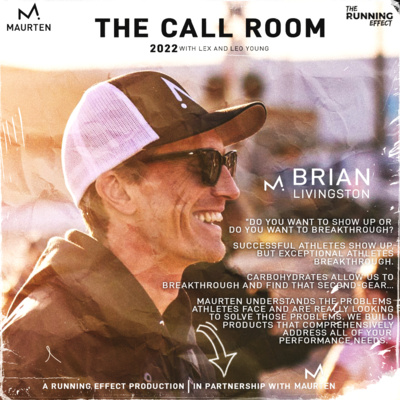
THE CALL ROOM With Lex & Leo Young | Episode 4: How Maurten Can Help You Reach Your Goals | Science Class With Brian Livingston
Have you ever wondered "What are some of those 1% things I can do to become a better runner?" Well, as my guest Brian Livingston scientifically describes, one of these things is fueling. And in my opinion, fueling may be a lot more than a 1% difference. Being properly fueled not only puts you at an advantage, but is actually necessary to perform well in the first place. As Brian so eloquently describes, Maurten can be that proper fuel for your gas tank.
In this episode you will learn:
* The difference between Fueling & Hydration
* Why carbohydrates are crucially important for athletes
* The science behind how Maurten works and why it's superior to every other fueling brand
* Why it's important to fuel for training and even distances as short as 1500m
* The benefits a younger runner can gain by using Maurten's products
I hope you all enjoy science class with Brian Livingston! This one was a blast to record, and Lex, Leo, and I are all very passionate about how well Maurten's products work. Let us know in the comments if you've ever used Maurten before (:
Please like, subscribe, and share with your friends if you enjoyed today’s episode! You can also give us a five-star review on Spotify or Apple podcasts. Subscribe to the podcast and turn on notifications so you don’t miss Episode 5 when it comes out! Episode 5 will be catching up with Lex and Leo on their training, getting ready to race, answering listener questions, and covering some other topics.
Podcast graphic done by the talented: Xavier Gallo
S H O W N O T E S
MAURTEN (click this link!): https://bit.ly/3QDuPbt
Lex & Leo Stanford YouTube Announcement: https://youtu.be/x3eviAm4RYQ
Our Instagram: https://www.instagram.com/therunningeffect/?hl=en
Lex’s Instagram: https://instagram.com/lex_young_?igshid=YmMyMTA2M2Y=
Leo’s Instagram: https://instagram.com/_leo.young?igshid=YmMyMTA2M2Y=
Available Results
Generated results are saved to your library for reuse and search.
Choose Template
Pick the result you want. You can review provider and model before generating.
A concise first-pass summary for understanding the episode quickly.
A comprehensive, source-grounded extraction of the reusable knowledge in an episode.
Scientific findings, mechanisms, studies, hypotheses, and the limits of the evidence discussed.
A dedicated analysis of warnings, limitations, trade-offs, weak evidence, and uncertainty.
Memorable statements and important claims with attribution and source context.
Technologies, AI models, technical methods, capabilities, limitations, and adoption implications.
A concise first-pass summary for understanding the episode quickly.
A detailed readable summary organized by chapter or topic.
A navigable map of subjects, topic flow, and suggested chapters.
A comprehensive, source-grounded extraction of the reusable knowledge in an episode.
Reusable atomic knowledge units extracted from the episode.
A comprehensive extraction focused on health practices, protocols, claims, and safety caveats.
A comprehensive extraction focused on opportunities, strategy, markets, and company building.
Explicit actions, next steps, habits, recommendations, and things to avoid.
A dedicated inventory of concrete resources named in the episode.
A dedicated analysis of warnings, limitations, trade-offs, weak evidence, and uncertainty.
A concise first-pass summary for understanding the episode quickly.
A detailed readable summary organized by chapter or topic.
A navigable map of subjects, topic flow, and suggested chapters.
A comprehensive, source-grounded extraction of the reusable knowledge in an episode.
Reusable atomic knowledge units extracted from the episode.
A comprehensive extraction focused on health practices, protocols, claims, and safety caveats.
A comprehensive extraction focused on opportunities, strategy, markets, and company building.
Scientific findings, mechanisms, studies, hypotheses, and the limits of the evidence discussed.
Technologies, AI models, technical methods, capabilities, limitations, and adoption implications.
Investment theses, assets, catalysts, valuation reasoning, time horizons, and risks.
Chronologies, actors, causes, consequences, turning points, and competing historical interpretations.
Policies, proposals, stakeholders, arguments, implementation constraints, and predicted effects.
Career paths, skills, hiring signals, workplace decisions, transitions, and limitations of the advice.
Behavioral mechanisms, biases, motivation, habits, emotions, interventions, and evidence limitations.
Economic mechanisms, incentives, indicators, market structure, forecasts, and uncertainty.
Leadership principles, team systems, organizational design, culture, feedback, and failure modes.
Audience, positioning, messaging, acquisition, retention, experiments, metrics, and failed approaches.
Teaching methods, learning strategies, practice, feedback, assessment, and effectiveness evidence.
Theses, premises, arguments, objections, values, thought experiments, and unresolved questions.
Communication patterns, conflict, boundaries, expectations, repair methods, and contextual limitations.
Books, papers, authors, courses, and other learning resources mentioned in the episode.
Repeatable methods, frameworks, mental models, processes, and systems.
Explicit actions, next steps, habits, recommendations, and things to avoid.
Memorable statements and important claims with attribution and source context.
A dedicated inventory of concrete resources named in the episode.
A dedicated analysis of warnings, limitations, trade-offs, weak evidence, and uncertainty.