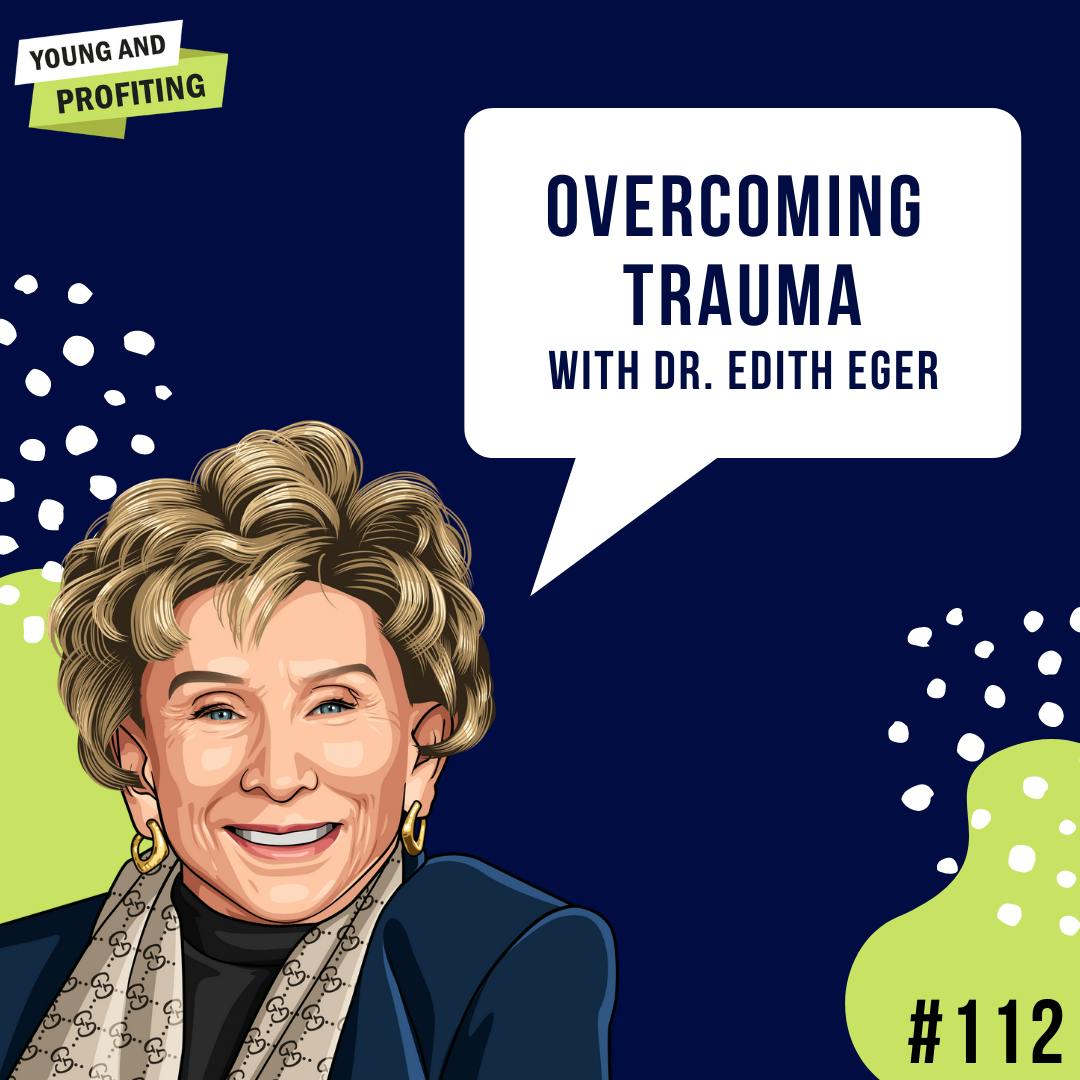
Holocaust Survivor, Dr. Edith Eger: Overcoming Trauma | E112
Hear From Holocaust Survivor and Psychologist, Dr. Edith Eger!
In this episode, we are chatting with Dr. Edith Eger, a best-selling author, psychologist, and survivor of the Holocaust. In 1944, she was taken to Auschwitz as a teenager and separated from her parents, who were taken to the gas chamber. Surviving on her bravery and imagination, she was able to stay alive until American soldiers liberated the camp. She went on to move to America and received a Bachelors of Psychology as well as a Doctorate.
Dr. Eger is a prolific author and a member of several professional associations. She has a clinical practice in La Jolla, California, and holds a faculty appointment at the University of California, San Diego. She has appeared on numerous television programs including CNN and the Oprah Winfrey Show, and was the primary subject of a holocaust documentary that appeared on Dutch National Television.
In today’s episode, we chat about Edith’s shot at competing in the Olympics as a teenager, her horrifying experience during the Holocaust, how her mental strength helped her survive. We’ll also chat more about how you can use your imagination to protect yourself, how to conquer traumatic experiences, why the label ‘victim’ shouldn’t be used, and Dr. Edith’s best tips to move forward from trauma and guilt. This is such a sobering and insightful episode that you definitely do not want to miss!
Sponsored by BetterHelp: Join over 1 million people who have taken charge of their mental health. Visit BetterHelp.com/YAP for 10% your first month.
Social Media:
Follow YAP on IG: www.instagram.com/youngandprofiting
Reach out to Hala directly at Hala@YoungandProfiting.com
Follow Hala on Linkedin: www.linkedin.com/in/htaha/
Follow Hala on Instagram: www.instagram.com/yapwithhala
Follow Hala on ClubHouse: @halataha
Check out our website to meet the team, view show notes and transcripts: www.youngandprofiting.com
Timestamps:
03:06 - Dr. Edith’s Life Before the Holocaust
06:22 - Dr. Edith’s Journey through the Holocaust
07:35 - Why Edith Couldn’t Compete in the Olympics
10:22 - How to Deal With Being in a Minority and Potential Shame
12:26 - Dr. Edith’s Final Moments With Her Mother
16:09 - How Dr. Edith Survived Her Time in Auschwitz
19:18 - Daily Life in Auschwitz and Edith’s Experiences
23:54 - Dr. Edith’s Lingering Survivors Guilt
28:21 - What Dr. Edith Did for 10 Years After the Holocaust
30:43 - How To Use Imagination to Protect Your Mental State
36:26 - How To Fully Grieve Traumatic Experiences
39:24 - Dr. Edith’s New Book, The Gift
40:33 - What Happens When You Are A Prisoner Of Your Own Mind
42:20 - Why Dr. Edith’s Not a Victim
45:08 - How to Move From ‘Victim’ to ‘Survivor’
47:09 - How to Control Internal Negative Talk
49:35 - How to End Hatred and Make Progress
51:57 - Actionable Steps To Deal With Trauma
57:48 - Does Dr. Edith Forgives the Nazis?
1:00:06 - Dr. Edith’s Secret to Profiting in Life
Mentioned in the Episode:
Dr. Edith’s Website: https://dreditheger.com/
Dr. Edith’s New Book, The Gift: https://dreditheger.com/the-gift-2/
Available Results
Generated results are saved to your library for reuse and search.
Choose Template
Pick the result you want. You can review provider and model before generating.
A concise first-pass summary for understanding the episode quickly.
A comprehensive, source-grounded extraction of the reusable knowledge in an episode.
A comprehensive extraction focused on health practices, protocols, claims, and safety caveats.
A dedicated analysis of warnings, limitations, trade-offs, weak evidence, and uncertainty.
Repeatable methods, frameworks, mental models, processes, and systems.
Technologies, AI models, technical methods, capabilities, limitations, and adoption implications.
A concise first-pass summary for understanding the episode quickly.
A detailed readable summary organized by chapter or topic.
A navigable map of subjects, topic flow, and suggested chapters.
A comprehensive, source-grounded extraction of the reusable knowledge in an episode.
Reusable atomic knowledge units extracted from the episode.
A comprehensive extraction focused on health practices, protocols, claims, and safety caveats.
A comprehensive extraction focused on opportunities, strategy, markets, and company building.
Explicit actions, next steps, habits, recommendations, and things to avoid.
A dedicated inventory of concrete resources named in the episode.
A dedicated analysis of warnings, limitations, trade-offs, weak evidence, and uncertainty.
A concise first-pass summary for understanding the episode quickly.
A detailed readable summary organized by chapter or topic.
A navigable map of subjects, topic flow, and suggested chapters.
A comprehensive, source-grounded extraction of the reusable knowledge in an episode.
Reusable atomic knowledge units extracted from the episode.
A comprehensive extraction focused on health practices, protocols, claims, and safety caveats.
A comprehensive extraction focused on opportunities, strategy, markets, and company building.
Scientific findings, mechanisms, studies, hypotheses, and the limits of the evidence discussed.
Technologies, AI models, technical methods, capabilities, limitations, and adoption implications.
Investment theses, assets, catalysts, valuation reasoning, time horizons, and risks.
Chronologies, actors, causes, consequences, turning points, and competing historical interpretations.
Policies, proposals, stakeholders, arguments, implementation constraints, and predicted effects.
Career paths, skills, hiring signals, workplace decisions, transitions, and limitations of the advice.
Behavioral mechanisms, biases, motivation, habits, emotions, interventions, and evidence limitations.
Economic mechanisms, incentives, indicators, market structure, forecasts, and uncertainty.
Leadership principles, team systems, organizational design, culture, feedback, and failure modes.
Audience, positioning, messaging, acquisition, retention, experiments, metrics, and failed approaches.
Teaching methods, learning strategies, practice, feedback, assessment, and effectiveness evidence.
Theses, premises, arguments, objections, values, thought experiments, and unresolved questions.
Communication patterns, conflict, boundaries, expectations, repair methods, and contextual limitations.
Books, papers, authors, courses, and other learning resources mentioned in the episode.
Repeatable methods, frameworks, mental models, processes, and systems.
Explicit actions, next steps, habits, recommendations, and things to avoid.
Memorable statements and important claims with attribution and source context.
A dedicated inventory of concrete resources named in the episode.
A dedicated analysis of warnings, limitations, trade-offs, weak evidence, and uncertainty.