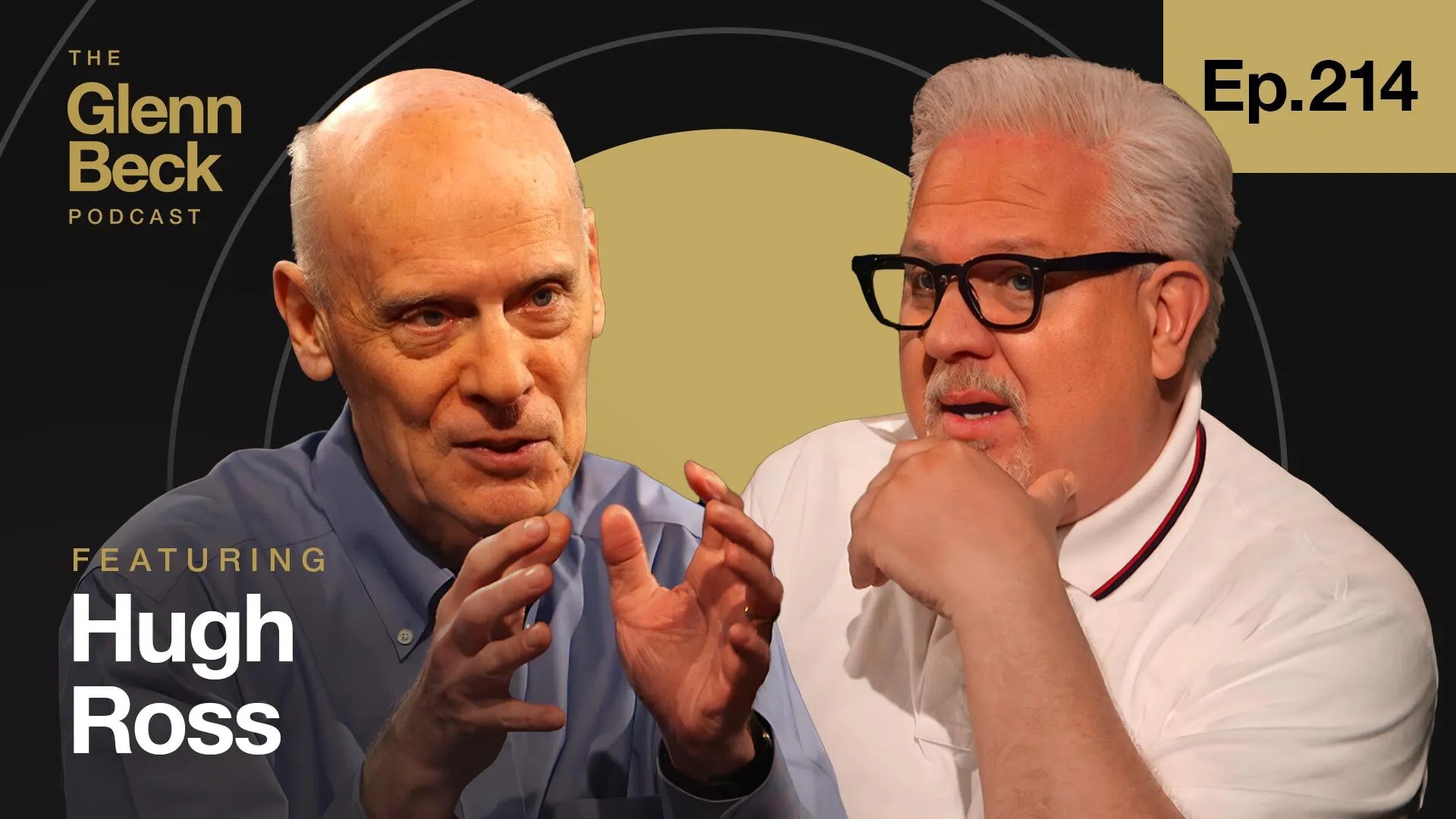
Ep 214 | Christian Scientist DESTROYS Darwin, Provides PROOF of God | The Glenn Beck Podcast
Astrophysicist Hugh Ross came to his Christian faith in a unique way — through the Big Bang. In this episode of "The Glenn Beck Podcast," Glenn and Hugh discuss the creation of the world, from the dinosaurs to what Darwin got wrong in his theory of evolution. As it turns out, “birdbrain” is actually a compliment, but there's still no creature as exceptional as the human being. AI isn't smart enough to pass ninth-grade math, and Hugh argues that even the advent of quantum computing will never make the Homo sapiens obsolete. Mankind's impact is so expansive that it even reaches the dark side of the moon, where, according to Hugh, NASA has the possibility of conducting research that could resolve the debate about the origin of human life once and for all. After a discussion about the scientific method, fossils, and bringing back the woolly mammoth, the conversation goes interstellar, as Hugh and Glenn talk about aliens and that one time Hugh told Carl Sagan that the Bible was the “Encyclopedia Galactica” he was looking for.
Sponsors:
Lear Capital: With over $3 billion in trusted transactions, thousands of five-star reviews, and a 24-hour risk-free purchase guarantee, Lear Capital is the precious metals leader you can trust. Call today for your free wealth protection guide and a $250 credit toward your first purchase at 800-957-GOLD.
Byrna: Not every emergency situation calls for lethal force. Sometimes, non-lethal is the right answer. That’s where the Byrna Launcher comes in. Visit https://byrna.com/glenn for an exclusive 10% discount.
Learn more about your ad choices. Visit megaphone.fm/adchoices
Available Results
Generated results are saved to your library for reuse and search.
Choose Template
Pick the result you want. You can review provider and model before generating.
A concise first-pass summary for understanding the episode quickly.
A comprehensive, source-grounded extraction of the reusable knowledge in an episode.
Scientific findings, mechanisms, studies, hypotheses, and the limits of the evidence discussed.
A dedicated analysis of warnings, limitations, trade-offs, weak evidence, and uncertainty.
Memorable statements and important claims with attribution and source context.
Technologies, AI models, technical methods, capabilities, limitations, and adoption implications.
A concise first-pass summary for understanding the episode quickly.
A detailed readable summary organized by chapter or topic.
A navigable map of subjects, topic flow, and suggested chapters.
A comprehensive, source-grounded extraction of the reusable knowledge in an episode.
Reusable atomic knowledge units extracted from the episode.
A comprehensive extraction focused on health practices, protocols, claims, and safety caveats.
A comprehensive extraction focused on opportunities, strategy, markets, and company building.
Explicit actions, next steps, habits, recommendations, and things to avoid.
A dedicated inventory of concrete resources named in the episode.
A dedicated analysis of warnings, limitations, trade-offs, weak evidence, and uncertainty.
A concise first-pass summary for understanding the episode quickly.
A detailed readable summary organized by chapter or topic.
A navigable map of subjects, topic flow, and suggested chapters.
A comprehensive, source-grounded extraction of the reusable knowledge in an episode.
Reusable atomic knowledge units extracted from the episode.
A comprehensive extraction focused on health practices, protocols, claims, and safety caveats.
A comprehensive extraction focused on opportunities, strategy, markets, and company building.
Scientific findings, mechanisms, studies, hypotheses, and the limits of the evidence discussed.
Technologies, AI models, technical methods, capabilities, limitations, and adoption implications.
Investment theses, assets, catalysts, valuation reasoning, time horizons, and risks.
Chronologies, actors, causes, consequences, turning points, and competing historical interpretations.
Policies, proposals, stakeholders, arguments, implementation constraints, and predicted effects.
Career paths, skills, hiring signals, workplace decisions, transitions, and limitations of the advice.
Behavioral mechanisms, biases, motivation, habits, emotions, interventions, and evidence limitations.
Economic mechanisms, incentives, indicators, market structure, forecasts, and uncertainty.
Leadership principles, team systems, organizational design, culture, feedback, and failure modes.
Audience, positioning, messaging, acquisition, retention, experiments, metrics, and failed approaches.
Teaching methods, learning strategies, practice, feedback, assessment, and effectiveness evidence.
Theses, premises, arguments, objections, values, thought experiments, and unresolved questions.
Communication patterns, conflict, boundaries, expectations, repair methods, and contextual limitations.
Books, papers, authors, courses, and other learning resources mentioned in the episode.
Repeatable methods, frameworks, mental models, processes, and systems.
Explicit actions, next steps, habits, recommendations, and things to avoid.
Memorable statements and important claims with attribution and source context.
A dedicated inventory of concrete resources named in the episode.
A dedicated analysis of warnings, limitations, trade-offs, weak evidence, and uncertainty.