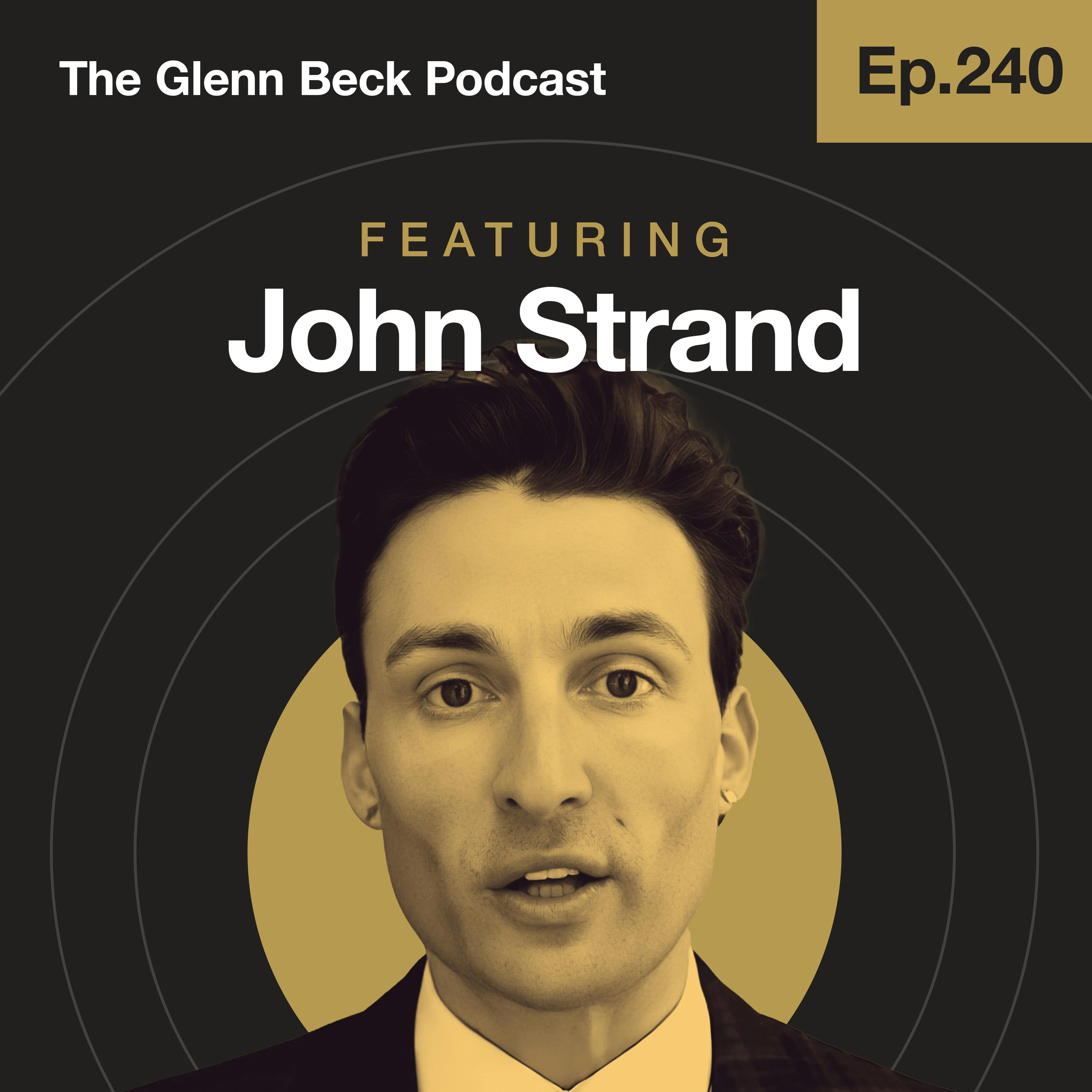
Ep 240 | Should Pardon ALL Jan. 6 Defendants?! | John Strand | The Glenn Beck Podcast
“You never forget your first time being on an FBI Most Wanted list,” says January 6 defendant John Strand. “The process is the punishment ... they punish you at every nook and cranny of the bureaucratic machine.” For what came down to four misdemeanors, John faced a year in prison, including four months in solitary confinement, where he was often denied his time outdoors, phone calls, or even a book to read. “It was so totalitarian,” John says. “I didn’t really expect justice.” He and Glenn discuss the Supreme Court ruling that shortened his 32-month prison sentence, the “uniparty attack on the American populist resistance,” and the aftermath of John’s “digital assassination.” The two consider whether or not government officials like Nancy Pelosi and D.C. Mayor Muriel Bowser “benefited by creating the conditions” that made January 6 possible. Did at least 26 FBI agents know what was coming that day? What about the pipe bombs at the DNC and RNC headquarters? The main question is what do we do now? John suggests that the January 6 prosecutions are legally “irredeemably tainted.” Will President-elect Donald Trump issue a blanket pardon?
Learn more about Patriot Plea by John Strand here- https://www.johnstrand.com/
Sponsors
Byrna
Byrna is the best alternative to deadly force. Visit https://byrna.com/GLENN for a 10% discount.
Learn more about your ad choices. Visit megaphone.fm/adchoices
Available Results
Generated results are saved to your library for reuse and search.
Choose Template
Pick the result you want. You can review provider and model before generating.
A concise first-pass summary for understanding the episode quickly.
A comprehensive, source-grounded extraction of the reusable knowledge in an episode.
Technologies, AI models, technical methods, capabilities, limitations, and adoption implications.
Repeatable methods, frameworks, mental models, processes, and systems.
A dedicated analysis of warnings, limitations, trade-offs, weak evidence, and uncertainty.
A dedicated inventory of concrete resources named in the episode.
A concise first-pass summary for understanding the episode quickly.
A detailed readable summary organized by chapter or topic.
A navigable map of subjects, topic flow, and suggested chapters.
A comprehensive, source-grounded extraction of the reusable knowledge in an episode.
Reusable atomic knowledge units extracted from the episode.
A comprehensive extraction focused on health practices, protocols, claims, and safety caveats.
A comprehensive extraction focused on opportunities, strategy, markets, and company building.
Explicit actions, next steps, habits, recommendations, and things to avoid.
A dedicated inventory of concrete resources named in the episode.
A dedicated analysis of warnings, limitations, trade-offs, weak evidence, and uncertainty.
A concise first-pass summary for understanding the episode quickly.
A detailed readable summary organized by chapter or topic.
A navigable map of subjects, topic flow, and suggested chapters.
A comprehensive, source-grounded extraction of the reusable knowledge in an episode.
Reusable atomic knowledge units extracted from the episode.
A comprehensive extraction focused on health practices, protocols, claims, and safety caveats.
A comprehensive extraction focused on opportunities, strategy, markets, and company building.
Scientific findings, mechanisms, studies, hypotheses, and the limits of the evidence discussed.
Technologies, AI models, technical methods, capabilities, limitations, and adoption implications.
Investment theses, assets, catalysts, valuation reasoning, time horizons, and risks.
Chronologies, actors, causes, consequences, turning points, and competing historical interpretations.
Policies, proposals, stakeholders, arguments, implementation constraints, and predicted effects.
Career paths, skills, hiring signals, workplace decisions, transitions, and limitations of the advice.
Behavioral mechanisms, biases, motivation, habits, emotions, interventions, and evidence limitations.
Economic mechanisms, incentives, indicators, market structure, forecasts, and uncertainty.
Leadership principles, team systems, organizational design, culture, feedback, and failure modes.
Audience, positioning, messaging, acquisition, retention, experiments, metrics, and failed approaches.
Teaching methods, learning strategies, practice, feedback, assessment, and effectiveness evidence.
Theses, premises, arguments, objections, values, thought experiments, and unresolved questions.
Communication patterns, conflict, boundaries, expectations, repair methods, and contextual limitations.
Books, papers, authors, courses, and other learning resources mentioned in the episode.
Repeatable methods, frameworks, mental models, processes, and systems.
Explicit actions, next steps, habits, recommendations, and things to avoid.
Memorable statements and important claims with attribution and source context.
A dedicated inventory of concrete resources named in the episode.
A dedicated analysis of warnings, limitations, trade-offs, weak evidence, and uncertainty.