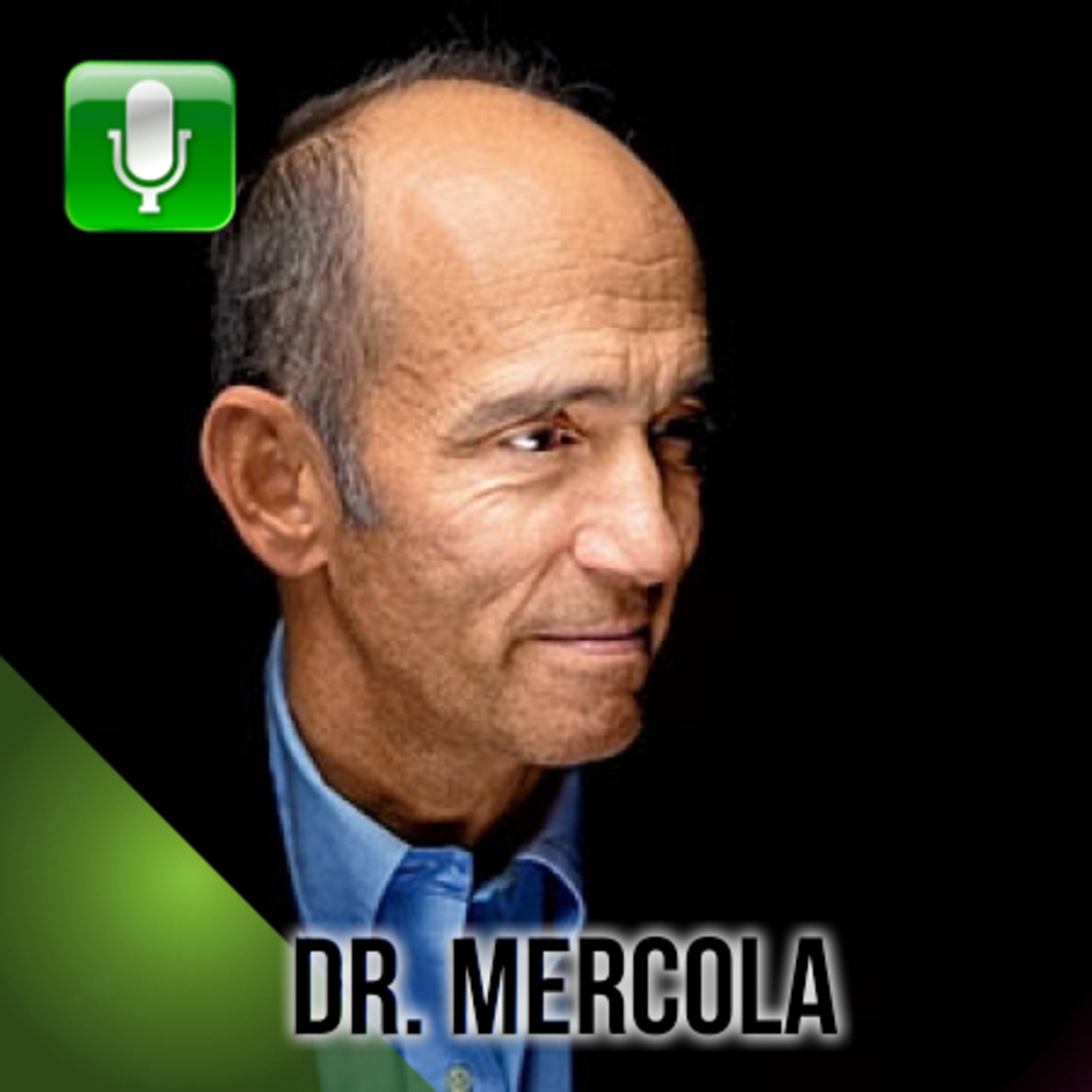
High-Fat Fudge Balls, The Best Fruits For Blood Sugar, Egg Allergies & More With "Fat For Fuel" Author Dr. Mercola
For over a century, we’ve accepted the scientific consensus that cancer results from genetic disease due to chromosomal damage in cell nuclei. But what if cancer isn’t a genetic disease after all?
What if scientists are chasing a flawed paradigm, and cancer isn’t a disease of damaged DNA but rather of defective metabolism as a result of mitochondrial dysfunction? What if that startling truth could revolutionize our understanding of other diseases as well—and show us a radical new path to optimal health? In the groundbreaking new book Fat for Fuel: A Revolutionary Diet to Combat Cancer, Boost Brain Power, and Increase Your Energy, the first of its kind, New York Times best-selling author, one of the nation's leading natural-health practitioner, and my previous guest on this podcast, Dr. Joseph Mercola explains how nearly all disease is caused by defective metabolic processes. Then he reveals what’s really causing your metabolism to go haywire: damage and dysfunction in the mitochondria, thousands of which are at work in nearly every cell in your body, generating 90 percent of the energy you need to stay alive and well. When mitochondria become damaged in large numbers, it is impossible to stay healthy.
That's his argument, at least. But in this podcast, you get to listen as Dr. Mercola and I take a deep dive in this new view of cancer and much, much more when it comes to optimizing your mitochondria. Dr. Mercola is a board certified family physician who has seen tens of thousands of patients before transitioning to a full time internet journalist, as he felt he could help far more people than he could in private practice. It turns out he was right, because every month he has ten million unique visitors and 80 million unique visitors for the year. It has been the most visited natural health site for the last 12 years and is now translated into six different languages.
During our discussion, you'll discover:
-Why you must "eat today to control the hormones that will tell your cells what to do tomorrow." [10:35]
-The problem with the popular diabetic drug metformin...[12:55]
-Why Dr. Mercola lost too much weight and got too skinny...[14:10]
-Why Dr. Mercola is such a fan of tracking iron levels, and what iron numbers are good to look for...[20:00]
-The "selfie stick" trick Dr. Mercola uses to minimize his EMF exposure from cell phone use...[27:10]
-Why berries and grapefruits are "acceptable" foods in Dr. Mercola's recommended diet...[33:50]
-Why Dr. Mercola eats 1-3 avocados per day, whether you need to buy organic, how to save 50% on avocados, and a trick for transporting avocados easily...[36:00]
-An extremely tasty high-fat fudge ball recipe...[36:30]
-How heating eggs can make you allergic to them...[47:30]
-The #1 food and macronutrient tracking tool that Dr. Mercola recommends...[54:20]
-And much more...
Resources from this episode: -Book: Fat for Fuel: A Revolutionary Diet to Combat Cancer, Boost Brain Power, and Increase Your Energy -Book: Tripping Over The Truth -Podcast: Killing Fat Cells, Fixing Mitochondria, Growing Superfoods & More: The Official, Much-Anticipated, Mind-Blowing, Geeked-Out Podcast With Dr. Mercola. -The bitter melon extract/rock lotus extract Ben mentions -The Greenwave dirty electricity filters Ben has in every room of his house -Cronometer.com -TrueDark glasses -Chadwick optical -Irlen lenses
Do you have questions, thoughts or feedback for Dr. Mercola or me? Leave your comments below and one of us will reply!
See omnystudio.com/listener for privacy information.
Available Results
Generated results are saved to your library for reuse and search.
Choose Template
Pick the result you want. You can review provider and model before generating.
A concise first-pass summary for understanding the episode quickly.
A comprehensive, source-grounded extraction of the reusable knowledge in an episode.
A comprehensive extraction focused on health practices, protocols, claims, and safety caveats.
A dedicated analysis of warnings, limitations, trade-offs, weak evidence, and uncertainty.
Repeatable methods, frameworks, mental models, processes, and systems.
Technologies, AI models, technical methods, capabilities, limitations, and adoption implications.
A concise first-pass summary for understanding the episode quickly.
A detailed readable summary organized by chapter or topic.
A navigable map of subjects, topic flow, and suggested chapters.
A comprehensive, source-grounded extraction of the reusable knowledge in an episode.
Reusable atomic knowledge units extracted from the episode.
A comprehensive extraction focused on health practices, protocols, claims, and safety caveats.
A comprehensive extraction focused on opportunities, strategy, markets, and company building.
Explicit actions, next steps, habits, recommendations, and things to avoid.
A dedicated inventory of concrete resources named in the episode.
A dedicated analysis of warnings, limitations, trade-offs, weak evidence, and uncertainty.
A concise first-pass summary for understanding the episode quickly.
A detailed readable summary organized by chapter or topic.
A navigable map of subjects, topic flow, and suggested chapters.
A comprehensive, source-grounded extraction of the reusable knowledge in an episode.
Reusable atomic knowledge units extracted from the episode.
A comprehensive extraction focused on health practices, protocols, claims, and safety caveats.
A comprehensive extraction focused on opportunities, strategy, markets, and company building.
Scientific findings, mechanisms, studies, hypotheses, and the limits of the evidence discussed.
Technologies, AI models, technical methods, capabilities, limitations, and adoption implications.
Investment theses, assets, catalysts, valuation reasoning, time horizons, and risks.
Chronologies, actors, causes, consequences, turning points, and competing historical interpretations.
Policies, proposals, stakeholders, arguments, implementation constraints, and predicted effects.
Career paths, skills, hiring signals, workplace decisions, transitions, and limitations of the advice.
Behavioral mechanisms, biases, motivation, habits, emotions, interventions, and evidence limitations.
Economic mechanisms, incentives, indicators, market structure, forecasts, and uncertainty.
Leadership principles, team systems, organizational design, culture, feedback, and failure modes.
Audience, positioning, messaging, acquisition, retention, experiments, metrics, and failed approaches.
Teaching methods, learning strategies, practice, feedback, assessment, and effectiveness evidence.
Theses, premises, arguments, objections, values, thought experiments, and unresolved questions.
Communication patterns, conflict, boundaries, expectations, repair methods, and contextual limitations.
Books, papers, authors, courses, and other learning resources mentioned in the episode.
Repeatable methods, frameworks, mental models, processes, and systems.
Explicit actions, next steps, habits, recommendations, and things to avoid.
Memorable statements and important claims with attribution and source context.
A dedicated inventory of concrete resources named in the episode.
A dedicated analysis of warnings, limitations, trade-offs, weak evidence, and uncertainty.