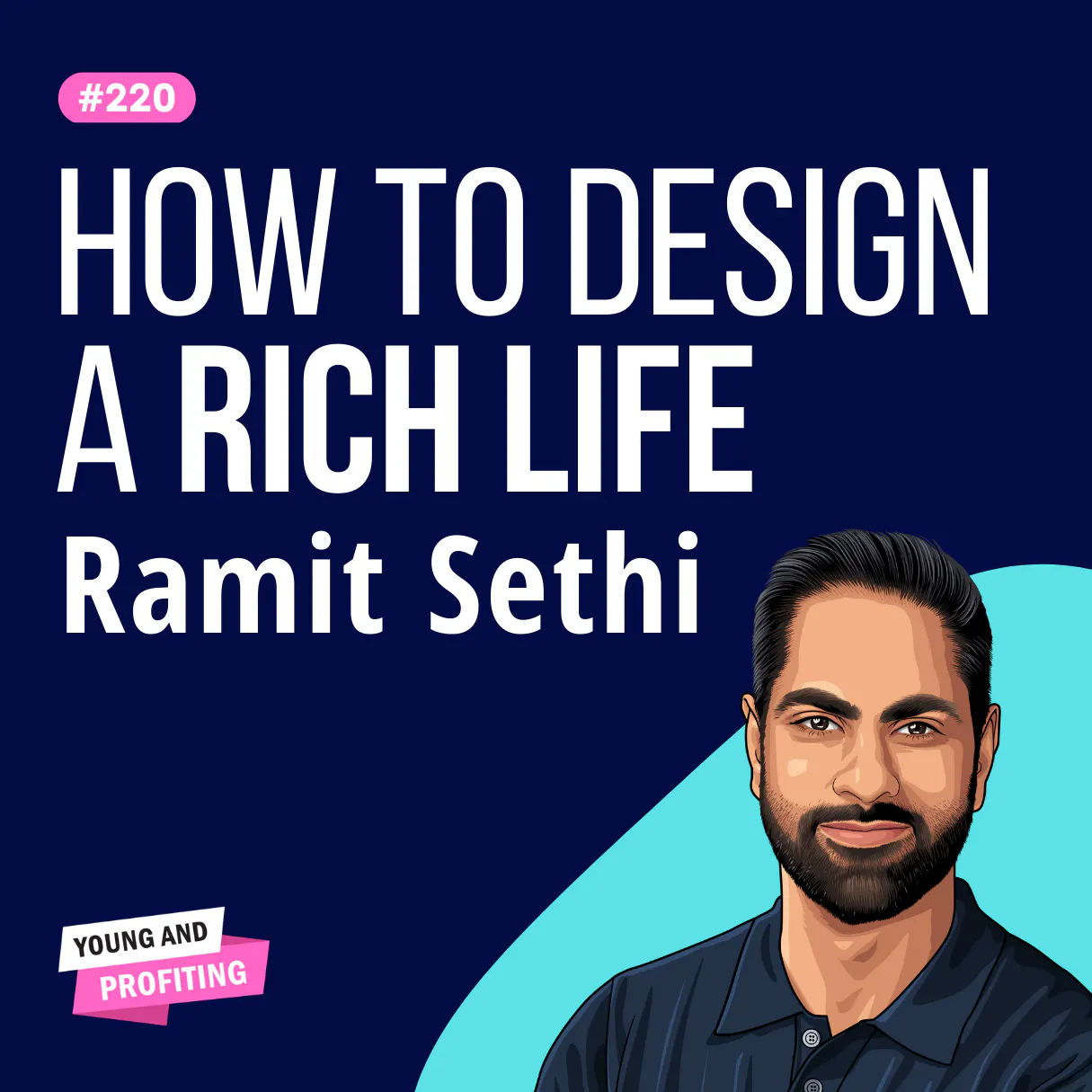
Ramit Sethi: The Psychology of Money, I Will Teach You To Be Rich | Finance | E220
When Ramit Sethi graduated from high school, he built a system to apply for 60+ scholarships that earned him a full ride to Stanford University. But when he got his first scholarship check, he invested it in the stock market and lost it all. That’s when he decided to change his money mindset and learn the secrets of money-making. Today, Ramit helps a worldwide community of people who want to create their Rich Lives, their own way. In this episode, Ramit will cover his background and the psychology behind money. He will break down the concept of money dials and how to indulge in guilt-free spending. He will share his advice on how to create our very own RICH life.
Ramit is a New York Times best-selling author of the popular book I Will Teach You To Be Rich. He is an expert on business, careers, negotiation, psychology, and money. Ramit hosts the popular podcast I Will Teach You To Be Rich and is also the host of the new show, "How to Get Rich," which premiered earlier this month on Netflix.
In this episode, Hala and Ramit will discuss:
- Ramit’s early views on money
- Why Ramit started his finance blog in college
- What it means to live a RICH life
- The “invisible scripts” we believe about money
- The biggest money mistake that couples make
- Four numbers you have to track as a conscious spender
- The psychology of spending
- Using our Money Dial
- Why we shouldn’t feel guilty about buying what we love
- How to land your dream job
- Negotiating your salary
- And other topics…
Ramit Sethi is a personal finance and business expert who studied psychology at Stanford. He started a blog about business, money, careers, and psychology that now has 1 million+ monthly readers. Ramit frequently appears in the media. He wrote the bestselling book I Will Teach You to Be Rich in 2009, and a new edition of the book in 2019. Ramit hosts the popular podcast I Will Teach You To Be Rich. Ramit also has a new Netflix Show called “How to Get Rich,” which premiered on April 18th, 2023.
Resources Mentioned:
Ramit’s Website: https://www.iwillteachyoutoberich.com/
Ramit’s LinkedIn: https://www.linkedin.com/in/ramitsethi/
Ramit’s Twitter: https://twitter.com/ramit
Ramit’s Instagram: https://www.instagram.com/ramit/
Ramit’s Facebook: https://www.facebook.com/IWT/
Ramit’s Podcast I Will Teach You to Be Rich: https://www.iwillteachyoutoberich.com/podcast/
Ramit’s book I Will Teach You to Be Rich, Second Edition: No Guilt. No Excuses. No BS. Just a 6-Week Program That Works: https://www.amazon.com/Will-Teach-You-Rich-Second-ebook/dp/B07GNXPP4P
Ramit’s show “How to Get Rich”: https://www.iwillteachyoutoberich.com/netflix/
LinkedIn Secrets Masterclass, Have Job Security For Life:
Use code ‘masterclass’ for 25% off at yapmedia.io/course.
Sponsored By:
Sign up for a $1 per month trial period at shopify.com/profiting
More About Young and Profiting
Download Transcripts - youngandprofiting.com
Get Sponsorship Deals - youngandprofiting.com/sponsorships
Leave a Review - ratethispodcast.com/yap
Watch Videos - youtube.com/c/YoungandProfiting
Follow Hala Taha
LinkedIn - linkedin.com/in/htaha/
Instagram - instagram.com/yapwithhala/
TikTok - tiktok.com/@yapwithhala
Twitter - twitter.com/yapwithhala
Learn more about YAP Media Agency Services - yapmedia.io/
Available Results
Generated results are saved to your library for reuse and search.
Choose Template
Pick the result you want. You can review provider and model before generating.
A concise first-pass summary for understanding the episode quickly.
A comprehensive, source-grounded extraction of the reusable knowledge in an episode.
A comprehensive extraction focused on opportunities, strategy, markets, and company building.
Explicit actions, next steps, habits, recommendations, and things to avoid.
Repeatable methods, frameworks, mental models, processes, and systems.
A dedicated inventory of concrete resources named in the episode.
A concise first-pass summary for understanding the episode quickly.
A detailed readable summary organized by chapter or topic.
A navigable map of subjects, topic flow, and suggested chapters.
A comprehensive, source-grounded extraction of the reusable knowledge in an episode.
Reusable atomic knowledge units extracted from the episode.
A comprehensive extraction focused on health practices, protocols, claims, and safety caveats.
A comprehensive extraction focused on opportunities, strategy, markets, and company building.
Explicit actions, next steps, habits, recommendations, and things to avoid.
A dedicated inventory of concrete resources named in the episode.
A dedicated analysis of warnings, limitations, trade-offs, weak evidence, and uncertainty.
A concise first-pass summary for understanding the episode quickly.
A detailed readable summary organized by chapter or topic.
A navigable map of subjects, topic flow, and suggested chapters.
A comprehensive, source-grounded extraction of the reusable knowledge in an episode.
Reusable atomic knowledge units extracted from the episode.
A comprehensive extraction focused on health practices, protocols, claims, and safety caveats.
A comprehensive extraction focused on opportunities, strategy, markets, and company building.
Scientific findings, mechanisms, studies, hypotheses, and the limits of the evidence discussed.
Technologies, AI models, technical methods, capabilities, limitations, and adoption implications.
Investment theses, assets, catalysts, valuation reasoning, time horizons, and risks.
Chronologies, actors, causes, consequences, turning points, and competing historical interpretations.
Policies, proposals, stakeholders, arguments, implementation constraints, and predicted effects.
Career paths, skills, hiring signals, workplace decisions, transitions, and limitations of the advice.
Behavioral mechanisms, biases, motivation, habits, emotions, interventions, and evidence limitations.
Economic mechanisms, incentives, indicators, market structure, forecasts, and uncertainty.
Leadership principles, team systems, organizational design, culture, feedback, and failure modes.
Audience, positioning, messaging, acquisition, retention, experiments, metrics, and failed approaches.
Teaching methods, learning strategies, practice, feedback, assessment, and effectiveness evidence.
Theses, premises, arguments, objections, values, thought experiments, and unresolved questions.
Communication patterns, conflict, boundaries, expectations, repair methods, and contextual limitations.
Books, papers, authors, courses, and other learning resources mentioned in the episode.
Repeatable methods, frameworks, mental models, processes, and systems.
Explicit actions, next steps, habits, recommendations, and things to avoid.
Memorable statements and important claims with attribution and source context.
A dedicated inventory of concrete resources named in the episode.
A dedicated analysis of warnings, limitations, trade-offs, weak evidence, and uncertainty.