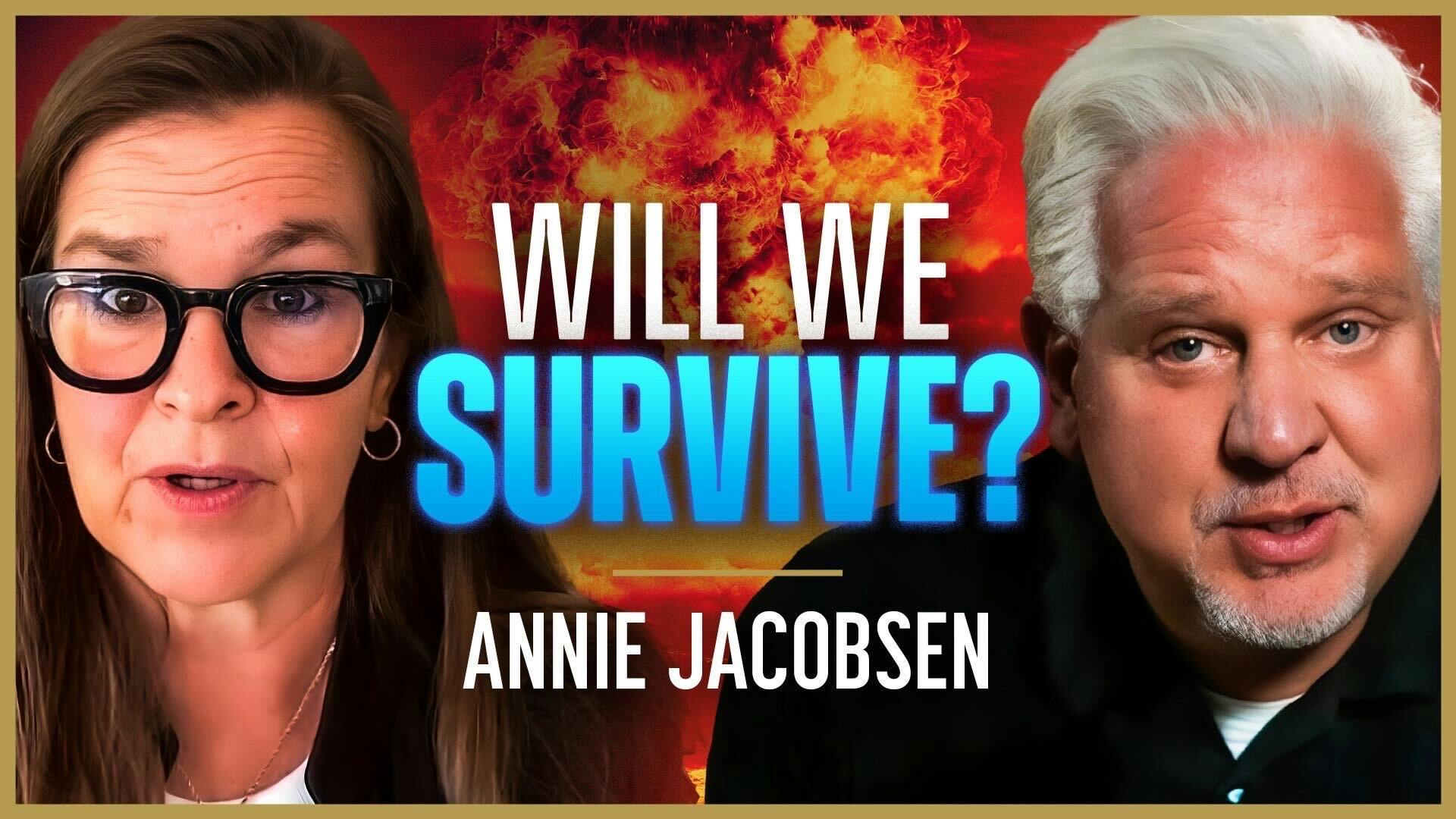
Ep 223 | What Nuclear War Under Joe Biden Would Look Like | Annie Jacobsen | The Glenn Beck Podcast
“Nuclear war can never be won and must never be fought,” declared Reagan and Gorbachev at their summit in Geneva in 1985. Yet nuclear war, says journalist Annie Jacobsen, is an “existential threat that still looms over us all.” From the nuclear “football” to the “black book of death,” Annie sheds light on what former CIA director and Secretary of Defense Leon Panetta says the American people “need to know.” When nations like Russia and China have a stockpile of nuclear weapons, Annie advises that it’s time to remember how to differentiate between enemies and adversaries in order to avoid nuclear winter and a potential return to the lifestyle of the hunter-gatherer. Glenn and Annie also discuss the covert Operation Paperclip that brought Nazi scientists to America, including “Hitler's favorite chemist,” and the CIA’s top-secret paramilitary operations. “No one knows who to trust,” says Glenn, and the scariest part is that we are all forced to put our trust in the one man who can launch American nuclear weapons any time he wants – President Joe Biden.
Sponsors:
Relief Factor
Relief Factor can help you live pain-free!
Visit https://www.relieffactor.com/ or call 800-4-RELIEF to save on your first order.
PreBorn
By introducing an expecting mother to her unborn baby through a free ultrasound, PreBorn doubles the chances that she will choose life. One lifesaving ultrasound is just $28.00. To donate securely, dial #250 and say the keyword “Baby,” or visit http://preborn.com/glenn.
Byrna
Byrna is the best alternative to deadly force. Visit https://byrna.com/pages/glenn-beck-landing for a 10% discount.
Learn more about your ad choices. Visit megaphone.fm/adchoices
Available Results
Generated results are saved to your library for reuse and search.
Choose Template
Pick the result you want. You can review provider and model before generating.
A concise first-pass summary for understanding the episode quickly.
A comprehensive, source-grounded extraction of the reusable knowledge in an episode.
Technologies, AI models, technical methods, capabilities, limitations, and adoption implications.
Repeatable methods, frameworks, mental models, processes, and systems.
A dedicated analysis of warnings, limitations, trade-offs, weak evidence, and uncertainty.
A dedicated inventory of concrete resources named in the episode.
A concise first-pass summary for understanding the episode quickly.
A detailed readable summary organized by chapter or topic.
A navigable map of subjects, topic flow, and suggested chapters.
A comprehensive, source-grounded extraction of the reusable knowledge in an episode.
Reusable atomic knowledge units extracted from the episode.
A comprehensive extraction focused on health practices, protocols, claims, and safety caveats.
A comprehensive extraction focused on opportunities, strategy, markets, and company building.
Explicit actions, next steps, habits, recommendations, and things to avoid.
A dedicated inventory of concrete resources named in the episode.
A dedicated analysis of warnings, limitations, trade-offs, weak evidence, and uncertainty.
A concise first-pass summary for understanding the episode quickly.
A detailed readable summary organized by chapter or topic.
A navigable map of subjects, topic flow, and suggested chapters.
A comprehensive, source-grounded extraction of the reusable knowledge in an episode.
Reusable atomic knowledge units extracted from the episode.
A comprehensive extraction focused on health practices, protocols, claims, and safety caveats.
A comprehensive extraction focused on opportunities, strategy, markets, and company building.
Scientific findings, mechanisms, studies, hypotheses, and the limits of the evidence discussed.
Technologies, AI models, technical methods, capabilities, limitations, and adoption implications.
Investment theses, assets, catalysts, valuation reasoning, time horizons, and risks.
Chronologies, actors, causes, consequences, turning points, and competing historical interpretations.
Policies, proposals, stakeholders, arguments, implementation constraints, and predicted effects.
Career paths, skills, hiring signals, workplace decisions, transitions, and limitations of the advice.
Behavioral mechanisms, biases, motivation, habits, emotions, interventions, and evidence limitations.
Economic mechanisms, incentives, indicators, market structure, forecasts, and uncertainty.
Leadership principles, team systems, organizational design, culture, feedback, and failure modes.
Audience, positioning, messaging, acquisition, retention, experiments, metrics, and failed approaches.
Teaching methods, learning strategies, practice, feedback, assessment, and effectiveness evidence.
Theses, premises, arguments, objections, values, thought experiments, and unresolved questions.
Communication patterns, conflict, boundaries, expectations, repair methods, and contextual limitations.
Books, papers, authors, courses, and other learning resources mentioned in the episode.
Repeatable methods, frameworks, mental models, processes, and systems.
Explicit actions, next steps, habits, recommendations, and things to avoid.
Memorable statements and important claims with attribution and source context.
A dedicated inventory of concrete resources named in the episode.
A dedicated analysis of warnings, limitations, trade-offs, weak evidence, and uncertainty.