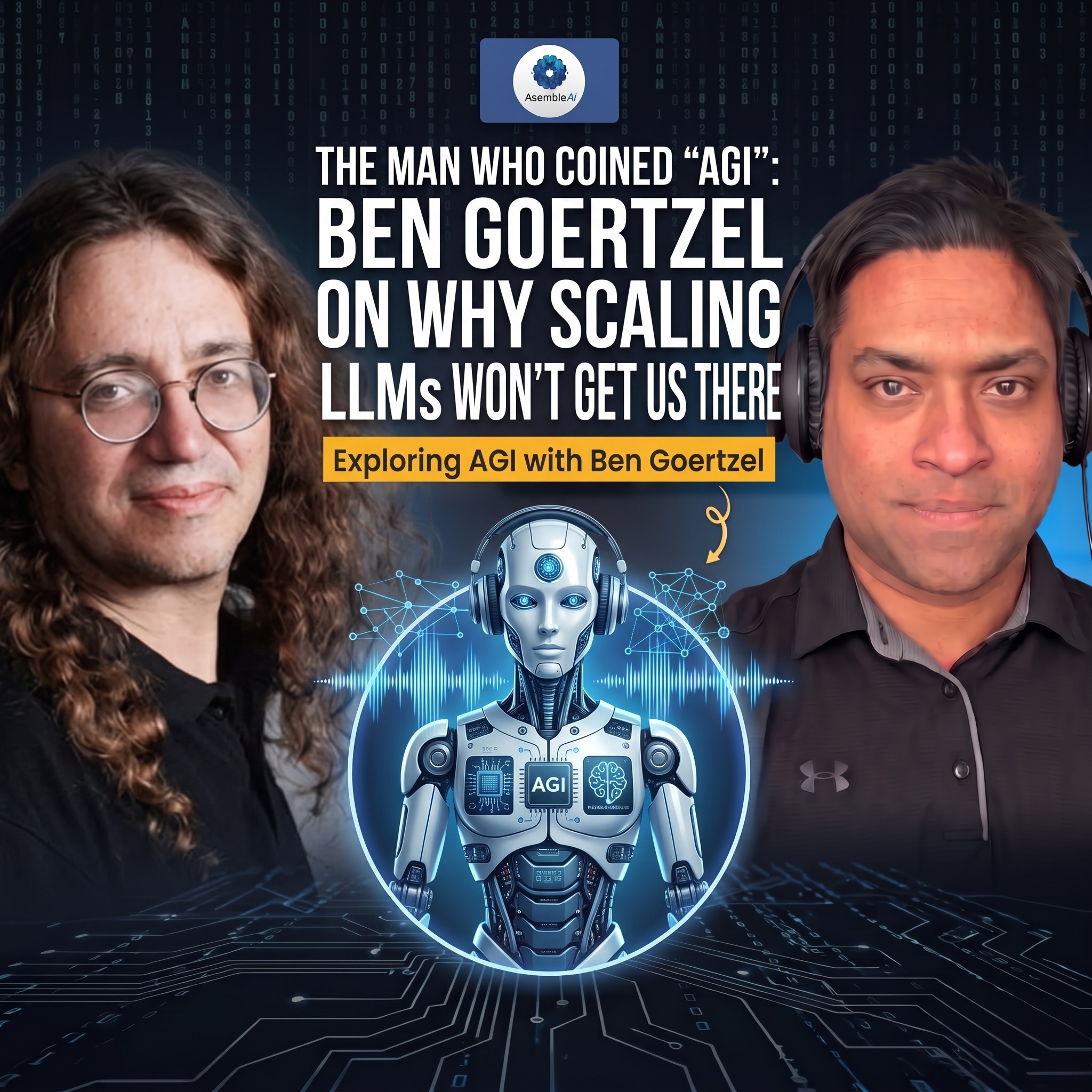
EP 70: The Man Who Coined "AGI" - on Why Scaling LLMs Won't Get Us There | Ben Goertzel, SingualarityNET
Ben Goertzel coined the term AGI over two decades ago — long before OpenAI, Anthropic, or the current wave of AI labs existed. Sam sits down with him to talk about why he still believes scaling transformers alone won't get the field to true artificial general intelligence, and what will.
Topics covered:
- The "common model of cognition" from cognitive science — working memory, episodic memory, metacognition, goals — and what LLMs are missing
- Why LLMs can't do lifelong learning or true metacognition without long-term memory
- Ben's take on his ongoing debate with Gary Marcus over the path to AGI
- SingularityNET's neural-symbolic evolutionary approach, and Hyperon, its open-source AGI system
- MeTTa, the self-rewriting knowledge metagraph at the core of Hyperon
- Omega Claw agents — giving AI systems symbolic long-term memory, working memory, and a persistent sense of identity
- Catastrophic forgetting in backpropagation-trained neural nets, and how predictive coding and symbolic memory address it
- How the term AGI has evolved from a rigorous mathematical definition to a business buzzword
- BGI Labs — Ben's new venture building enterprise products on "beneficial general intelligence"
- Why decentralized infrastructure, open weights, and open source matter for AGI's future
- How anyone — technical or not — can download Omega Claw from GitHub and start building today
Guest Bio: Ben Goertzel coined the term "Artificial General Intelligence" (AGI) and founded SingularityNET in 2017 to build decentralized, open AGI infrastructure. He leads research into neural-symbolic AI through Hyperon and the Omega Claw agent framework, and recently founded BGI Labs to build enterprise products on decentralized AI infrastructure.
Connect: Find more on SingularityNET, Hyperon (hyperon.dev), and Omega Claw on GitHub.
More description
Ben Goertzel coined the term AGI over two decades ago — long before OpenAI, Anthropic, or the current wave of AI labs existed. Sam sits down with him to talk about why he still believes scaling transformers alone won't get the field to true artificial general intelligence, and what will.
Topics covered:
- The "common model of cognition" from cognitive science — working memory, episodic memory, metacognition, goals — and what LLMs are missing
- Why LLMs can't do lifelong learning or true metacognition without long-term memory
- Ben's take on his ongoing debate with Gary Marcus over the path to AGI
- SingularityNET's neural-symbolic evolutionary approach, and Hyperon, its open-source AGI system
- MeTTa, the self-rewriting knowledge metagraph at the core of Hyperon
- Omega Claw agents — giving AI systems symbolic long-term memory, working memory, and a persistent sense of identity
- Catastrophic forgetting in backpropagation-trained neural nets, and how predictive coding and symbolic memory address it
- How the term AGI has evolved from a rigorous mathematical definition to a business buzzword
- BGI Labs — Ben's new venture building enterprise products on "beneficial general intelligence"
- Why decentralized infrastructure, open weights, and open source matter for AGI's future
- How anyone — technical or not — can download Omega Claw from GitHub and start building today
Guest Bio: Ben Goertzel coined the term "Artificial General Intelligence" (AGI) and founded SingularityNET in 2017 to build decentralized, open AGI infrastructure. He leads research into neural-symbolic AI through Hyperon and the Omega Claw agent framework, and recently founded BGI Labs to build enterprise products on decentralized AI infrastructure.
Connect: Find more on SingularityNET, Hyperon (hyperon.dev), and Omega Claw on GitHub.
Listen elsewhere
Available Results
Generated results are saved to your library for reuse and search.