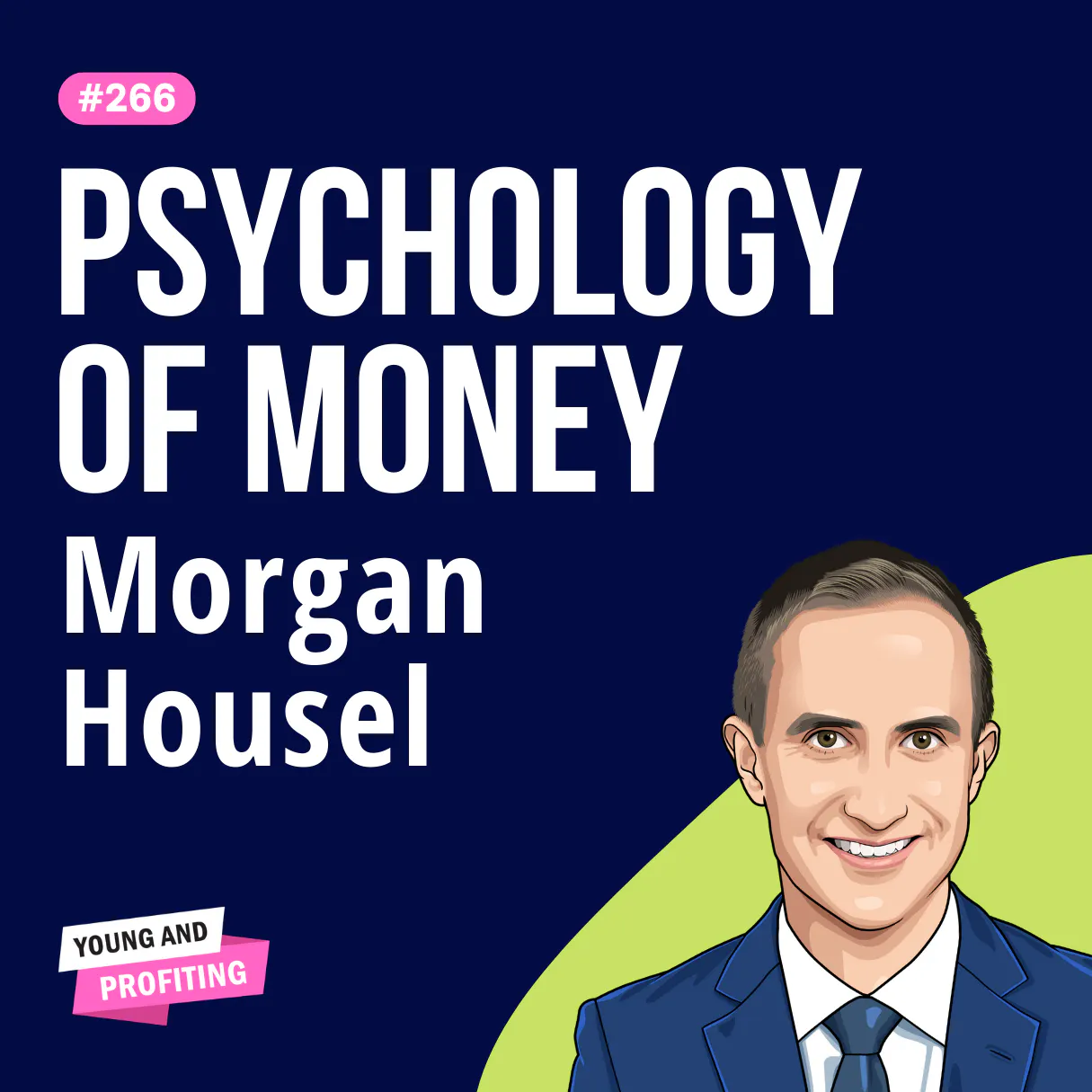
Morgan Housel: How to ACTUALLY Build Wealth, Investing to Gain Financial Independence | Finance E266
Morgan Housel made his first investment when he was 18, putting $1,000 into a certificate of deposit at his local bank. When he started to make some interest on that investment, he was hooked. He devoured books on finance and economics, eventually becoming a financial columnist for The Motley Fool and The Wall Street Journal. In today’s episode, Morgan shares why he thinks finance is more like psychology than physics, some of the common emotional pitfalls related to money, his secrets to staying rich, and much more.
Morgan Housel is a partner at The Collaborative Fund. He's the author of the best-selling book The Psychology of Money. He is a two-time winner of the Best in Business Award from the Society of American Business Editors and Writers and winner of the New York Times Sidney Award. His latest book is Same As Ever: A Guide to What Never Changes.
In this episode, Hala and Morgan will discuss:
- Serendipitously finding a job he loves
- The skiing accident that changed his life
- What he learned from James Clear and Atomic Habits
- How behavior can trump smarts
- Why finance is more like psychology than physics
- Independence and the purpose of wealth
- Common emotional pitfalls related to money
- Secrets to staying rich
- What Bill Gates can teach you about optimism
- Which unappreciated trait of Warren Buffet we should emulate
- How stress can be a good thing
- And other topics…
Morgan Housel is a partner at The Collaborative Fund. He's the author of the best-selling book The Psychology of Money. He is a two-time winner of the Best in Business Award from the Society of American Business Editors and Writers and winner of the New York Times Sidney Award. In 2022, MarketWatch named him one of the 50 most influential people in markets. He serves on the board of directors at Markel. His latest book is Same As Ever: A Guide to What Never Changes.
Sponsored By:
Shopify - Sign up for a one-dollar-per-month trial period at youngandprofiting.co/shopify
Nom Nom - Go to youngandprofiting.co/trynomnom for 50% off on your two-week trial
HelloFresh - Go to HelloFresh.com/profitingfree and use code profitingfree for FREE breakfast for life!
Indeed - Get a $75 job credit at indeed.com/profiting
More About Young and Profiting
Download Transcripts - youngandprofiting.com
Get Sponsorship Deals - youngandprofiting.com/sponsorships
Leave a Review - ratethispodcast.com/yap
Watch Videos - youtube.com/c/YoungandProfiting
Follow Hala Taha
LinkedIn - linkedin.com/in/htaha/
Instagram - instagram.com/yapwithhala/
TikTok - tiktok.com/@yapwithhala
Twitter - twitter.com/yapwithhala
Entrepreneurship, entrepreneurship podcast, Business, Business podcast, Self Improvement, Self-Improvement, Personal development, Starting a business, Strategy, Investing, Sales, Selling, Psychology, Productivity, Entrepreneurs, AI, Artificial Intelligence, Technology, Marketing, Negotiation, Money, Finance, Side hustle, Startup, mental health, Career, Leadership, Mindset, Health, Growth mindset, Finance, Financial, Personal Finance, Wealth, Stock Market, Scalability, Investment, Financial Freedom, Risk Management, Financial Planning, Business Coaching, Finance podcast, Investing, Saving,
Learn more about YAP Media Agency Services - yapmedia.io/
Available Results
Generated results are saved to your library for reuse and search.
Choose Template
Pick the result you want. You can review provider and model before generating.
A concise first-pass summary for understanding the episode quickly.
A comprehensive, source-grounded extraction of the reusable knowledge in an episode.
A comprehensive extraction focused on health practices, protocols, claims, and safety caveats.
A dedicated analysis of warnings, limitations, trade-offs, weak evidence, and uncertainty.
Repeatable methods, frameworks, mental models, processes, and systems.
A comprehensive extraction focused on opportunities, strategy, markets, and company building.
A concise first-pass summary for understanding the episode quickly.
A detailed readable summary organized by chapter or topic.
A navigable map of subjects, topic flow, and suggested chapters.
A comprehensive, source-grounded extraction of the reusable knowledge in an episode.
Reusable atomic knowledge units extracted from the episode.
A comprehensive extraction focused on health practices, protocols, claims, and safety caveats.
A comprehensive extraction focused on opportunities, strategy, markets, and company building.
Explicit actions, next steps, habits, recommendations, and things to avoid.
A dedicated inventory of concrete resources named in the episode.
A dedicated analysis of warnings, limitations, trade-offs, weak evidence, and uncertainty.
A concise first-pass summary for understanding the episode quickly.
A detailed readable summary organized by chapter or topic.
A navigable map of subjects, topic flow, and suggested chapters.
A comprehensive, source-grounded extraction of the reusable knowledge in an episode.
Reusable atomic knowledge units extracted from the episode.
A comprehensive extraction focused on health practices, protocols, claims, and safety caveats.
A comprehensive extraction focused on opportunities, strategy, markets, and company building.
Scientific findings, mechanisms, studies, hypotheses, and the limits of the evidence discussed.
Technologies, AI models, technical methods, capabilities, limitations, and adoption implications.
Investment theses, assets, catalysts, valuation reasoning, time horizons, and risks.
Chronologies, actors, causes, consequences, turning points, and competing historical interpretations.
Policies, proposals, stakeholders, arguments, implementation constraints, and predicted effects.
Career paths, skills, hiring signals, workplace decisions, transitions, and limitations of the advice.
Behavioral mechanisms, biases, motivation, habits, emotions, interventions, and evidence limitations.
Economic mechanisms, incentives, indicators, market structure, forecasts, and uncertainty.
Leadership principles, team systems, organizational design, culture, feedback, and failure modes.
Audience, positioning, messaging, acquisition, retention, experiments, metrics, and failed approaches.
Teaching methods, learning strategies, practice, feedback, assessment, and effectiveness evidence.
Theses, premises, arguments, objections, values, thought experiments, and unresolved questions.
Communication patterns, conflict, boundaries, expectations, repair methods, and contextual limitations.
Books, papers, authors, courses, and other learning resources mentioned in the episode.
Repeatable methods, frameworks, mental models, processes, and systems.
Explicit actions, next steps, habits, recommendations, and things to avoid.
Memorable statements and important claims with attribution and source context.
A dedicated inventory of concrete resources named in the episode.
A dedicated analysis of warnings, limitations, trade-offs, weak evidence, and uncertainty.