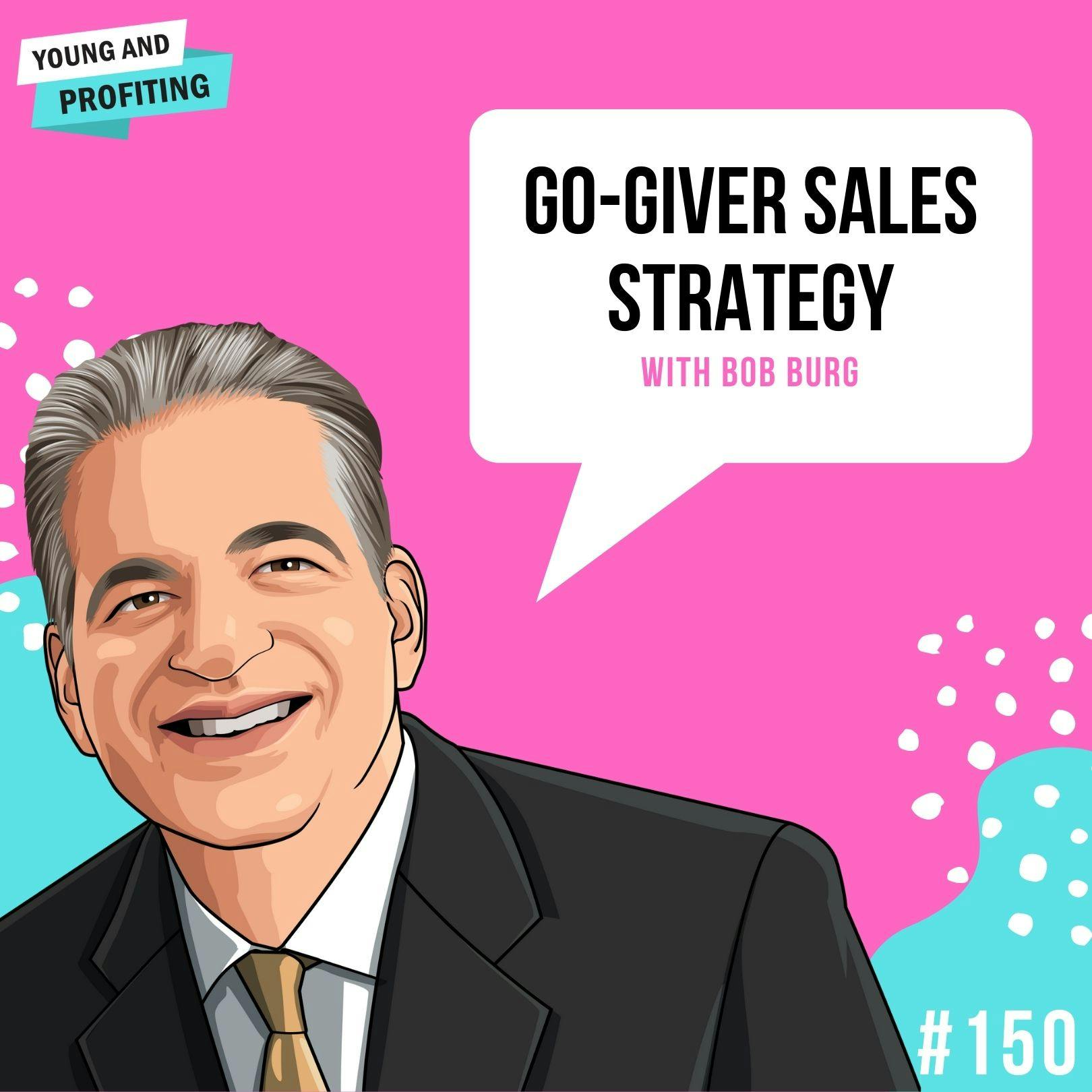
Bob Burg: Go-Giver Sales Strategy | E150
Sell the go-giver way by shifting your focus from getting to giving!
This week on YAP we’re chatting with Bob Burg, best-selling author, motivational speaker, and sales guru.
For over 30 years, Bob has successfully shown entrepreneurs and sales professionals how to communicate their value and accelerate their referral business. For much of his career, Bob was known for his book Endless Referrals, but it’s his newest series The Go-Giver that has grown into a world-wide movement.
The Go-Giver series contains 4 books which have sold more than one million copies, and have been translated into 30 languages. Go-Giver was listed in Inc. Magazine’s top 10 Most Motivational Books Ever Written and was on HubSpot’s 20 Most Highly Rated Sales Books of All Time.
In today’s episode, we’ll learn why Bob believes you’re better off being a ‘go-giver’ instead of being an opportunistic ‘go-taker’ when you’re trying to gain influence. We’ll uncover the difference between influence, persuasion and manipulation, and gain insight as to why the best influencers pull others in as opposed to pushing them. And lastly, Bob will break down his five laws of success, as well as the law of the backdoor and how you can use these key aspects of human nature to your advantage.
If you’ve been wanting to enhance your ability to influence and increase your success in sales, keep on listening!
Sponsored by -
Hirect - Download the number 1 hiring app for startups https://hirectapp.onelink.me/YctD/halataha
Real Vision - Visit realvision.com/yap and join Real Vision for just $1!
Athletic Greens - Visit athleticgreens.com/YAP and get FREE 1 year supply of immune-supporting Vitamin D AND 5 FREE travel packs with your first purchase.
Blinkist - Check out blinkist.com/yap and save 25% on your first year of Blinkist
Social Media:
Follow YAP on IG: www.instagram.com/youngandprofiting
Reach out to Hala directly at Hala@YoungandProfiting.com
Follow Hala on Linkedin: www.linkedin.com/in/htaha/
Follow Hala on Instagram: www.instagram.com/yapwithhala
Follow Hala on Clubhouse: @halataha
Check out our website to meet the team, view show notes and transcripts: www.youngandprofiting.com
Timestamps:
0:00 - Intro
0:46 - Broadcasting Background
3:12 - Importance of Reading
4:24 - What is a Go-Giver?
7:19 - Bob’s Laws to Success
10:54 - Strategies to Get Referrals
14:05 - Law of Influence
17:30 - Difference Between Influence, Persuasion, and Manipulation
19:55 - Law of the Backdoor
22:20 - Law of Authenticity
24:22 - Law of Receptivity
26:00 - Bob’s Secret to Profiting In Life
Mentioned In The Episode:
The Go-Giver
The Art of Talking So That People Will Listen by Paul W. Sweats
Bob’s website burg.com
Available Results
Generated results are saved to your library for reuse and search.
Choose Template
Pick the result you want. You can review provider and model before generating.
A concise first-pass summary for understanding the episode quickly.
A comprehensive, source-grounded extraction of the reusable knowledge in an episode.
A comprehensive extraction focused on opportunities, strategy, markets, and company building.
Explicit actions, next steps, habits, recommendations, and things to avoid.
Repeatable methods, frameworks, mental models, processes, and systems.
A dedicated inventory of concrete resources named in the episode.
A concise first-pass summary for understanding the episode quickly.
A detailed readable summary organized by chapter or topic.
A navigable map of subjects, topic flow, and suggested chapters.
A comprehensive, source-grounded extraction of the reusable knowledge in an episode.
Reusable atomic knowledge units extracted from the episode.
A comprehensive extraction focused on health practices, protocols, claims, and safety caveats.
A comprehensive extraction focused on opportunities, strategy, markets, and company building.
Explicit actions, next steps, habits, recommendations, and things to avoid.
A dedicated inventory of concrete resources named in the episode.
A dedicated analysis of warnings, limitations, trade-offs, weak evidence, and uncertainty.
A concise first-pass summary for understanding the episode quickly.
A detailed readable summary organized by chapter or topic.
A navigable map of subjects, topic flow, and suggested chapters.
A comprehensive, source-grounded extraction of the reusable knowledge in an episode.
Reusable atomic knowledge units extracted from the episode.
A comprehensive extraction focused on health practices, protocols, claims, and safety caveats.
A comprehensive extraction focused on opportunities, strategy, markets, and company building.
Scientific findings, mechanisms, studies, hypotheses, and the limits of the evidence discussed.
Technologies, AI models, technical methods, capabilities, limitations, and adoption implications.
Investment theses, assets, catalysts, valuation reasoning, time horizons, and risks.
Chronologies, actors, causes, consequences, turning points, and competing historical interpretations.
Policies, proposals, stakeholders, arguments, implementation constraints, and predicted effects.
Career paths, skills, hiring signals, workplace decisions, transitions, and limitations of the advice.
Behavioral mechanisms, biases, motivation, habits, emotions, interventions, and evidence limitations.
Economic mechanisms, incentives, indicators, market structure, forecasts, and uncertainty.
Leadership principles, team systems, organizational design, culture, feedback, and failure modes.
Audience, positioning, messaging, acquisition, retention, experiments, metrics, and failed approaches.
Teaching methods, learning strategies, practice, feedback, assessment, and effectiveness evidence.
Theses, premises, arguments, objections, values, thought experiments, and unresolved questions.
Communication patterns, conflict, boundaries, expectations, repair methods, and contextual limitations.
Books, papers, authors, courses, and other learning resources mentioned in the episode.
Repeatable methods, frameworks, mental models, processes, and systems.
Explicit actions, next steps, habits, recommendations, and things to avoid.
Memorable statements and important claims with attribution and source context.
A dedicated inventory of concrete resources named in the episode.
A dedicated analysis of warnings, limitations, trade-offs, weak evidence, and uncertainty.