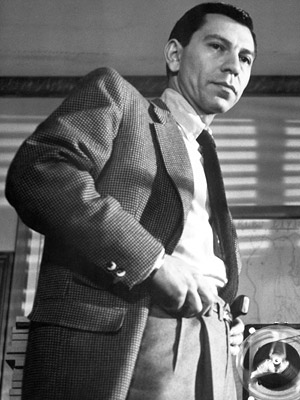
"The story you're about to hear is true..."
On June 3, 1949, Dragnet premiered on NBC and ushered in a new era of crime drama. Created by Jack Webb, the series dramatized actual cases of the Los Angeles Police Department and did so with radio's most realistic depiction of police procedure. Webb, in partnership with LAPD technical advisers, brought radio listeners deep into the world of the police with a matter-of-fact, underplayed style.
Jack Webb himself was the chief innovator of that style as the no-nonsense Sgt. Joe Friday. Friday was a cop's cop, a determined public servant committed to keeping the streets of the city safe. Webb brought Dragnet to the big and small screens in the 1950s, and he resurrected the show for a late 1960s run.With its focus on the mechanics of crime-solving (including forensics, interrogation, and stake-outs) the influence of Dragnet can still be felt in police dramas today.
During the shoot of He Walked By Night (1948), Webb struck up a friendship with the film's Los Angeles Police Department technical adviser, Sgt. Marty Wynn. The two discussed how police officers were depicted in films and on the radio and how far that portrayal strayed from the real day-in, day-out work of a policeman. Webb thought that a realistic representation of policework could be a hit. Convincing a network would prove to be tricky.
NBC wasn't enthusiastic when Webb pitched them the series. Police shows were a dime a dozen on radio, and the network did not see the merits of adding one more to its schedule. Two things helped sell the series. The first was Webb himself, who in 1949 had returned to Pat Novak for Hire for a run over ABC's national network and was making a name for himself. The second was the network's recent loss of big stars like Jack Benny, Red Skelton, and George Burns and Gracie Allen to CBS in a raid of comedic talent. In need of programming, NBC commissioned an audition program. Webb and writer James Moser already had a script prepared, but they needed the cooperation of the Los Angeles Police Department. Without it, Webb couldn't hope to leverage the department's case files and official procedures. Then-Chief of Police Clemence B. Horrall granted permission with two conditions. First, the LAPD would get to okay the program's sponsors. Second, the department would not be portrayed in an unflattering light (as a result, certain practices - including allegations of department racism and corruption - were not addressed on the series).
In the program's first years, Barton Yarborough co-starred as Sgt. Ben Romero, Friday's partner on the force. When Yarborough passed away unexpectedly in 1951, Friday was partnered with a handful of officers before being paired with Frank Smith (voiced by former child actor Ben Alexander). Friday and Smith would remain on the job through the end of the radio series and on into the television run.
Webb said goodbye to Dragnet to focus on his production company and his work as a producer of new shows. In the 1960s, however, he worked with NBC to revive the series for a four season run. At the time, Ben Alexander was unavailable and actor Harry Morgan (Col. Potter on M*A*S*H*) played Friday's new partner Bill Gannon. Another revival was planned for the early 1980s but was scrapped when Webb passed away. The man who had done so much to change the perception of police officers was honored by them; Joe Friday's badge number was retired and the LAPD flew its flags at half staff after Webb's passing. Since then, Dragnet has endured in reruns, remakes, and the style that Jack Webb took a gamble on nearly 70 years ago.
Available Results
Generated results are saved to your library for reuse and search.
Choose Template
Pick the result you want. You can review provider and model before generating.
A concise first-pass summary for understanding the episode quickly.
A comprehensive, source-grounded extraction of the reusable knowledge in an episode.
A comprehensive extraction focused on opportunities, strategy, markets, and company building.
Explicit actions, next steps, habits, recommendations, and things to avoid.
Repeatable methods, frameworks, mental models, processes, and systems.
A dedicated inventory of concrete resources named in the episode.
A concise first-pass summary for understanding the episode quickly.
A detailed readable summary organized by chapter or topic.
A navigable map of subjects, topic flow, and suggested chapters.
A comprehensive, source-grounded extraction of the reusable knowledge in an episode.
Reusable atomic knowledge units extracted from the episode.
A comprehensive extraction focused on health practices, protocols, claims, and safety caveats.
A comprehensive extraction focused on opportunities, strategy, markets, and company building.
Explicit actions, next steps, habits, recommendations, and things to avoid.
A dedicated inventory of concrete resources named in the episode.
A dedicated analysis of warnings, limitations, trade-offs, weak evidence, and uncertainty.
A concise first-pass summary for understanding the episode quickly.
A detailed readable summary organized by chapter or topic.
A navigable map of subjects, topic flow, and suggested chapters.
A comprehensive, source-grounded extraction of the reusable knowledge in an episode.
Reusable atomic knowledge units extracted from the episode.
A comprehensive extraction focused on health practices, protocols, claims, and safety caveats.
A comprehensive extraction focused on opportunities, strategy, markets, and company building.
Scientific findings, mechanisms, studies, hypotheses, and the limits of the evidence discussed.
Technologies, AI models, technical methods, capabilities, limitations, and adoption implications.
Investment theses, assets, catalysts, valuation reasoning, time horizons, and risks.
Chronologies, actors, causes, consequences, turning points, and competing historical interpretations.
Policies, proposals, stakeholders, arguments, implementation constraints, and predicted effects.
Career paths, skills, hiring signals, workplace decisions, transitions, and limitations of the advice.
Behavioral mechanisms, biases, motivation, habits, emotions, interventions, and evidence limitations.
Economic mechanisms, incentives, indicators, market structure, forecasts, and uncertainty.
Leadership principles, team systems, organizational design, culture, feedback, and failure modes.
Audience, positioning, messaging, acquisition, retention, experiments, metrics, and failed approaches.
Teaching methods, learning strategies, practice, feedback, assessment, and effectiveness evidence.
Theses, premises, arguments, objections, values, thought experiments, and unresolved questions.
Communication patterns, conflict, boundaries, expectations, repair methods, and contextual limitations.
Books, papers, authors, courses, and other learning resources mentioned in the episode.
Repeatable methods, frameworks, mental models, processes, and systems.
Explicit actions, next steps, habits, recommendations, and things to avoid.
Memorable statements and important claims with attribution and source context.
A dedicated inventory of concrete resources named in the episode.
A dedicated analysis of warnings, limitations, trade-offs, weak evidence, and uncertainty.