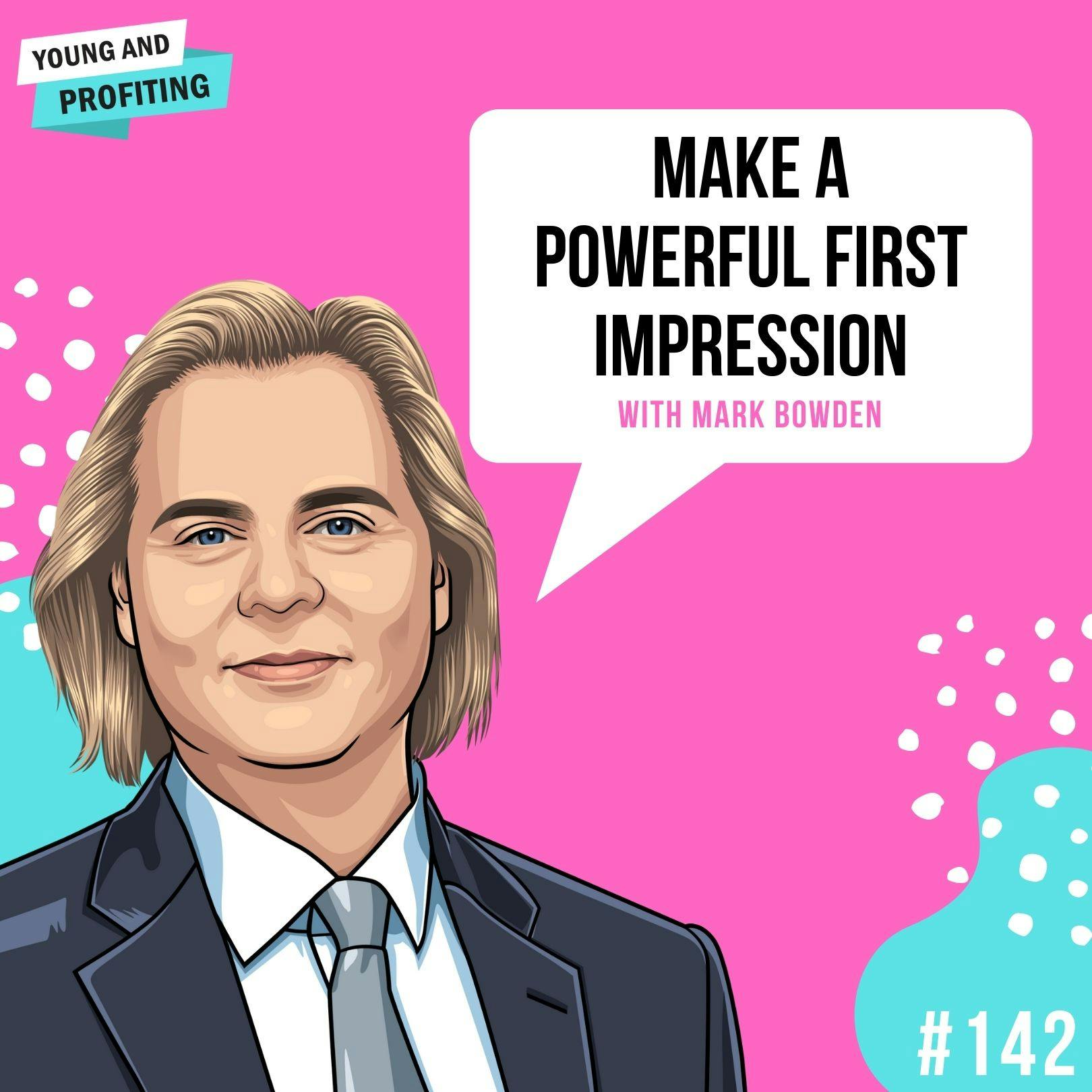
Mark Bowden: Make a Powerful First Impression | E142
Want to learn how to influence people and learn their values just by their language?
In this episode, we talk with Mark Bowden! Mark is a best-selling author, Founder, and Human Behavior/Body Language expert! He is credited with pioneering nonverbal analysis of human behavior where it pertains to influence and/or persuasion. His techniques have been used by G7 leaders, including Canadian Prime Minister and Stephen Harper. He is the Founder and President of TRUTHPLANE, a communication training company that offers a unique methodology for anyone who has to communicate with impact to an audience. His bestselling books on body language and human behavior are: Winning Body Language; Winning Body Language for Sales Professionals; Tame the Primitive Brain; and Truth & Lies, What People are Really Thinking. Mark is a regular instructor for Canada’s #1-ranked EMBA program at Kellogg-Schulich School of Business, and he is President of the National Communication Coach Association of Canada.
Mark uses his unique system of cutting-edge and effective nonverbal communication techniques to instantly help audiences become more confident, collaborative, and credible in their communication. His highly acclaimed TEDx talk, “The Importance of Being In-Authentic”, and YouTube Channel have reached millions of people, and he has presented to many of the most prestigious organizations in the world, including Microsoft, Toyota, VW, Samsung, Johnson & Johnson, KPMG, GSK, Walmart and Nestle.
In today’s episode, we cover Mark’s childhood, how he learned to live with his dyslexia, and how it brought him to his passion for human behavior. We’ll also learn the difference between influence and persuasion, how to learn other people’s values from small talk, and making a powerful first impression. If you want to learn how to read behaviors from others fast, keep listening!
Sponsored by -
Kraken - Visit kraken.com/yap now to learn more or search for "Kraken" in the app store
Eight Sleep - Go to eightsleep.com/yap to check out the Pod Pro Cover and save $250 at checkout
Jordan Harbinger - Check out jordanharbinger.com/start for some episode recommendations
Social Media:
Follow YAP on IG: www.instagram.com/youngandprofiting
Reach out to Hala directly at Hala@YoungandProfiting.com
Follow Hala on Linkedin: www.linkedin.com/in/htaha/
Follow Hala on Instagram: www.instagram.com/yapwithhala
Follow Hala on Clubhouse: @halataha
Check out our website to meet the team, view show notes and transcripts: www.youngandprofiting.com
Timestamps:
00:52- Mark’s Childhood and Living with Dyslexia
9:22- The Animal and Reptile Brain
12:37- How Influence and Persuasion Are Different
16:27- Understanding Other People’s Values
28:30- How to Influence People Using Their Values
30:21- Difference Between Traits, States, and Moods
39:39- Making a Powerful First Impression
46:52- How to Take Up Space
50:45- Mark’s Best Advice for Dating Phases
1:01:57- The Need to Be Inauthentic
1:08:36- What Makes a Great Story
1:12:45- Mark’s Secret to Profiting in Life
Mentioned in the episode:
Mark’s Website: https://truthplane.com/
Available Results
Generated results are saved to your library for reuse and search.
Choose Template
Pick the result you want. You can review provider and model before generating.
A concise first-pass summary for understanding the episode quickly.
A comprehensive, source-grounded extraction of the reusable knowledge in an episode.
A comprehensive extraction focused on health practices, protocols, claims, and safety caveats.
A dedicated analysis of warnings, limitations, trade-offs, weak evidence, and uncertainty.
Repeatable methods, frameworks, mental models, processes, and systems.
A comprehensive extraction focused on opportunities, strategy, markets, and company building.
A concise first-pass summary for understanding the episode quickly.
A detailed readable summary organized by chapter or topic.
A navigable map of subjects, topic flow, and suggested chapters.
A comprehensive, source-grounded extraction of the reusable knowledge in an episode.
Reusable atomic knowledge units extracted from the episode.
A comprehensive extraction focused on health practices, protocols, claims, and safety caveats.
A comprehensive extraction focused on opportunities, strategy, markets, and company building.
Explicit actions, next steps, habits, recommendations, and things to avoid.
A dedicated inventory of concrete resources named in the episode.
A dedicated analysis of warnings, limitations, trade-offs, weak evidence, and uncertainty.
A concise first-pass summary for understanding the episode quickly.
A detailed readable summary organized by chapter or topic.
A navigable map of subjects, topic flow, and suggested chapters.
A comprehensive, source-grounded extraction of the reusable knowledge in an episode.
Reusable atomic knowledge units extracted from the episode.
A comprehensive extraction focused on health practices, protocols, claims, and safety caveats.
A comprehensive extraction focused on opportunities, strategy, markets, and company building.
Scientific findings, mechanisms, studies, hypotheses, and the limits of the evidence discussed.
Technologies, AI models, technical methods, capabilities, limitations, and adoption implications.
Investment theses, assets, catalysts, valuation reasoning, time horizons, and risks.
Chronologies, actors, causes, consequences, turning points, and competing historical interpretations.
Policies, proposals, stakeholders, arguments, implementation constraints, and predicted effects.
Career paths, skills, hiring signals, workplace decisions, transitions, and limitations of the advice.
Behavioral mechanisms, biases, motivation, habits, emotions, interventions, and evidence limitations.
Economic mechanisms, incentives, indicators, market structure, forecasts, and uncertainty.
Leadership principles, team systems, organizational design, culture, feedback, and failure modes.
Audience, positioning, messaging, acquisition, retention, experiments, metrics, and failed approaches.
Teaching methods, learning strategies, practice, feedback, assessment, and effectiveness evidence.
Theses, premises, arguments, objections, values, thought experiments, and unresolved questions.
Communication patterns, conflict, boundaries, expectations, repair methods, and contextual limitations.
Books, papers, authors, courses, and other learning resources mentioned in the episode.
Repeatable methods, frameworks, mental models, processes, and systems.
Explicit actions, next steps, habits, recommendations, and things to avoid.
Memorable statements and important claims with attribution and source context.
A dedicated inventory of concrete resources named in the episode.
A dedicated analysis of warnings, limitations, trade-offs, weak evidence, and uncertainty.