How To Use Low Level Light Therapy and Intranasal Light Therapy For Athletic Performance, Cognitive Enhancement & More.
Several weeks ago, in the article, The Ultimate Guide To Using Light To Biohack Your Circadian Rhythms, Sleep Better & Beat Jet Lag Forever, I told you about an in-ear light phototherapy device called "The Human Charger", which I've been experimenting with for everything from jet lag to a burst of pre-workout wakefulness.
Then, in the article, Pink Makes You Docile, Orange Makes You Buy Stuff, Red Makes You Mad: How To Use Color Light Therapy For Mood, Cognition, Healing & More, I taught you how to use something called chromotherapy to change your mood, deal with insomnia, or even treat a variety of health issues.
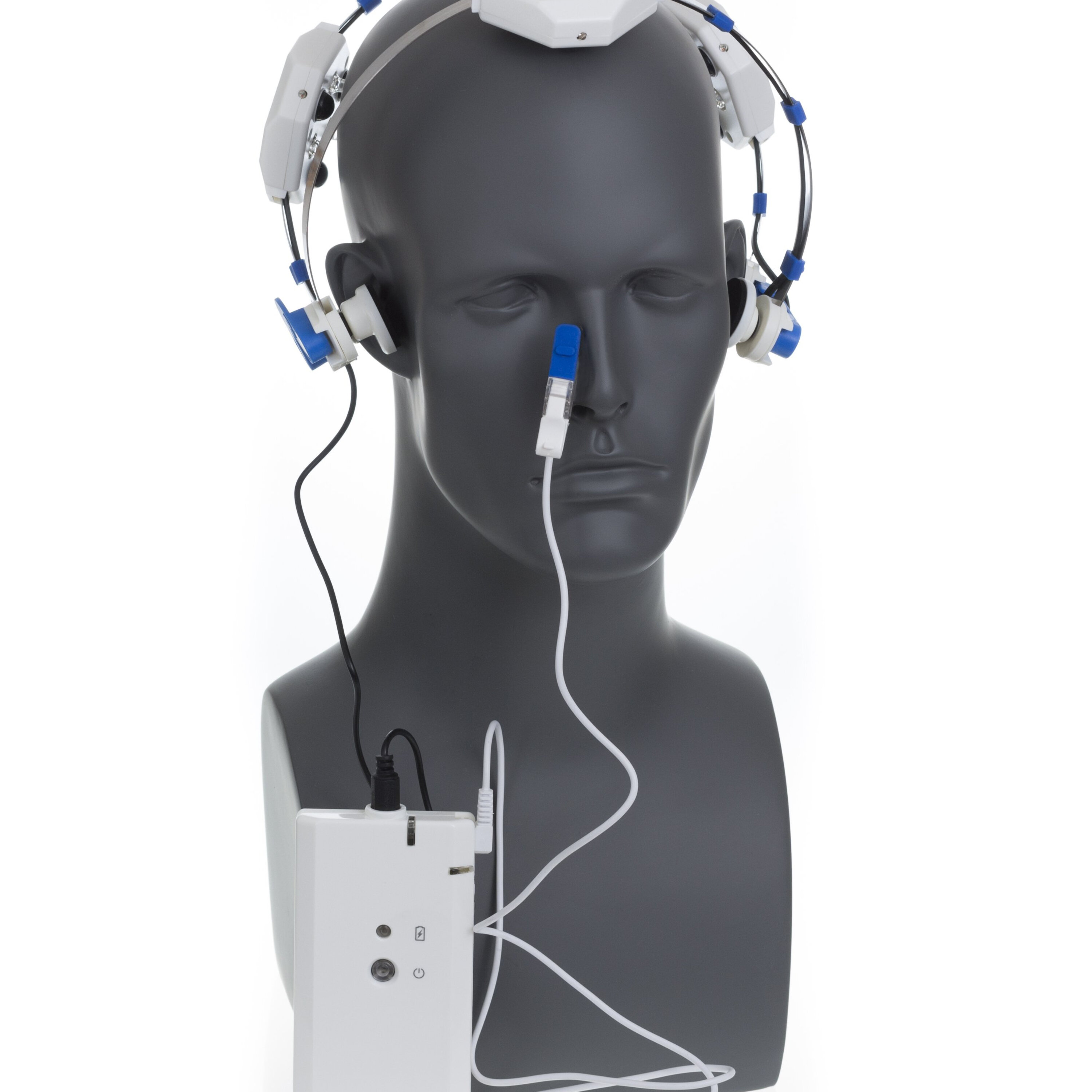
Finally, several days ago (probably because it appears I've lately been obsessed with light biohacks) one of my friends mentioned the word "photomedicine" to me. This word photomedicine was a new term in my vernacular, but when I looked into it, I found that intranasal light therapy, which is literally light stimulation of blood capillaries in the nasal cavity, has been used for the past couple decades as a very non-invasive method to introduce therapeutic light energy into the human body, and there's actually a surprising amount of research on this form of nonionizing radiation on biological systems, including effects on cognitive performance, fighting free radicals, combatting Alzheimer's symptoms and more. So for today's podcast, I hunted down an expert in photomedicine, also known as photobiomodulation (PBM), or low level light therapy. His name is Dr. Lew Lim, and Dr. Lim is the co-inventor of a wearable, intranasal light therapy device designed for home-use called the "Vielight". Dr. Lim is a Doctor of Naturopathy, has a Graduate Engineering Diploma, a MBA, and is a Chartered Accountant. He is also certified in Medical Neuroscience, Neurobiology and Human Physiology. He has obtained qualifications from University of California at Berkeley, Duke University, University of Chicago and University of Sheffield, UK and collaborates with Harvard Medical School and Boston University in research relating to the field of photobiomodulation. During our discussion, you'll discover:
-Why any athlete should pay close attention to the emerging field of photomedicine, particularly low level light therapy...
-Why the FDA has approved infrared therapy for everything from eliminating microbes and fungus in the human body to killing cancer cells...
-What happens to your cells (and specifically to your nitric oxide production) when your cells get exposed to low level light therapy...
-How to use intranasal light therapy as a way to "charge up your brain" prior to mentally demanding tasks...
-A biohack that combines red light therapy and infrared light therapy... -Exactly when, how and how long to use low level light therapy and intranasal light therapy for everything from brain stimulation to sleep...
-And much more!
Resources from this episode:
-The HumanCharger (10% discount code is “BENG10HC”)
-Vielight (10% discount code is "GREENFIELD")
-Lew's free, upcoming "World Summit of Integrative Medicine"
-Applications of Intranasal Low Intensity Laser Therapy in Sports Medicine
Do you have questions, comments or feedback about Vielight, intranasal light therapy or anything else we discuss on this episode? Leave your thoughts at BenGreenfieldFitness.com.
See omnystudio.com/listener for privacy information.
Available Results
Generated results are saved to your library for reuse and search.
Choose Template
Pick the result you want. You can review provider and model before generating.
A concise first-pass summary for understanding the episode quickly.
A comprehensive, source-grounded extraction of the reusable knowledge in an episode.
A comprehensive extraction focused on health practices, protocols, claims, and safety caveats.
A dedicated analysis of warnings, limitations, trade-offs, weak evidence, and uncertainty.
Repeatable methods, frameworks, mental models, processes, and systems.
Scientific findings, mechanisms, studies, hypotheses, and the limits of the evidence discussed.
A concise first-pass summary for understanding the episode quickly.
A detailed readable summary organized by chapter or topic.
A navigable map of subjects, topic flow, and suggested chapters.
A comprehensive, source-grounded extraction of the reusable knowledge in an episode.
Reusable atomic knowledge units extracted from the episode.
A comprehensive extraction focused on health practices, protocols, claims, and safety caveats.
A comprehensive extraction focused on opportunities, strategy, markets, and company building.
Explicit actions, next steps, habits, recommendations, and things to avoid.
A dedicated inventory of concrete resources named in the episode.
A dedicated analysis of warnings, limitations, trade-offs, weak evidence, and uncertainty.
A concise first-pass summary for understanding the episode quickly.
A detailed readable summary organized by chapter or topic.
A navigable map of subjects, topic flow, and suggested chapters.
A comprehensive, source-grounded extraction of the reusable knowledge in an episode.
Reusable atomic knowledge units extracted from the episode.
A comprehensive extraction focused on health practices, protocols, claims, and safety caveats.
A comprehensive extraction focused on opportunities, strategy, markets, and company building.
Scientific findings, mechanisms, studies, hypotheses, and the limits of the evidence discussed.
Technologies, AI models, technical methods, capabilities, limitations, and adoption implications.
Investment theses, assets, catalysts, valuation reasoning, time horizons, and risks.
Chronologies, actors, causes, consequences, turning points, and competing historical interpretations.
Policies, proposals, stakeholders, arguments, implementation constraints, and predicted effects.
Career paths, skills, hiring signals, workplace decisions, transitions, and limitations of the advice.
Behavioral mechanisms, biases, motivation, habits, emotions, interventions, and evidence limitations.
Economic mechanisms, incentives, indicators, market structure, forecasts, and uncertainty.
Leadership principles, team systems, organizational design, culture, feedback, and failure modes.
Audience, positioning, messaging, acquisition, retention, experiments, metrics, and failed approaches.
Teaching methods, learning strategies, practice, feedback, assessment, and effectiveness evidence.
Theses, premises, arguments, objections, values, thought experiments, and unresolved questions.
Communication patterns, conflict, boundaries, expectations, repair methods, and contextual limitations.
Books, papers, authors, courses, and other learning resources mentioned in the episode.
Repeatable methods, frameworks, mental models, processes, and systems.
Explicit actions, next steps, habits, recommendations, and things to avoid.
Memorable statements and important claims with attribution and source context.
A dedicated inventory of concrete resources named in the episode.
A dedicated analysis of warnings, limitations, trade-offs, weak evidence, and uncertainty.