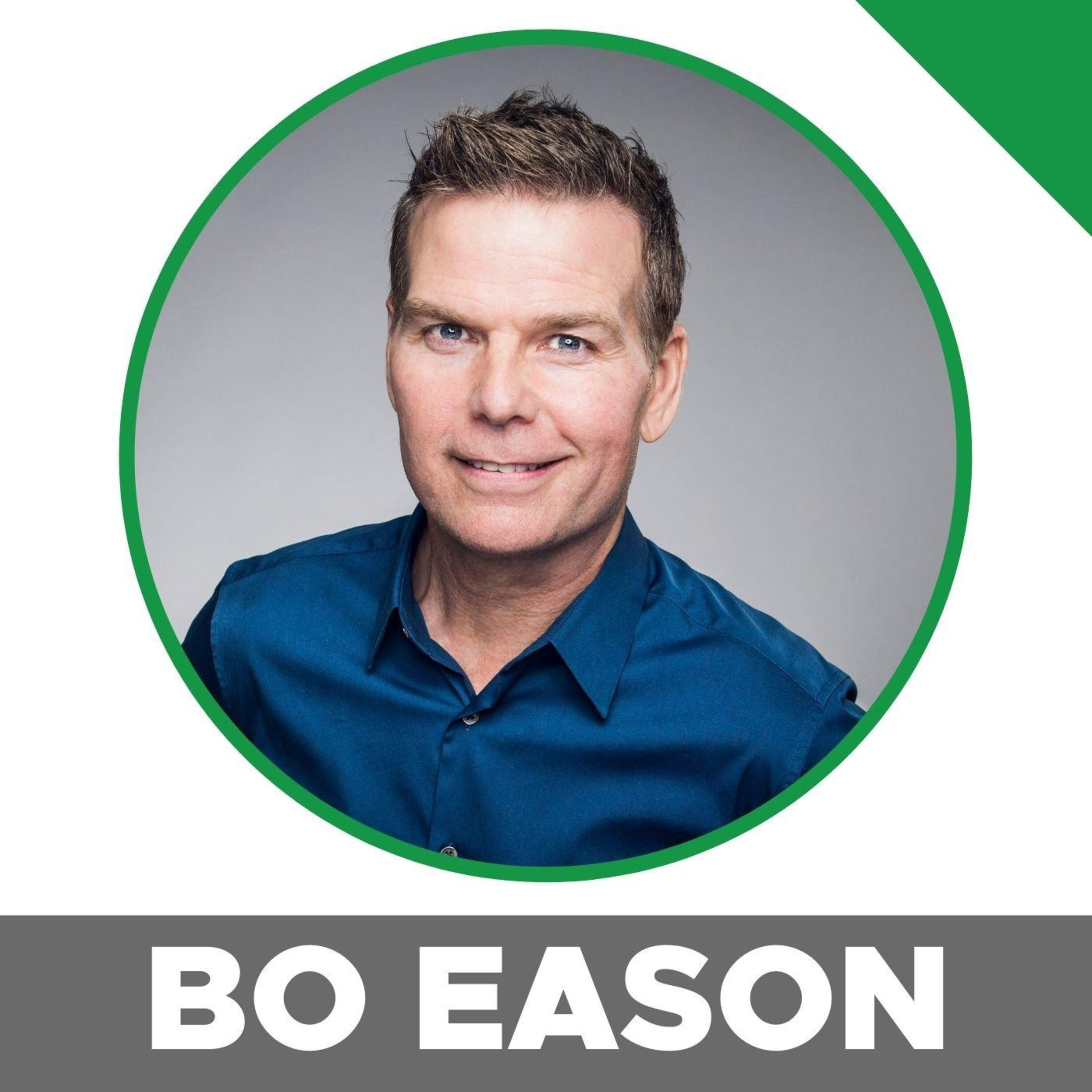
How A 9 Year Old Created A 20 Year Plan To Play In The NFL, How To Move So People Can't Take Their Eyes Off You, Parenting Tips For Raising Impactful Children & More With Bo Eason.
BenGreenfieldFitness.com/boeason
Speaker, performer, author and my guest on today's show, Bo Eason, started his career in the NFL, as a top pick for the Houston Oilers and continuing on with the San Francisco 49ers. During his 5-year career, Bo competed beside and against some of the greatest players of his generation.
In 2001, Bo wrote and performed his one-man play, Runt of the Litter, which opened in New York to rave reviews. The New York Times called it “One of the most powerful plays in the last decade.” Bo toured with the play in over 50 cities and it is now being adapted as a major motion picture. In his quest for excellence on the stage, Bo trained with some of the world’s most brilliant performance and movement coaches, Larry Moss and Jean-Louis Rodrigue.
Bo now draws from their techniques and wisdom to coach others to be excellent presenters and storytellers. Bo is dedicated to helping others tap the power of their personal story and become effective, persuasive communicators. He delivered his keynotes and workshops to groups such as Protective Life Insurance, Dimensional Fund Advisors, Morgan Stanley, and Young Presidents Association.
Bo has also appeared as a guest on shows like Bill Maher, Fox Sports Net, ESPN, The Rosie O’Donnell Show and CNN. Bo got the opportunity to share his life experiences and inspirational lessons with the world! Bo wrote There’s No Plan B For Your A-Game because he truly believes that anyone has the ability to be great.
His book uses inspiring, practical, and real-world guidance, coupled with absolute accountability to teach anyone how to be the best in the world at what they do: the best leader, the best business owner, the best athlete, the best artist, the best partner, the best parent. Recently, I spoke at one of Bo's events, and also had a chance to drop by his house for an intriguing and inspiring podcast.
During our discussion, you'll discover: -How Bo's "Best"program stemmed from his upbringing...06:00 -How Bo improved his speed ...16:30 -How Bo's unique movements influence his stage presence...19:40 -The one key element in making Bo's play so successful...25:30 -Why the FBI and CIA needed Jean-Louis's training...32:10 -Why the way we walk into a room matters...40:55 -How Bo uses storytelling, voice timbre, tone and inflection to capture audiences...44:40 -The bridge between the hero's journey and great stories...51:00 -What Bo does to influence his children to go after their dreams...55:30 -And much more... Resources from this episode: Episode sponsors: Do you have questions, thoughts or feedback for Bo Eason or me? Leave your comments at https://bengreenfieldfitness.com/boeason and one of us will reply!See omnystudio.com/listener for privacy information.
Available Results
Generated results are saved to your library for reuse and search.
Choose Template
Pick the result you want. You can review provider and model before generating.
A concise first-pass summary for understanding the episode quickly.
A comprehensive, source-grounded extraction of the reusable knowledge in an episode.
A comprehensive extraction focused on health practices, protocols, claims, and safety caveats.
A dedicated analysis of warnings, limitations, trade-offs, weak evidence, and uncertainty.
Repeatable methods, frameworks, mental models, processes, and systems.
A comprehensive extraction focused on opportunities, strategy, markets, and company building.
A concise first-pass summary for understanding the episode quickly.
A detailed readable summary organized by chapter or topic.
A navigable map of subjects, topic flow, and suggested chapters.
A comprehensive, source-grounded extraction of the reusable knowledge in an episode.
Reusable atomic knowledge units extracted from the episode.
A comprehensive extraction focused on health practices, protocols, claims, and safety caveats.
A comprehensive extraction focused on opportunities, strategy, markets, and company building.
Explicit actions, next steps, habits, recommendations, and things to avoid.
A dedicated inventory of concrete resources named in the episode.
A dedicated analysis of warnings, limitations, trade-offs, weak evidence, and uncertainty.
A concise first-pass summary for understanding the episode quickly.
A detailed readable summary organized by chapter or topic.
A navigable map of subjects, topic flow, and suggested chapters.
A comprehensive, source-grounded extraction of the reusable knowledge in an episode.
Reusable atomic knowledge units extracted from the episode.
A comprehensive extraction focused on health practices, protocols, claims, and safety caveats.
A comprehensive extraction focused on opportunities, strategy, markets, and company building.
Scientific findings, mechanisms, studies, hypotheses, and the limits of the evidence discussed.
Technologies, AI models, technical methods, capabilities, limitations, and adoption implications.
Investment theses, assets, catalysts, valuation reasoning, time horizons, and risks.
Chronologies, actors, causes, consequences, turning points, and competing historical interpretations.
Policies, proposals, stakeholders, arguments, implementation constraints, and predicted effects.
Career paths, skills, hiring signals, workplace decisions, transitions, and limitations of the advice.
Behavioral mechanisms, biases, motivation, habits, emotions, interventions, and evidence limitations.
Economic mechanisms, incentives, indicators, market structure, forecasts, and uncertainty.
Leadership principles, team systems, organizational design, culture, feedback, and failure modes.
Audience, positioning, messaging, acquisition, retention, experiments, metrics, and failed approaches.
Teaching methods, learning strategies, practice, feedback, assessment, and effectiveness evidence.
Theses, premises, arguments, objections, values, thought experiments, and unresolved questions.
Communication patterns, conflict, boundaries, expectations, repair methods, and contextual limitations.
Books, papers, authors, courses, and other learning resources mentioned in the episode.
Repeatable methods, frameworks, mental models, processes, and systems.
Explicit actions, next steps, habits, recommendations, and things to avoid.
Memorable statements and important claims with attribution and source context.
A dedicated inventory of concrete resources named in the episode.
A dedicated analysis of warnings, limitations, trade-offs, weak evidence, and uncertainty.