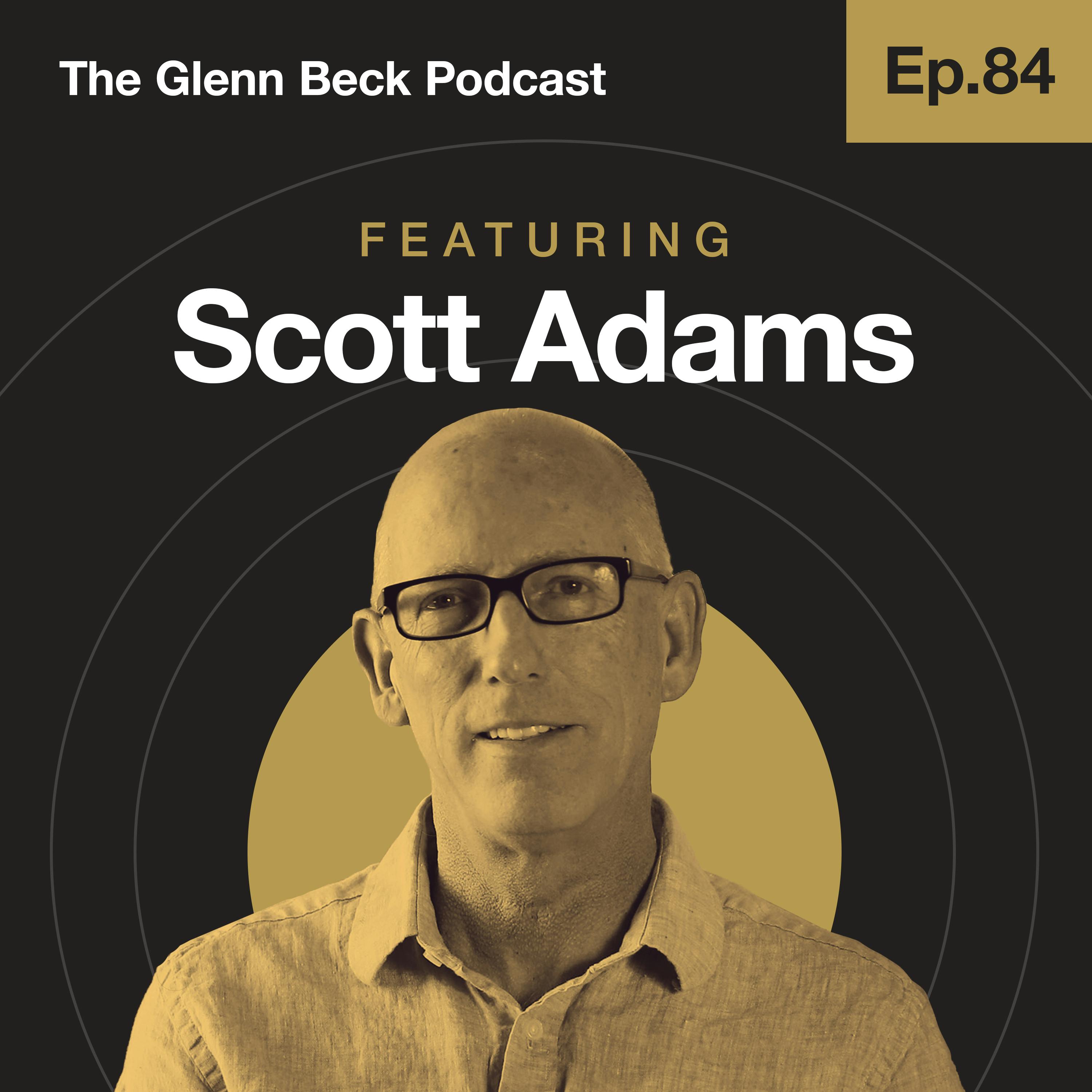
Ep 84 | You Don't Become Hitler at 70 | Scott Adams | The Glenn Beck Podcast
If you’ve ever worked in an office setting, no matter what your role, you can relate to Glenn's guest. In fact, he has probably made you laugh more than once at the absurdity of the personalities and situations you encounter at work. Until late 2015, he was best known as a wildly successful cartoonist and bestselling author. But a certain larger-than-life presidential candidate changed that. While the media drove itself and the rest of America insane trying to figure out the how and why of Donald Trump, he had an articulate explanation that to him seemed very obvious: Trump is a master of persuasion. Still, he does not call himself a conservative, nor a Democrat. He is one of the leading voices of what is becoming an endangered American species: people who dare to think for themselves. He is still a cartoonist and bestselling author, but has now added blogger, podcaster, and political commentator to his day job. He is creator of the worldwide comic strip phenomenon "Dilbert" – Scott Adams.
This Week’s Sponsors:
AR500 Armor makes buying ballistic body armor easy, approachable, and affordable. They’ve built out a special package that’s 30% off for my listeners that’s perfect for anyone trying to ensure they have just the right amount of protection for dangerous situations, while maintaining affordability. Go to https://AR500ARMOR.com/BECK to see this package and use code “BECK” for 20% off anything else in their entire store.
Ashford University’s online bachelor’s and master’s degree programs allow you to learn on a convenient and flexible schedule. Go from dreaming to doing. Your bigger future starts today at Ashford University. There’s NO FEE to apply or standardized testing required to enroll. Go to http://ashford.edu/BECK
Learn more about your ad choices. Visit megaphone.fm/adchoices
Available Results
Generated results are saved to your library for reuse and search.
Choose Template
Pick the result you want. You can review provider and model before generating.
A concise first-pass summary for understanding the episode quickly.
A comprehensive, source-grounded extraction of the reusable knowledge in an episode.
Technologies, AI models, technical methods, capabilities, limitations, and adoption implications.
Repeatable methods, frameworks, mental models, processes, and systems.
A dedicated analysis of warnings, limitations, trade-offs, weak evidence, and uncertainty.
A dedicated inventory of concrete resources named in the episode.
A concise first-pass summary for understanding the episode quickly.
A detailed readable summary organized by chapter or topic.
A navigable map of subjects, topic flow, and suggested chapters.
A comprehensive, source-grounded extraction of the reusable knowledge in an episode.
Reusable atomic knowledge units extracted from the episode.
A comprehensive extraction focused on health practices, protocols, claims, and safety caveats.
A comprehensive extraction focused on opportunities, strategy, markets, and company building.
Explicit actions, next steps, habits, recommendations, and things to avoid.
A dedicated inventory of concrete resources named in the episode.
A dedicated analysis of warnings, limitations, trade-offs, weak evidence, and uncertainty.
A concise first-pass summary for understanding the episode quickly.
A detailed readable summary organized by chapter or topic.
A navigable map of subjects, topic flow, and suggested chapters.
A comprehensive, source-grounded extraction of the reusable knowledge in an episode.
Reusable atomic knowledge units extracted from the episode.
A comprehensive extraction focused on health practices, protocols, claims, and safety caveats.
A comprehensive extraction focused on opportunities, strategy, markets, and company building.
Scientific findings, mechanisms, studies, hypotheses, and the limits of the evidence discussed.
Technologies, AI models, technical methods, capabilities, limitations, and adoption implications.
Investment theses, assets, catalysts, valuation reasoning, time horizons, and risks.
Chronologies, actors, causes, consequences, turning points, and competing historical interpretations.
Policies, proposals, stakeholders, arguments, implementation constraints, and predicted effects.
Career paths, skills, hiring signals, workplace decisions, transitions, and limitations of the advice.
Behavioral mechanisms, biases, motivation, habits, emotions, interventions, and evidence limitations.
Economic mechanisms, incentives, indicators, market structure, forecasts, and uncertainty.
Leadership principles, team systems, organizational design, culture, feedback, and failure modes.
Audience, positioning, messaging, acquisition, retention, experiments, metrics, and failed approaches.
Teaching methods, learning strategies, practice, feedback, assessment, and effectiveness evidence.
Theses, premises, arguments, objections, values, thought experiments, and unresolved questions.
Communication patterns, conflict, boundaries, expectations, repair methods, and contextual limitations.
Books, papers, authors, courses, and other learning resources mentioned in the episode.
Repeatable methods, frameworks, mental models, processes, and systems.
Explicit actions, next steps, habits, recommendations, and things to avoid.
Memorable statements and important claims with attribution and source context.
A dedicated inventory of concrete resources named in the episode.
A dedicated analysis of warnings, limitations, trade-offs, weak evidence, and uncertainty.