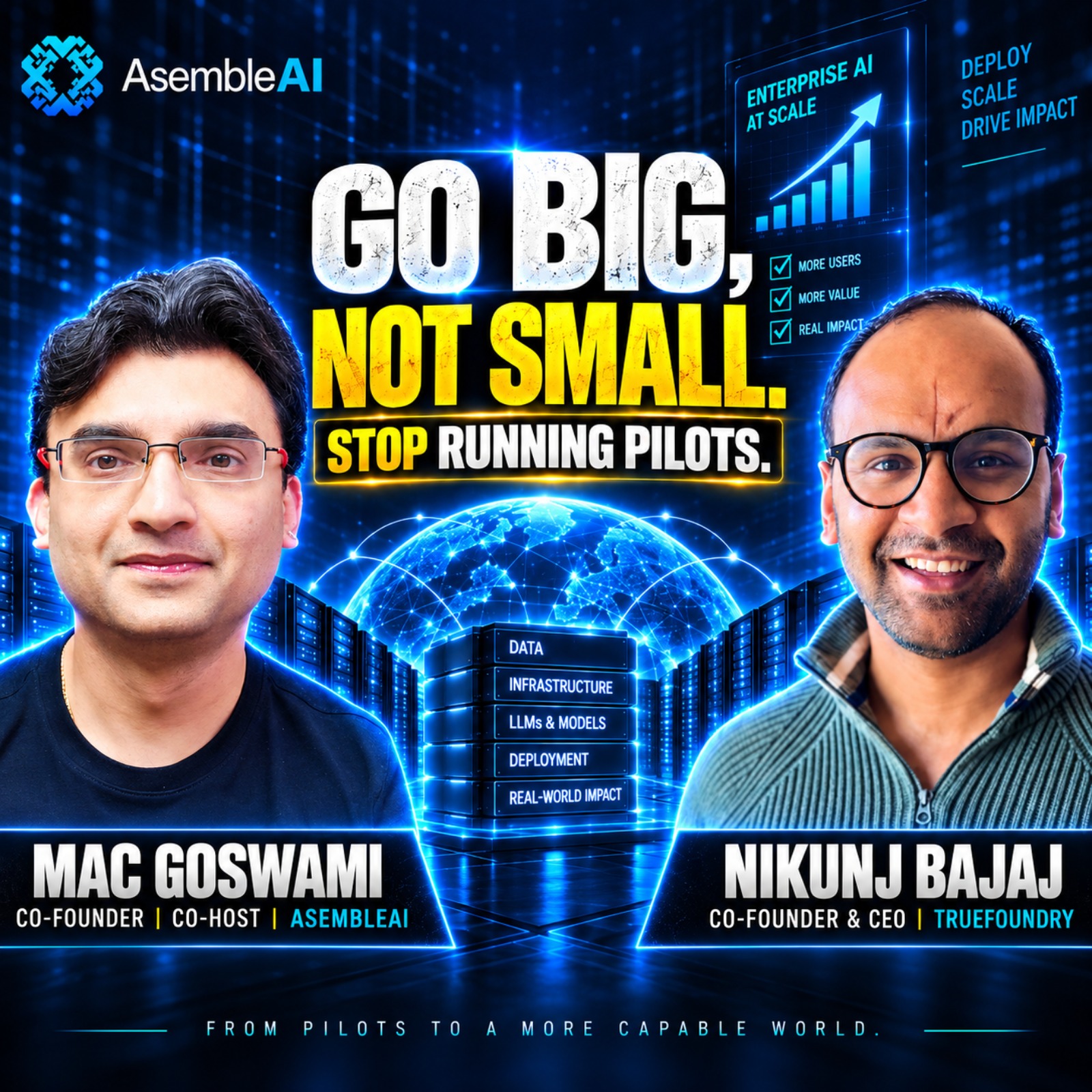
EP 69: "You Don't Build a Power Plant to Charge Phones" — Why Enterprise AI Should Start Big | Nikunj Bajaj, TrueFoundry
This episode was recorded live from the Ai4 conference podcast pavilion, where host Mac Goswami sat down with Nikunj Bajaj — co-founder & CEO of TrueFoundry and former AI team lead at Meta — about his contrarian message for enterprises: stop starting small with AI, and go big.
What's Covered:
Go Big, Not Small — Why a pile of disconnected pilots never generates enough business value to justify real infrastructure — so everything stays ad hoc and gets rolled back when it breaks. Nikunj's case for building one high-value anchor use case first.
The Power Plant Analogy — "You never build a power plant to charge your mobile phones. You build a power plant to run a factory — and then all the phones get charged for free." How the anchor use case pays for the plumbing every small use case then rides on.
Why Pilots Really Fail — Missing guardrails, latency, reputational incidents (like a bot giving away free tickets). Why it's usually a platform problem, not an individual's.
Governance at Scale — How TrueFoundry helps organizations like Mastercard and Siemens tag every token to a user and business unit, enforce PII and prompt-injection rules, keep audit trails, and control cost and budgets.
Ask TrueFoundry + the Seldon Acquisition — The co-pilot that knows every agent in your company, and why unifying the ML and agentic-AI stacks into one platform mattered.
"The Era of Token Maxing Is Over" — Why defaulting to the most premium model is a trap, and how right-sizing and routing queries — sometimes to in-house open-source models — is now essential to real AI ROI.
Key Quote: "The era of token maxing is over. It's not about just using tokens for using's sake — you want to generate ROI."
Connect with Nikunj: LinkedIn: https://www.linkedin.com/in/nikunj-bajaj-10476824/
TrueFoundry: https://www.truefoundry.com/
Follow and subscribe to AsembleAI: Spotify | Apple Podcasts | Amazon Music | iHeart Radio | YouTube | Substack
More description
This episode was recorded live from the Ai4 conference podcast pavilion, where host Mac Goswami sat down with Nikunj Bajaj — co-founder & CEO of TrueFoundry and former AI team lead at Meta — about his contrarian message for enterprises: stop starting small with AI, and go big.
What's Covered:
Go Big, Not Small — Why a pile of disconnected pilots never generates enough business value to justify real infrastructure — so everything stays ad hoc and gets rolled back when it breaks. Nikunj's case for building one high-value anchor use case first.
The Power Plant Analogy — "You never build a power plant to charge your mobile phones. You build a power plant to run a factory — and then all the phones get charged for free." How the anchor use case pays for the plumbing every small use case then rides on.
Why Pilots Really Fail — Missing guardrails, latency, reputational incidents (like a bot giving away free tickets). Why it's usually a platform problem, not an individual's.
Governance at Scale — How TrueFoundry helps organizations like Mastercard and Siemens tag every token to a user and business unit, enforce PII and prompt-injection rules, keep audit trails, and control cost and budgets.
Ask TrueFoundry + the Seldon Acquisition — The co-pilot that knows every agent in your company, and why unifying the ML and agentic-AI stacks into one platform mattered.
"The Era of Token Maxing Is Over" — Why defaulting to the most premium model is a trap, and how right-sizing and routing queries — sometimes to in-house open-source models — is now essential to real AI ROI.
Key Quote: "The era of token maxing is over. It's not about just using tokens for using's sake — you want to generate ROI."
Connect with Nikunj: LinkedIn: https://www.linkedin.com/in/nikunj-bajaj-10476824/
TrueFoundry: https://www.truefoundry.com/
Follow and subscribe to AsembleAI: Spotify | Apple Podcasts | Amazon Music | iHeart Radio | YouTube | Substack
Listen elsewhere
Available Results
Generated results are saved to your library for reuse and search.