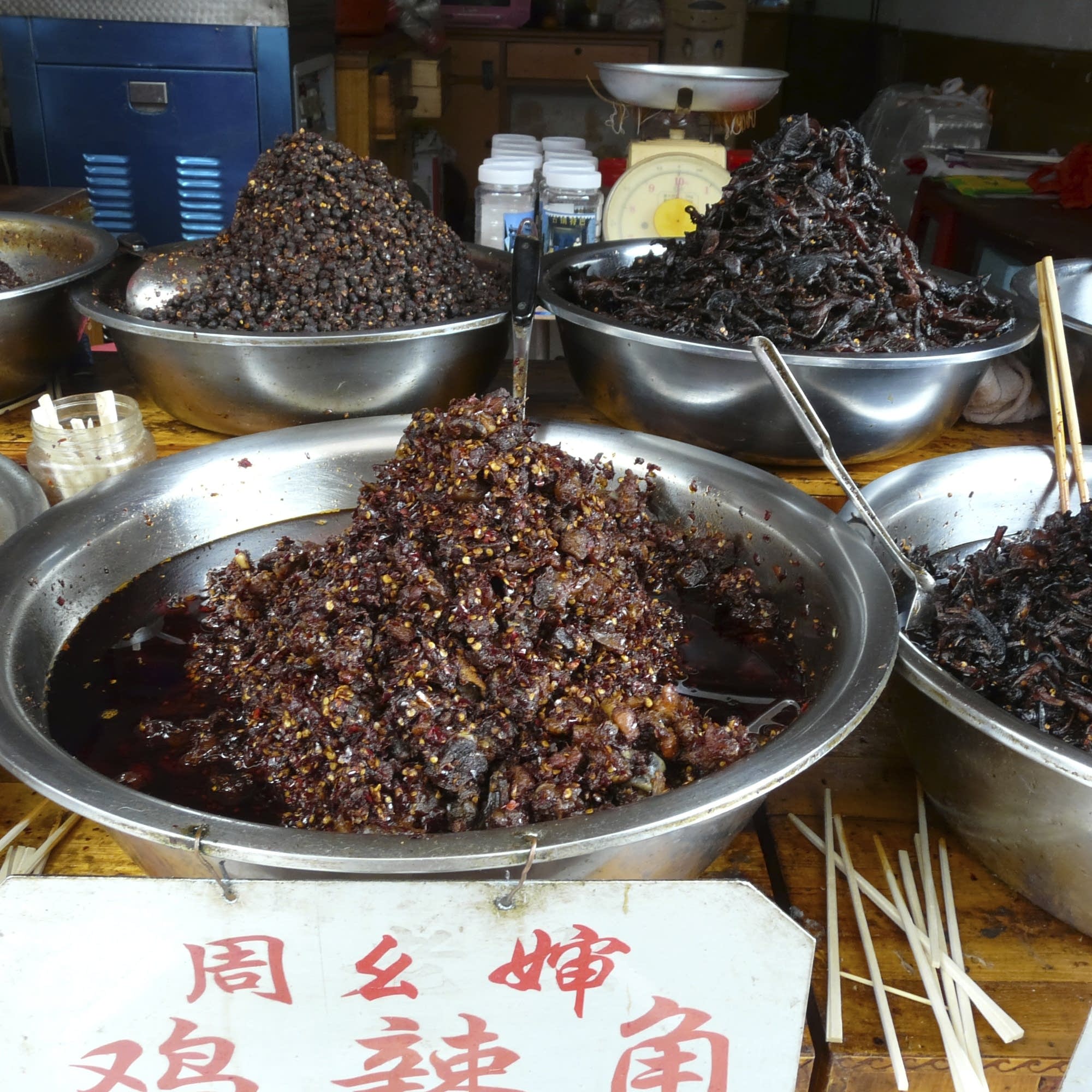
"Our guest is BBC journalist Fuchsia Dunlop, the first foreigner invited to study at the professional chef's school in Sichuan, China. She fell in love with the spicy, hot, and unique cuisine the Chinese call "audacious cooking," and went on to pen Land of Plenty: A Treasury of Authentic Sichuan Cooking. She leaves us her recipe for Fish-Fragrant Eggplant from the book.
For the Sterns, it's French toast and Red Velvet Cake at Diana's in Charleston, and Lynne reveals her "Southern Fantasy Trip Back Seat Library!" We'll talk international beans and weenies with Anya Von Bremzen. Her recipe for Feijoada Completa is from her new book, The Greatest Dishes!: Around the World in 80 Recipes.
Wine expert Jay McInerney is back offering his opinions on the world of wine. This time he's predicting Sauvignon Blanc will cancel out Chardonnay! In a bow to the current political climate, we'll address one of the issues dividing the nation—the diet wars. And we'll hear from Murph Dawkins who, during a renovation of her St. Paul bar, discovered hidden treasure in the basement!
Broadcast dates for this episode:
- March 20, 2004 (originally aired)
- March 26, 2005 (rebroadcast)
Available Results
Generated results are saved to your library for reuse and search.
Choose Template
Pick the result you want. You can review provider and model before generating.
A concise first-pass summary for understanding the episode quickly.
A comprehensive, source-grounded extraction of the reusable knowledge in an episode.
Scientific findings, mechanisms, studies, hypotheses, and the limits of the evidence discussed.
A dedicated analysis of warnings, limitations, trade-offs, weak evidence, and uncertainty.
Memorable statements and important claims with attribution and source context.
Technologies, AI models, technical methods, capabilities, limitations, and adoption implications.
A concise first-pass summary for understanding the episode quickly.
A detailed readable summary organized by chapter or topic.
A navigable map of subjects, topic flow, and suggested chapters.
A comprehensive, source-grounded extraction of the reusable knowledge in an episode.
Reusable atomic knowledge units extracted from the episode.
A comprehensive extraction focused on health practices, protocols, claims, and safety caveats.
A comprehensive extraction focused on opportunities, strategy, markets, and company building.
Explicit actions, next steps, habits, recommendations, and things to avoid.
A dedicated inventory of concrete resources named in the episode.
A dedicated analysis of warnings, limitations, trade-offs, weak evidence, and uncertainty.
A concise first-pass summary for understanding the episode quickly.
A detailed readable summary organized by chapter or topic.
A navigable map of subjects, topic flow, and suggested chapters.
A comprehensive, source-grounded extraction of the reusable knowledge in an episode.
Reusable atomic knowledge units extracted from the episode.
A comprehensive extraction focused on health practices, protocols, claims, and safety caveats.
A comprehensive extraction focused on opportunities, strategy, markets, and company building.
Scientific findings, mechanisms, studies, hypotheses, and the limits of the evidence discussed.
Technologies, AI models, technical methods, capabilities, limitations, and adoption implications.
Investment theses, assets, catalysts, valuation reasoning, time horizons, and risks.
Chronologies, actors, causes, consequences, turning points, and competing historical interpretations.
Policies, proposals, stakeholders, arguments, implementation constraints, and predicted effects.
Career paths, skills, hiring signals, workplace decisions, transitions, and limitations of the advice.
Behavioral mechanisms, biases, motivation, habits, emotions, interventions, and evidence limitations.
Economic mechanisms, incentives, indicators, market structure, forecasts, and uncertainty.
Leadership principles, team systems, organizational design, culture, feedback, and failure modes.
Audience, positioning, messaging, acquisition, retention, experiments, metrics, and failed approaches.
Teaching methods, learning strategies, practice, feedback, assessment, and effectiveness evidence.
Theses, premises, arguments, objections, values, thought experiments, and unresolved questions.
Communication patterns, conflict, boundaries, expectations, repair methods, and contextual limitations.
Books, papers, authors, courses, and other learning resources mentioned in the episode.
Repeatable methods, frameworks, mental models, processes, and systems.
Explicit actions, next steps, habits, recommendations, and things to avoid.
Memorable statements and important claims with attribution and source context.
A dedicated inventory of concrete resources named in the episode.
A dedicated analysis of warnings, limitations, trade-offs, weak evidence, and uncertainty.