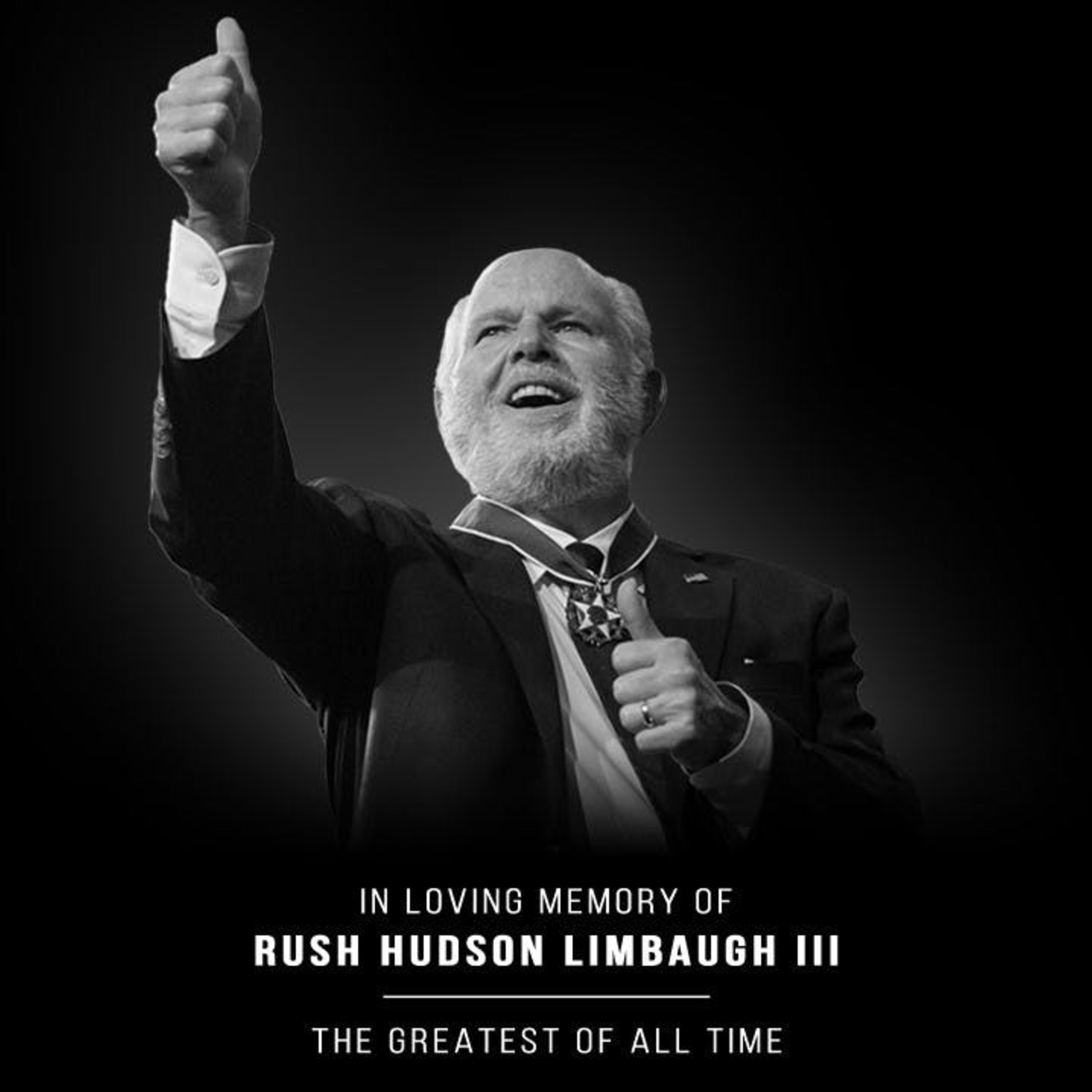
The Rush Limbaugh Show Podcast
PODCAST SUMMARY HOUR 1:
Former Congressman Jason Lewis guides us through today's program, opens the show by discussing the 113th Congress in which he served, everything that was accomplished in President Trump's first two years. Rush on how the learning never stops at the Limbaugh Institute. The difference between how Democrats and Republicans use power, Kristi Noem is an example of a Republican who gets it. A third party wouldn't even be discussed if the GOP united around conservatism and using power to defeat Democrats. Rush on how Democrats use identity politics as a distraction from their disastrous policies. Is it worth running for Congress? Election integrity.
PODCAST SUMMARY HOUR 2:
Rush on how the Democrats used COVID restrictions to change voting rules, further their goal of wiping out elections. Rush took a call from a mail carrier on mail-in ballot fraud. Rush talks to a caller about how Establishment Republicans were squandering an opportunity to save the country because they refused to embrace conservatism. Conservatism works every time it's tried. Caller on devotion to the truth.
PODCAST SUMMARY HOUR 3:
Rush tells stories that show his love for his cats and dogs. Rush on meeting Mikhail Gorbachev at George H.W. Bush's birthday party. How Gorbachev's birthmark moved to Rush's head. Rush relives his classic Reagan-era innovation: The Gorbasm. Dittohead: We need to stick together and carry on the fight.
Learn more about your ad-choices at https://www.iheartpodcastnetwork.com
Follow Clay & Buck on YouTube: https://www.youtube.com/c/clayandbuck
See omnystudio.com/listener for privacy information.
Available Results
Generated results are saved to your library for reuse and search.
Choose Template
Pick the result you want. You can review provider and model before generating.
A concise first-pass summary for understanding the episode quickly.
A comprehensive, source-grounded extraction of the reusable knowledge in an episode.
Technologies, AI models, technical methods, capabilities, limitations, and adoption implications.
Repeatable methods, frameworks, mental models, processes, and systems.
A dedicated analysis of warnings, limitations, trade-offs, weak evidence, and uncertainty.
A dedicated inventory of concrete resources named in the episode.
A concise first-pass summary for understanding the episode quickly.
A detailed readable summary organized by chapter or topic.
A navigable map of subjects, topic flow, and suggested chapters.
A comprehensive, source-grounded extraction of the reusable knowledge in an episode.
Reusable atomic knowledge units extracted from the episode.
A comprehensive extraction focused on health practices, protocols, claims, and safety caveats.
A comprehensive extraction focused on opportunities, strategy, markets, and company building.
Explicit actions, next steps, habits, recommendations, and things to avoid.
A dedicated inventory of concrete resources named in the episode.
A dedicated analysis of warnings, limitations, trade-offs, weak evidence, and uncertainty.
A concise first-pass summary for understanding the episode quickly.
A detailed readable summary organized by chapter or topic.
A navigable map of subjects, topic flow, and suggested chapters.
A comprehensive, source-grounded extraction of the reusable knowledge in an episode.
Reusable atomic knowledge units extracted from the episode.
A comprehensive extraction focused on health practices, protocols, claims, and safety caveats.
A comprehensive extraction focused on opportunities, strategy, markets, and company building.
Scientific findings, mechanisms, studies, hypotheses, and the limits of the evidence discussed.
Technologies, AI models, technical methods, capabilities, limitations, and adoption implications.
Investment theses, assets, catalysts, valuation reasoning, time horizons, and risks.
Chronologies, actors, causes, consequences, turning points, and competing historical interpretations.
Policies, proposals, stakeholders, arguments, implementation constraints, and predicted effects.
Career paths, skills, hiring signals, workplace decisions, transitions, and limitations of the advice.
Behavioral mechanisms, biases, motivation, habits, emotions, interventions, and evidence limitations.
Economic mechanisms, incentives, indicators, market structure, forecasts, and uncertainty.
Leadership principles, team systems, organizational design, culture, feedback, and failure modes.
Audience, positioning, messaging, acquisition, retention, experiments, metrics, and failed approaches.
Teaching methods, learning strategies, practice, feedback, assessment, and effectiveness evidence.
Theses, premises, arguments, objections, values, thought experiments, and unresolved questions.
Communication patterns, conflict, boundaries, expectations, repair methods, and contextual limitations.
Books, papers, authors, courses, and other learning resources mentioned in the episode.
Repeatable methods, frameworks, mental models, processes, and systems.
Explicit actions, next steps, habits, recommendations, and things to avoid.
Memorable statements and important claims with attribution and source context.
A dedicated inventory of concrete resources named in the episode.
Numbers, percentages, dates, quantities, benchmarks, and study results with their source context.
A dedicated analysis of warnings, limitations, trade-offs, weak evidence, and uncertainty.
Claims mapped to the support, counterarguments, uncertainty, and verification needs mentioned in the episode.
Decisions, options, arguments, constraints, trade-offs, unknowns, and speaker preferences.
Speaker positions, areas of agreement, disagreements, reasoning, and unresolved tensions.