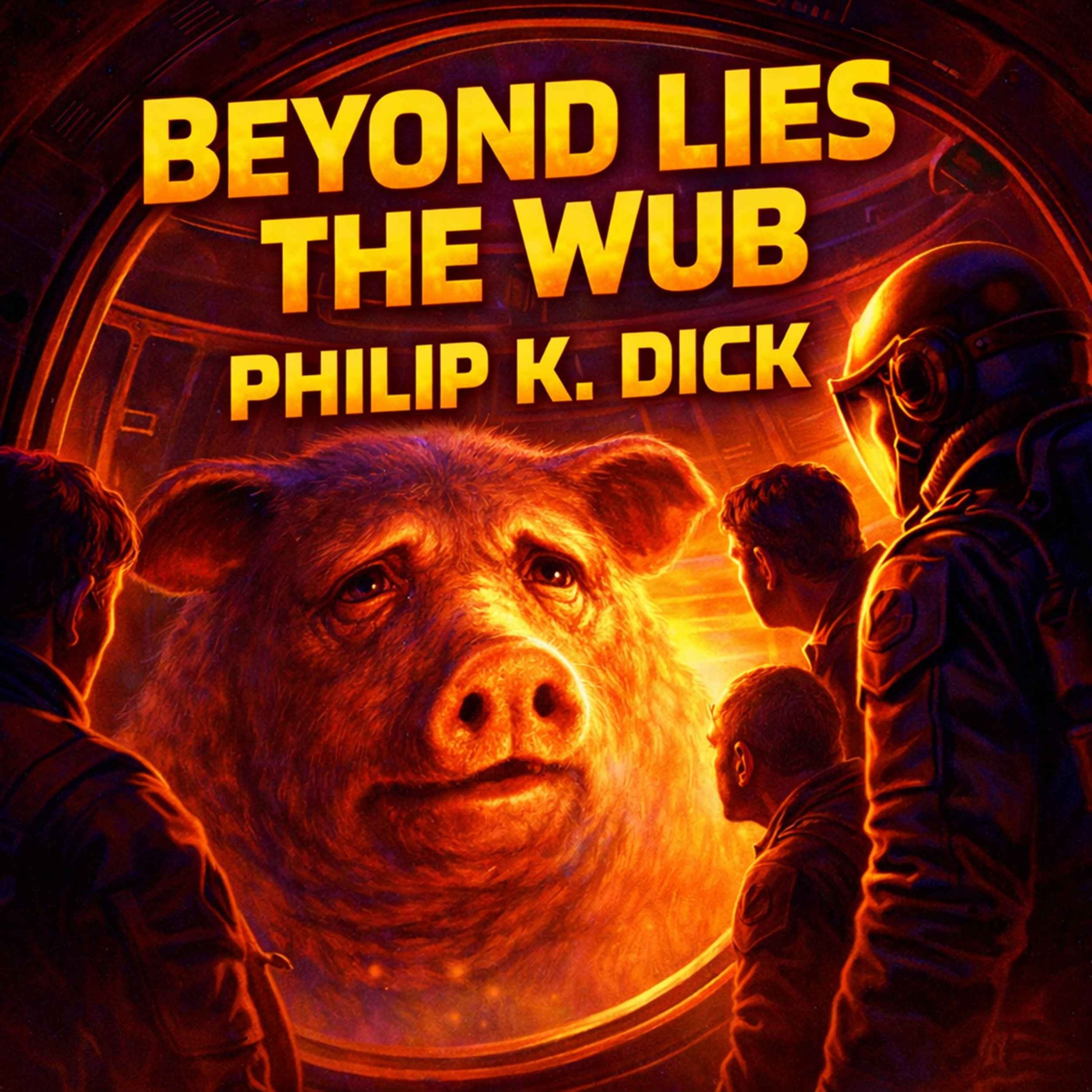
Beyond Lies the Wub by Philip K. Dick - Philip K. Dick Short Stories
The slovenly wub might well have said: Many men talk like philosophers and live like fools. Beyond Lies the Wub by Philip K. Dick, that’s next on The Lost Sci-Fi Podcast, with at least one lost vintage sci-fi short story in every episode.
Another 5 star review on Apple Podcasts, this one from Archoneponymous who says, “Great Narration. This podcast has excellent stories told well.” Thank you Archoneponymous!
This 5 star review is from the Podcast Addict app, posted by Jesse Willis, “I UNRESERVEDLY RECOMMEND THE LOST SCI-FI PODCAST. Host and narrator Scott Miller is an excellent audiobook narrator. His choice of stories is top tier. There are new episodes twice a week, all episodes are complete and unabridged audiobooks! His is the best new podcast of the 2020s.”
Wow! Thanks Jesse!
Your reviews are one of the reasons our podcast continues to grow, so thank you, and if you haven’t already given us a 5 star review, we would love it if you would, if you think we deserve it of course.
Leber8tr bought us $25 worth of coffee and had this to say, “Great story telling! Thank you for hours and hours of audio entertainment.” Thank you Leber8tr! There’s a link in the description if you’d like to contribute.
We are thankful for you. Please don’t ever forget that.
https://www.buymeacoffee.com/scottsV
Merch - https://lostscifi.creator-spring.com/
There was no fanfare when this story was released since nobody knew who Philip K. Dick was at the time. It wasn’t the first story he had written but it was the first story that was ever published in a science fiction magazine. Let’s open the pages of the July 1952 issue of Planet Stories Magazine to page 69 for Beyond Lies the Wub by Philip K. Dick…
You can’t ever go wrong narrating a story by Philip K. Dick, who remains the most popular author on our podcast with Ray Bradbury and Isaac Asimov gaining ground. Clever and fun are the words I would use to describe Beyond Lies the Wub. I narrated the story simply because I enjoyed it and it was written by PKD.
Sign up for our newsletter - https://lostscifi.com/free/
Next on The Lost Sci-Fi Podcast, Martians were weak, sensitive, a dying race, frail and impotent before the superiority of master Earthmen. Only in the sly and mentally skillful game of Duchal might sons of the red planet emerge gloriously from their shells. Alien Equivalent by Richard R. Smith, that’s next on The Lost Sci-Fi Podcast.
https://lostscifi.com/podcast/beyond-lies-the-wub-by-philip-k-dick-episode-149/
Listen without commercials and enjoy exclusive bonus episodes every month with Lost Sci-Fi Premium—start your free 7-day trial today. https://lostscifi.supercast.com/
Hosted by Simplecast, an AdsWizz company. See pcm.adswizz.com for information about our collection and use of personal data for advertising.
Available Results
Generated results are saved to your library for reuse and search.
Choose Template
Pick the result you want. You can review provider and model before generating.
A concise first-pass summary for understanding the episode quickly.
A comprehensive, source-grounded extraction of the reusable knowledge in an episode.
A comprehensive extraction focused on opportunities, strategy, markets, and company building.
Explicit actions, next steps, habits, recommendations, and things to avoid.
Repeatable methods, frameworks, mental models, processes, and systems.
A dedicated inventory of concrete resources named in the episode.
A concise first-pass summary for understanding the episode quickly.
A detailed readable summary organized by chapter or topic.
A navigable map of subjects, topic flow, and suggested chapters.
A comprehensive, source-grounded extraction of the reusable knowledge in an episode.
Reusable atomic knowledge units extracted from the episode.
A comprehensive extraction focused on health practices, protocols, claims, and safety caveats.
A comprehensive extraction focused on opportunities, strategy, markets, and company building.
Explicit actions, next steps, habits, recommendations, and things to avoid.
A dedicated inventory of concrete resources named in the episode.
A dedicated analysis of warnings, limitations, trade-offs, weak evidence, and uncertainty.
A concise first-pass summary for understanding the episode quickly.
A detailed readable summary organized by chapter or topic.
A navigable map of subjects, topic flow, and suggested chapters.
A comprehensive, source-grounded extraction of the reusable knowledge in an episode.
Reusable atomic knowledge units extracted from the episode.
A comprehensive extraction focused on health practices, protocols, claims, and safety caveats.
A comprehensive extraction focused on opportunities, strategy, markets, and company building.
Scientific findings, mechanisms, studies, hypotheses, and the limits of the evidence discussed.
Technologies, AI models, technical methods, capabilities, limitations, and adoption implications.
Investment theses, assets, catalysts, valuation reasoning, time horizons, and risks.
Chronologies, actors, causes, consequences, turning points, and competing historical interpretations.
Policies, proposals, stakeholders, arguments, implementation constraints, and predicted effects.
Career paths, skills, hiring signals, workplace decisions, transitions, and limitations of the advice.
Behavioral mechanisms, biases, motivation, habits, emotions, interventions, and evidence limitations.
Economic mechanisms, incentives, indicators, market structure, forecasts, and uncertainty.
Leadership principles, team systems, organizational design, culture, feedback, and failure modes.
Audience, positioning, messaging, acquisition, retention, experiments, metrics, and failed approaches.
Teaching methods, learning strategies, practice, feedback, assessment, and effectiveness evidence.
Theses, premises, arguments, objections, values, thought experiments, and unresolved questions.
Communication patterns, conflict, boundaries, expectations, repair methods, and contextual limitations.
Books, papers, authors, courses, and other learning resources mentioned in the episode.
Repeatable methods, frameworks, mental models, processes, and systems.
Explicit actions, next steps, habits, recommendations, and things to avoid.
Memorable statements and important claims with attribution and source context.
A dedicated inventory of concrete resources named in the episode.
A dedicated analysis of warnings, limitations, trade-offs, weak evidence, and uncertainty.