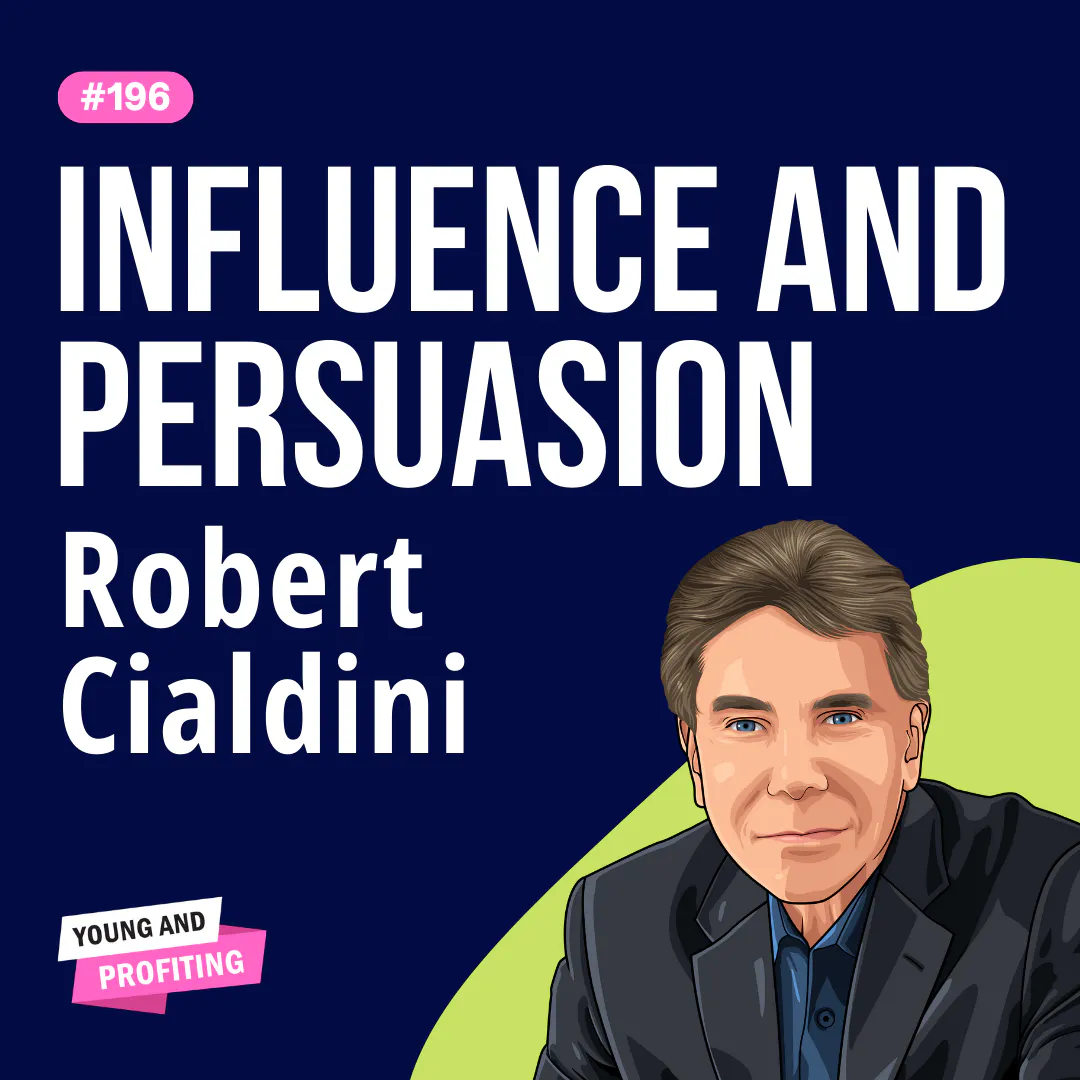
Robert Cialdini: World's #1 Influence and Persuasion Expert Shares All | Human Behavior| E196
Robert Cialdini is known globally as the foundational expert in the science of influence. His Six Principles of Persuasion have become a cornerstone for any organization serious about effectively increasing its influence. His research is focused on uncovering why people say “yes” to certain requests and how to apply these findings ethically in the business world.
In this episode, Robert and Hala discuss how to become a skilled persuader and why that matters in business. Robert breaks down the tactics to recognize when we are being influenced so we can defend ourselves against it and make the best decisions for ourselves. They also discuss Robert’s 7 universal principles of persuasion: reciprocity, liking, unity, social proof, authority, consistency, and scarcity.
Topics Include:
- How small changes in language can have big impacts on behavior
- The ethics of persuasion
- Why humans require mental shortcuts
- The power of reciprocity
- Why we shouldn’t downplay our favors
- How kindness can help us retain employees
- Rejection-then-Retreat Method
- How to use the Liking Principle
- The Joe Gerard Sales Method
- Why Social Proofing reduces uncertainty
- How to be perceived as an authority figure
- Difference between being in authority and an authority
- How can we use the scarcity principle in business?
- The importance of appearing consistent
- And other topics…
Robert Cialdini is a Wall Street Journal and New York Times best-selling author, speaker, professor, and social psychologist who specializes in the science of influence. He has authored several books, and his latest book, Influence, is a new and expanded version of his classic international bestseller, which has been translated in over 30 languages and has sold over 5 million copies. As a keynote speaker, Dr. Cialdini has earned a worldwide reputation for his ability to translate science into valuable and practical actions. His on-stage stories are described as dramatic and indelible. Because of all of this, he is frequently regarded as “The Godfather of Influence”.
Resources Mentioned:
Robert’s Books: https://www.robertcialdinibf.com/
Robert’s Website: https://www.robertcialdinibf.com/
Robert’s LinkedIn: https://www.linkedin.com/in/robertcialdini/
Robert’s Twitter: https://twitter.com/RobertCialdini
Robert’s Instagram: https://www.instagram.com/teamrobertcialdini/
Robert’s Facebook: https://www.facebook.com/robert.cialdini
Influence by Robert Cialdini: https://www.amazon.com/Influence-New-Expanded-Psychology-Persuasion/dp/0062937650/ref=sr_1_1?dchild=1&keywords=cialdini+influence&qid=1620080949&sr=8-1
Sponsored By:
The Jordan Harbinger Show - Check out jordanharbinger.com/start for some episode recommendations
Shopify - Sign up for a free trial at shopify.com/profiting
Swag.com - Go to swag.com/yap and get 10% off your order
Titan - Head to Titan.com/YAP and you’ll get a free $25 investment into another one of Titan’s portfolios.
JustWorks - Check out JustWorks' transparent pricing by visiting justworks.com/pricing
More About Young and Profiting
Download Transcripts - youngandprofiting.com
Get Sponsorship Deals - youngandprofiting.com/sponsorships
Leave a Review - ratethispodcast.com/yap
Watch Videos - youtube.com/c/YoungandProfiting
Follow Hala Taha
LinkedIn - linkedin.com/in/htaha/
Instagram - instagram.com/yapwithhala/
TikTok - tiktok.com/@yapwithhala
Twitter - twitter.com/yapwithhala
Learn more about YAP Media Agency Services - yapmedia.io/
Join Hala's LinkedIn Masterclass - yapmedia.io/course
Available Results
Generated results are saved to your library for reuse and search.
Choose Template
Pick the result you want. You can review provider and model before generating.
A concise first-pass summary for understanding the episode quickly.
A comprehensive, source-grounded extraction of the reusable knowledge in an episode.
A comprehensive extraction focused on opportunities, strategy, markets, and company building.
Explicit actions, next steps, habits, recommendations, and things to avoid.
Repeatable methods, frameworks, mental models, processes, and systems.
A dedicated inventory of concrete resources named in the episode.
A concise first-pass summary for understanding the episode quickly.
A detailed readable summary organized by chapter or topic.
A navigable map of subjects, topic flow, and suggested chapters.
A comprehensive, source-grounded extraction of the reusable knowledge in an episode.
Reusable atomic knowledge units extracted from the episode.
A comprehensive extraction focused on health practices, protocols, claims, and safety caveats.
A comprehensive extraction focused on opportunities, strategy, markets, and company building.
Explicit actions, next steps, habits, recommendations, and things to avoid.
A dedicated inventory of concrete resources named in the episode.
A dedicated analysis of warnings, limitations, trade-offs, weak evidence, and uncertainty.
A concise first-pass summary for understanding the episode quickly.
A detailed readable summary organized by chapter or topic.
A navigable map of subjects, topic flow, and suggested chapters.
A comprehensive, source-grounded extraction of the reusable knowledge in an episode.
Reusable atomic knowledge units extracted from the episode.
A comprehensive extraction focused on health practices, protocols, claims, and safety caveats.
A comprehensive extraction focused on opportunities, strategy, markets, and company building.
Scientific findings, mechanisms, studies, hypotheses, and the limits of the evidence discussed.
Technologies, AI models, technical methods, capabilities, limitations, and adoption implications.
Investment theses, assets, catalysts, valuation reasoning, time horizons, and risks.
Chronologies, actors, causes, consequences, turning points, and competing historical interpretations.
Policies, proposals, stakeholders, arguments, implementation constraints, and predicted effects.
Career paths, skills, hiring signals, workplace decisions, transitions, and limitations of the advice.
Behavioral mechanisms, biases, motivation, habits, emotions, interventions, and evidence limitations.
Economic mechanisms, incentives, indicators, market structure, forecasts, and uncertainty.
Leadership principles, team systems, organizational design, culture, feedback, and failure modes.
Audience, positioning, messaging, acquisition, retention, experiments, metrics, and failed approaches.
Teaching methods, learning strategies, practice, feedback, assessment, and effectiveness evidence.
Theses, premises, arguments, objections, values, thought experiments, and unresolved questions.
Communication patterns, conflict, boundaries, expectations, repair methods, and contextual limitations.
Books, papers, authors, courses, and other learning resources mentioned in the episode.
Repeatable methods, frameworks, mental models, processes, and systems.
Explicit actions, next steps, habits, recommendations, and things to avoid.
Memorable statements and important claims with attribution and source context.
A dedicated inventory of concrete resources named in the episode.
A dedicated analysis of warnings, limitations, trade-offs, weak evidence, and uncertainty.