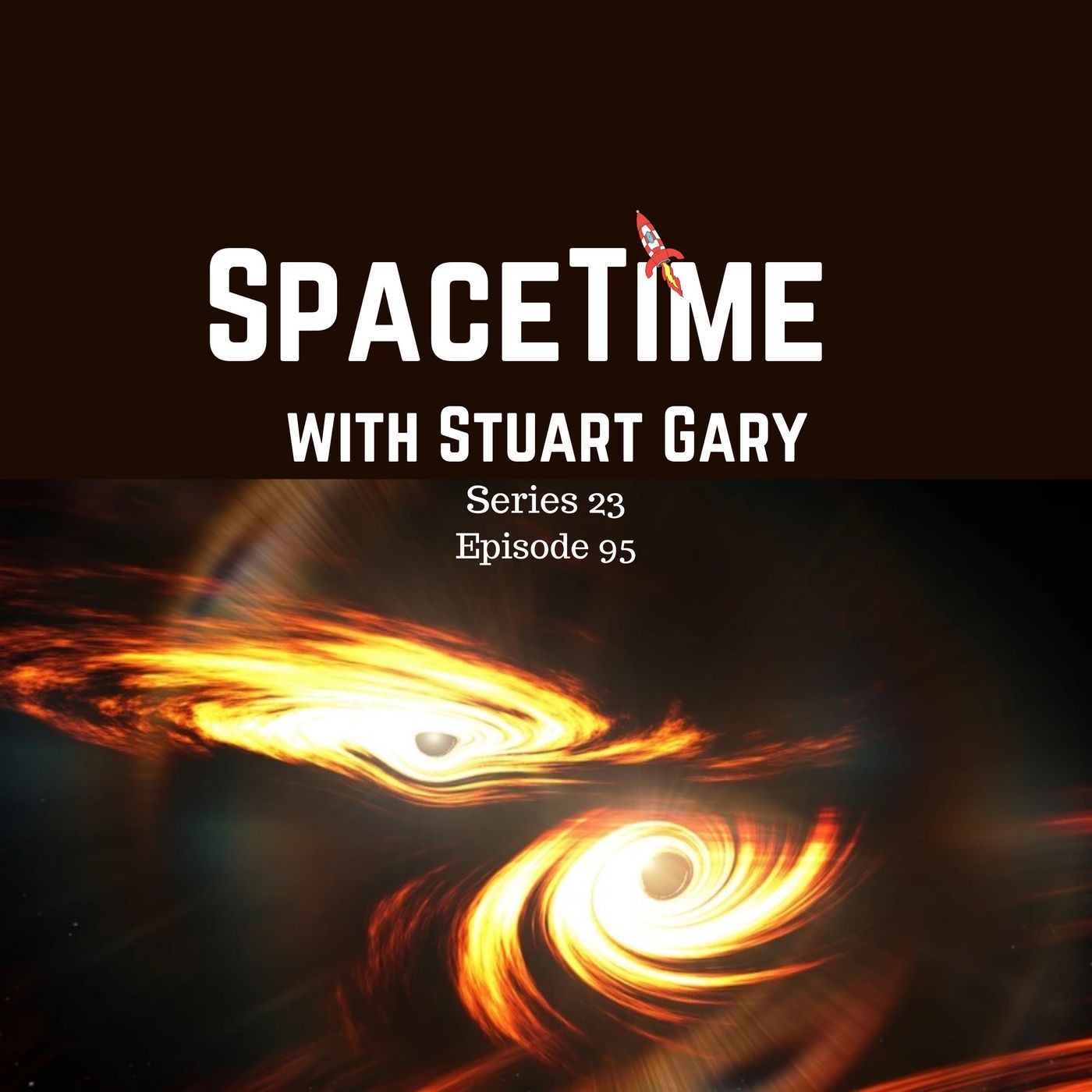
Biggest Black Hole Collision Ever Detected
Scientists have observed the most massive black hole collision ever seen. The event appears to have originated from a point some seven billion light-years away – at a time when the universe was just half its present age – and making it one of the most distant gravitational wave sources ever detected.
*A new estimate for the age of Earth’s core
A new study suggests the Earth’s solid inner core is between one and 1.3 billion years old.
*China launches top-secret reusable spaceplane
China has launched a new top-secret reusable spaceplane for the Peoples Liberation Army. China's state-run Global Times news agency saying Beijing should have the capability to strike anywhere on Earth within half an hour.
*The Science Report
Russia’s controversial new Sputnik V COVID-19 vaccine appears to be working.
Ice loss in Greenland and Antarctica in line with worst-case climate change predictions.
A new study warns that mobile apps are harvesting data on preschool children.
The new hand-held video game console allowing indefinite gameplay without batteries.
Why educational standards plummet in Australia and the United States despite billions being spent.
Sponsor Details:
This episode of SpaceTime is brought to with the support of NameCheap.com….your online presence begins with a great domain name. Find your perfect one for a great price with NameCheap's powerful tools. Visit spacetimewithstuartgary.com/namcheap for more details and help support the show.
For a great VPN deal visit www.tryexpressvpn.com/space
Keep forgetting passwords? Then you need LastPass password manager….it’s one we use and is a lifesaver. Check it out for free at spacetimewithstuartgary.com/lastpass and help support the show.
For more SpaceTime visit https://spacetimewithstuartgary.com (mobile friendly).
For enhanced Show Notes including photos to accompany this episode, visit: http://www.bitesz.com/spacetimeshownotes
Get immediate access to over 200 commercial-free, double and triple episode editions of SpaceTime plus extended interview bonus content. Subscribe via Patreon or Supercast....and share in the rewards. Details at www.patreon.com/spacetimewithstuartgary or Supercast - https://bitesznetwork.supercast.tech/
RSS feed: https://rss.acast.com/spacetime
Email: SpaceTime@bitesz.com
To receive the Astronomy Daily Newsletter free, direct to your inbox...just join our mailing list at www.bitesz.com/mailinglist or visit https://www.bitesz.com/astronomy-daily
See acast.com/privacy for privacy and opt-out information.
Become a supporter of this podcast: https://www.spreaker.com/podcast/spacetime-with-stuart-gary--2458531/support.
Available Results
Generated results are saved to your library for reuse and search.
Choose Template
Pick the result you want. You can review provider and model before generating.
A concise first-pass summary for understanding the episode quickly.
A comprehensive, source-grounded extraction of the reusable knowledge in an episode.
A comprehensive extraction focused on opportunities, strategy, markets, and company building.
Explicit actions, next steps, habits, recommendations, and things to avoid.
Repeatable methods, frameworks, mental models, processes, and systems.
A dedicated inventory of concrete resources named in the episode.
A concise first-pass summary for understanding the episode quickly.
A detailed readable summary organized by chapter or topic.
A navigable map of subjects, topic flow, and suggested chapters.
A comprehensive, source-grounded extraction of the reusable knowledge in an episode.
Reusable atomic knowledge units extracted from the episode.
A comprehensive extraction focused on health practices, protocols, claims, and safety caveats.
A comprehensive extraction focused on opportunities, strategy, markets, and company building.
Explicit actions, next steps, habits, recommendations, and things to avoid.
A dedicated inventory of concrete resources named in the episode.
A dedicated analysis of warnings, limitations, trade-offs, weak evidence, and uncertainty.
A concise first-pass summary for understanding the episode quickly.
A detailed readable summary organized by chapter or topic.
A navigable map of subjects, topic flow, and suggested chapters.
A comprehensive, source-grounded extraction of the reusable knowledge in an episode.
Reusable atomic knowledge units extracted from the episode.
A comprehensive extraction focused on health practices, protocols, claims, and safety caveats.
A comprehensive extraction focused on opportunities, strategy, markets, and company building.
Scientific findings, mechanisms, studies, hypotheses, and the limits of the evidence discussed.
Technologies, AI models, technical methods, capabilities, limitations, and adoption implications.
Investment theses, assets, catalysts, valuation reasoning, time horizons, and risks.
Chronologies, actors, causes, consequences, turning points, and competing historical interpretations.
Policies, proposals, stakeholders, arguments, implementation constraints, and predicted effects.
Career paths, skills, hiring signals, workplace decisions, transitions, and limitations of the advice.
Behavioral mechanisms, biases, motivation, habits, emotions, interventions, and evidence limitations.
Economic mechanisms, incentives, indicators, market structure, forecasts, and uncertainty.
Leadership principles, team systems, organizational design, culture, feedback, and failure modes.
Audience, positioning, messaging, acquisition, retention, experiments, metrics, and failed approaches.
Teaching methods, learning strategies, practice, feedback, assessment, and effectiveness evidence.
Theses, premises, arguments, objections, values, thought experiments, and unresolved questions.
Communication patterns, conflict, boundaries, expectations, repair methods, and contextual limitations.
Books, papers, authors, courses, and other learning resources mentioned in the episode.
Repeatable methods, frameworks, mental models, processes, and systems.
Explicit actions, next steps, habits, recommendations, and things to avoid.
Memorable statements and important claims with attribution and source context.
A dedicated inventory of concrete resources named in the episode.
A dedicated analysis of warnings, limitations, trade-offs, weak evidence, and uncertainty.