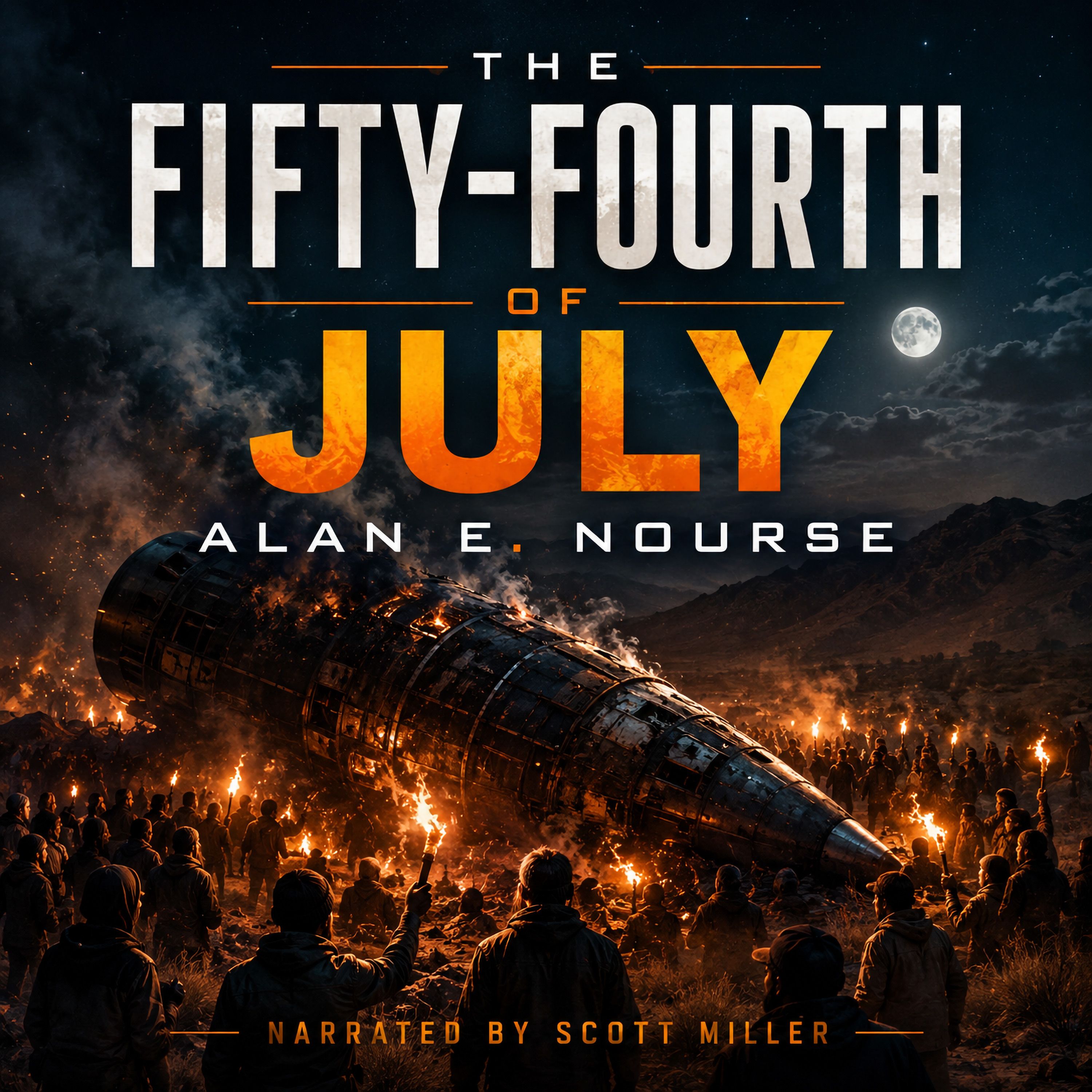
The Fifty-Fourth of July by Alan E Nourse
The author of today’s short sci-fi story had an interesting life. Born on August 11th 1928 in Des Moines Iowa, after graduating high school he went to Rutgers University, two years in the Navy, then on to the University of Pennsylvania to become a Doctor. He helped pay for his medical degree by writing science fiction for magazines. In a 1952 issue of Other Worlds he said he started reading science fiction while at Rutgers and was reading sci-fi like a man possessed. Saying he ended up being the most incurable type of science fiction addict, the kind that has to write it as well as read it!
Support the show - https://www.buymeacoffee.com/scottsV
Merch - https://lostscifi.creator-spring.com/
Sign up for our newsletter https://lostscifi.com/free/
He wrote more than 30 short stories and more than a dozen novels. If dating, getting married, college, medical school, the US Navy, writing for science fiction magazines and publishing his first novel weren’t enough in the first 5 years of the 1950’s, he also found the time to make 4 appearances on television as an actor, including one during the 8 year run of the The Philco Television Playhouse.
And if that wasn’t enough, the Good Doctor had a column in Good Housekeeping Magazine. In 1965 he wrote a nonfiction book titled “Intern” under the pseudonym Doctor X.
His legal name? Alan Edward Nourse. He’s perhaps better known as Alan E. Nourse.
In the first episode of the Lost Sci-Fi podcast we mentioned that Philip K. Dicks Sci-Fi Novel “Do Androids Dream of Electric Sheep?” became the movie Blade Runner. But did you know that the movie got its name, not the content, the name and name only from the 1974 novel written by Alan E Nourse The Blade Runner? 3 minutes and 7 seconds after the credits for Blade Runner start you’ll see these words on the screen, With Thanks to Alan E Nourse for the use of the title Blade Runner. It really is 3 minutes and 7 seconds, yea, I’m weird like that.
Matt had to destroy the rocket because it was a symbol of evil that had brought economic disaster. But must he also destroy—the future? From Imagination Stories of Science and Fantasy in March 1954 - The Fifty-Fourth of July written by Alan E Nourse...
Listen without commercials and enjoy exclusive bonus episodes every month with Lost Sci-Fi Premium—start your free 7-day trial today. https://lostscifi.supercast.com/
Hosted by Simplecast, an AdsWizz company. See pcm.adswizz.com for information about our collection and use of personal data for advertising.
Available Results
Generated results are saved to your library for reuse and search.
Choose Template
Pick the result you want. You can review provider and model before generating.
A concise first-pass summary for understanding the episode quickly.
A comprehensive, source-grounded extraction of the reusable knowledge in an episode.
A comprehensive extraction focused on opportunities, strategy, markets, and company building.
Explicit actions, next steps, habits, recommendations, and things to avoid.
Repeatable methods, frameworks, mental models, processes, and systems.
A dedicated inventory of concrete resources named in the episode.
A concise first-pass summary for understanding the episode quickly.
A detailed readable summary organized by chapter or topic.
A navigable map of subjects, topic flow, and suggested chapters.
A comprehensive, source-grounded extraction of the reusable knowledge in an episode.
Reusable atomic knowledge units extracted from the episode.
A comprehensive extraction focused on health practices, protocols, claims, and safety caveats.
A comprehensive extraction focused on opportunities, strategy, markets, and company building.
Explicit actions, next steps, habits, recommendations, and things to avoid.
A dedicated inventory of concrete resources named in the episode.
A dedicated analysis of warnings, limitations, trade-offs, weak evidence, and uncertainty.
A concise first-pass summary for understanding the episode quickly.
A detailed readable summary organized by chapter or topic.
A navigable map of subjects, topic flow, and suggested chapters.
A comprehensive, source-grounded extraction of the reusable knowledge in an episode.
Reusable atomic knowledge units extracted from the episode.
A comprehensive extraction focused on health practices, protocols, claims, and safety caveats.
A comprehensive extraction focused on opportunities, strategy, markets, and company building.
Scientific findings, mechanisms, studies, hypotheses, and the limits of the evidence discussed.
Technologies, AI models, technical methods, capabilities, limitations, and adoption implications.
Investment theses, assets, catalysts, valuation reasoning, time horizons, and risks.
Chronologies, actors, causes, consequences, turning points, and competing historical interpretations.
Policies, proposals, stakeholders, arguments, implementation constraints, and predicted effects.
Career paths, skills, hiring signals, workplace decisions, transitions, and limitations of the advice.
Behavioral mechanisms, biases, motivation, habits, emotions, interventions, and evidence limitations.
Economic mechanisms, incentives, indicators, market structure, forecasts, and uncertainty.
Leadership principles, team systems, organizational design, culture, feedback, and failure modes.
Audience, positioning, messaging, acquisition, retention, experiments, metrics, and failed approaches.
Teaching methods, learning strategies, practice, feedback, assessment, and effectiveness evidence.
Theses, premises, arguments, objections, values, thought experiments, and unresolved questions.
Communication patterns, conflict, boundaries, expectations, repair methods, and contextual limitations.
Books, papers, authors, courses, and other learning resources mentioned in the episode.
Repeatable methods, frameworks, mental models, processes, and systems.
Explicit actions, next steps, habits, recommendations, and things to avoid.
Memorable statements and important claims with attribution and source context.
A dedicated inventory of concrete resources named in the episode.
A dedicated analysis of warnings, limitations, trade-offs, weak evidence, and uncertainty.