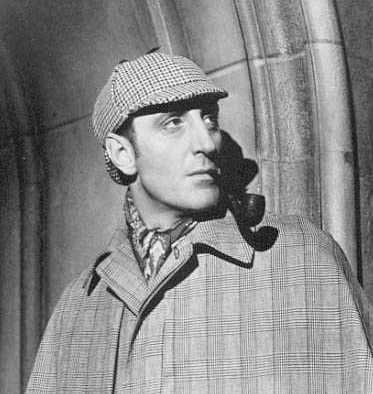
Happy Birthday, Basil Rathbone
Basil Rathbone, the debonair British actor and one of Hollywood's most famous performers, was born June 13, 1892. With hundreds of stage and screen roles to his credit, Rathbone is most famous for his fourteen films and hundreds of radio episodes as the world's greatest detective, Sherlock Holmes.
Rathbone made a splash in Hollywood in a number of dashing roles through the 1930s, including the dastardly Sir Guy of Gisbourne in The Adventures of Robin Hood, suave detective Philo Vance in The Bishop Murder Case, and Captain Pasquale in The Mark of Zorro.
In 1939, he first played Sherlock Holmes and kicked off a seven year run as Arthur Conan Doyle's master detective that included fourteen films and hundreds of radio performances. Rathbone was always paired with his old friend Nigel Bruce as Dr. Watson both in radio recreations of the Doyle stories and in Universal B-movies that brought Holmes and Watson into the twentieth century. For many, Rathbone is Sherlock Holmes, and his films have continued to entertain mystery fans since their release seventy-five years ago. Ultimately, frustration with typecasting led Rathbone to bid farewell to Sherlock Holmes in 1946.
Rathbone returned to the detective well in his post-Holmes years; first, he starred as Inspector Burke on Scotland Yard, and later he played himself as an amateur sleuth on Tales of Fatima. Both shows were short-lived, and they did not come close to eclipsing the image of Holmes in the public's eye.
In later years, he appeared opposite Danny Kaye in The Court Jester and Humphrey Bogart in We're No Angels. Rathbone co-starred with Vincent Price in Roger Corman's Tales of Terror, and he made memorable recordings of poems by Edgar Allan Poe and "The Night Before Christmas." Rathbone passed away in 1967, nearly twenty years after he hung up Holmes' deerstalker cap.
Available Results
Generated results are saved to your library for reuse and search.
Choose Template
Pick the result you want. You can review provider and model before generating.
A concise first-pass summary for understanding the episode quickly.
A comprehensive, source-grounded extraction of the reusable knowledge in an episode.
Technologies, AI models, technical methods, capabilities, limitations, and adoption implications.
Repeatable methods, frameworks, mental models, processes, and systems.
A dedicated analysis of warnings, limitations, trade-offs, weak evidence, and uncertainty.
A dedicated inventory of concrete resources named in the episode.
A concise first-pass summary for understanding the episode quickly.
A detailed readable summary organized by chapter or topic.
A navigable map of subjects, topic flow, and suggested chapters.
A comprehensive, source-grounded extraction of the reusable knowledge in an episode.
Reusable atomic knowledge units extracted from the episode.
A comprehensive extraction focused on health practices, protocols, claims, and safety caveats.
A comprehensive extraction focused on opportunities, strategy, markets, and company building.
Explicit actions, next steps, habits, recommendations, and things to avoid.
A dedicated inventory of concrete resources named in the episode.
A dedicated analysis of warnings, limitations, trade-offs, weak evidence, and uncertainty.
A concise first-pass summary for understanding the episode quickly.
A detailed readable summary organized by chapter or topic.
A navigable map of subjects, topic flow, and suggested chapters.
A comprehensive, source-grounded extraction of the reusable knowledge in an episode.
Reusable atomic knowledge units extracted from the episode.
A comprehensive extraction focused on health practices, protocols, claims, and safety caveats.
A comprehensive extraction focused on opportunities, strategy, markets, and company building.
Scientific findings, mechanisms, studies, hypotheses, and the limits of the evidence discussed.
Technologies, AI models, technical methods, capabilities, limitations, and adoption implications.
Investment theses, assets, catalysts, valuation reasoning, time horizons, and risks.
Chronologies, actors, causes, consequences, turning points, and competing historical interpretations.
Policies, proposals, stakeholders, arguments, implementation constraints, and predicted effects.
Career paths, skills, hiring signals, workplace decisions, transitions, and limitations of the advice.
Behavioral mechanisms, biases, motivation, habits, emotions, interventions, and evidence limitations.
Economic mechanisms, incentives, indicators, market structure, forecasts, and uncertainty.
Leadership principles, team systems, organizational design, culture, feedback, and failure modes.
Audience, positioning, messaging, acquisition, retention, experiments, metrics, and failed approaches.
Teaching methods, learning strategies, practice, feedback, assessment, and effectiveness evidence.
Theses, premises, arguments, objections, values, thought experiments, and unresolved questions.
Communication patterns, conflict, boundaries, expectations, repair methods, and contextual limitations.
Books, papers, authors, courses, and other learning resources mentioned in the episode.
Repeatable methods, frameworks, mental models, processes, and systems.
Explicit actions, next steps, habits, recommendations, and things to avoid.
Memorable statements and important claims with attribution and source context.
A dedicated inventory of concrete resources named in the episode.
A dedicated analysis of warnings, limitations, trade-offs, weak evidence, and uncertainty.