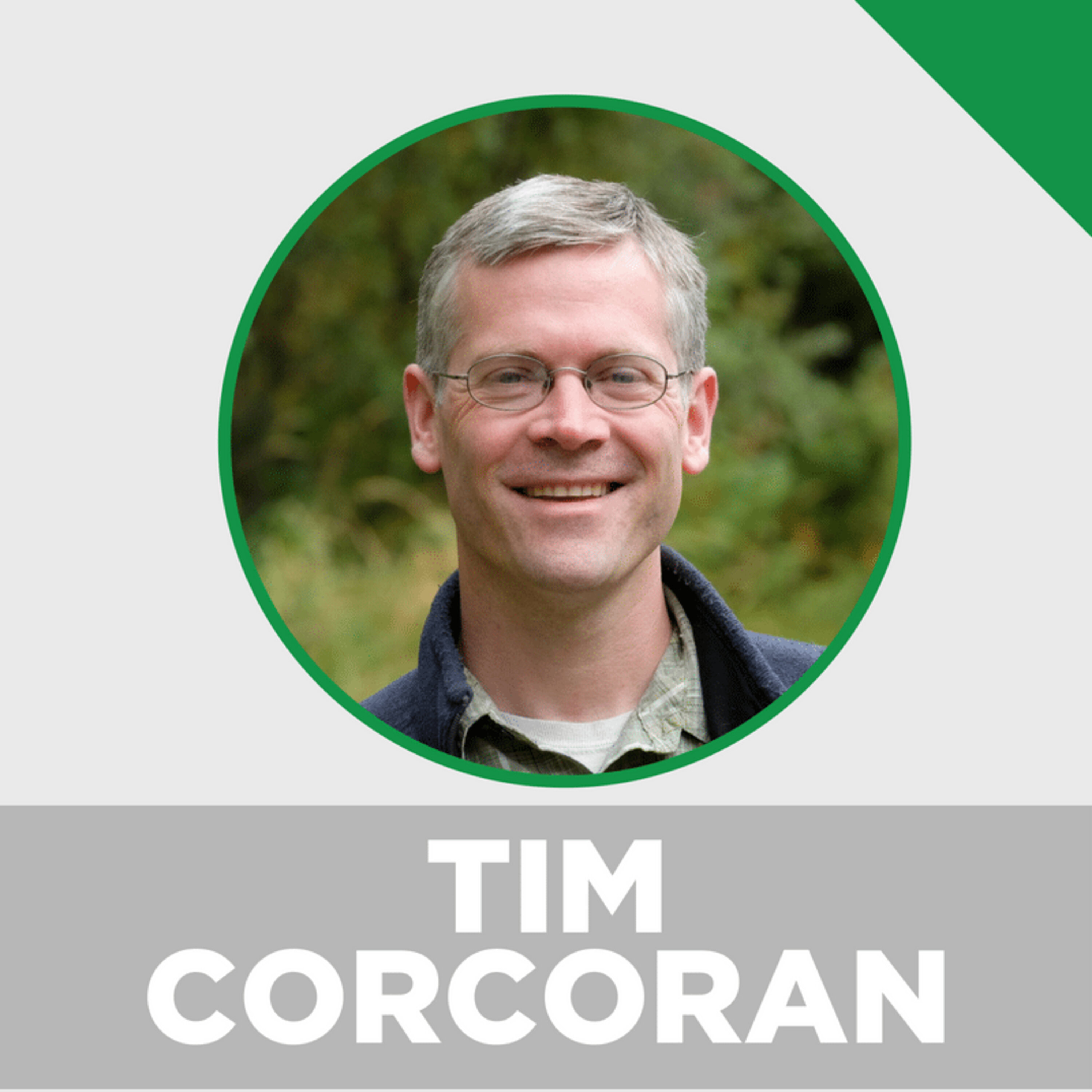
How To Go On A Vision Quest & Embark Upon A Rite Of Passage.
I first met Tim Corcoran when I was looking for a local plant expert to teach me more about wild plant foraging. Not only did he come to my house to record this podcast episode, but we also shot a host of videos in which he taught me and my boys how to harvest plants from our land such as wild nettle, mullein, comfrey, oregon grape root, wild mint and beyond.
This guy is a true wealth of wilderness knowledge. As a matter of fact, each year I send my children to attend his wilderness survival camp and also his winter adventure camp. Tim himself is a heart centered father of two brilliant boys and husband to a magnificent wife.
Recently, I was talking to Tim about the concept of vision quests and rites of passage - for both youth and adults alike, and he told me about a new program he is creating to achieve just that - a program based on a concept he calls "Purpose Mountain".
Tim is the founder of Purpose Mountain, where he offers Nature Based Purpose Guidance to support people with a love for wild nature who feel a deep yearning and a burning desire to discover their purpose, as well as work with resistance and fears through the Ecology of Self and Voice Dialogue.
Tim also serves as co-Director of Twin Eagles Wilderness School, an organization he co-founded with his wife, Jeannine Tidwell, in Sandpoint, Idaho in 2005 dedicated to facilitating deep nature connection mentoring, cultural restoration, and inner tracking. Tim is a leader of men’s groups, holistic rites of passage for boys, and wilderness quests, guiding and initiating men and boys into the new paradigm of the mature masculine.
Since 1999, Tim has dedicated his life towards consciously furthering this vision of living in balance with the Earth, community, family, and self. Healing the cultural rift between the mainstream and indigenous cultures, transformational consciousness work, the spiritual journey, ancestral work, deep nature connection, family and health are all deep commitments in his life.
During our discussion, you'll discover:
-Why men and women these days suffer from lack of a proper transition from childhood into adulthood...10:00
-Ancestral societies that have a rite of passage, such as the Australian aborigine walkabout...12:00
-The difference between a vision quest and a rite of passage...17:45
-The right age to embark upon a rite of passage, and why adults should also do a rite of passage...23:00
-Tim's story of how a moose nearly killed him during his rite of passage but eventually became part of his growing experience...44:30
-What a rite of passage actually looks like for a boy vs. a man...55:30
-Why Tim refers to his rite of passage as "Purpose Mountain"...1:09:00
-And much more!
Resources from this episode:
-Twin Eagles Wilderness School
-My first podcast with Tim about how to find wild edibles in your backyard
-My podcast with Paul Chek in which we discuss vision quests and rites of passage
-King, Warrior, Magician, Lover book
-Way Of The Superior Man book
Episode Sponsors
-Gainswave Get 30% off your first treatment!
-Penguin/Random House Audiobooks Sign up and your first audio book is free!
-Organifi Use promo code “greenfield” and get 20% off your order.
Do you have questions, thoughts or feedback for Tim or me? Leave your comments at http://bengreenfieldfitness.com/purpose and one of us will reply!
See omnystudio.com/listener for privacy information.
Available Results
Generated results are saved to your library for reuse and search.
Choose Template
Pick the result you want. You can review provider and model before generating.
A concise first-pass summary for understanding the episode quickly.
A comprehensive, source-grounded extraction of the reusable knowledge in an episode.
A comprehensive extraction focused on health practices, protocols, claims, and safety caveats.
A dedicated analysis of warnings, limitations, trade-offs, weak evidence, and uncertainty.
Repeatable methods, frameworks, mental models, processes, and systems.
A comprehensive extraction focused on opportunities, strategy, markets, and company building.
A concise first-pass summary for understanding the episode quickly.
A detailed readable summary organized by chapter or topic.
A navigable map of subjects, topic flow, and suggested chapters.
A comprehensive, source-grounded extraction of the reusable knowledge in an episode.
Reusable atomic knowledge units extracted from the episode.
A comprehensive extraction focused on health practices, protocols, claims, and safety caveats.
A comprehensive extraction focused on opportunities, strategy, markets, and company building.
Explicit actions, next steps, habits, recommendations, and things to avoid.
A dedicated inventory of concrete resources named in the episode.
A dedicated analysis of warnings, limitations, trade-offs, weak evidence, and uncertainty.
A concise first-pass summary for understanding the episode quickly.
A detailed readable summary organized by chapter or topic.
A navigable map of subjects, topic flow, and suggested chapters.
A comprehensive, source-grounded extraction of the reusable knowledge in an episode.
Reusable atomic knowledge units extracted from the episode.
A comprehensive extraction focused on health practices, protocols, claims, and safety caveats.
A comprehensive extraction focused on opportunities, strategy, markets, and company building.
Scientific findings, mechanisms, studies, hypotheses, and the limits of the evidence discussed.
Technologies, AI models, technical methods, capabilities, limitations, and adoption implications.
Investment theses, assets, catalysts, valuation reasoning, time horizons, and risks.
Chronologies, actors, causes, consequences, turning points, and competing historical interpretations.
Policies, proposals, stakeholders, arguments, implementation constraints, and predicted effects.
Career paths, skills, hiring signals, workplace decisions, transitions, and limitations of the advice.
Behavioral mechanisms, biases, motivation, habits, emotions, interventions, and evidence limitations.
Economic mechanisms, incentives, indicators, market structure, forecasts, and uncertainty.
Leadership principles, team systems, organizational design, culture, feedback, and failure modes.
Audience, positioning, messaging, acquisition, retention, experiments, metrics, and failed approaches.
Teaching methods, learning strategies, practice, feedback, assessment, and effectiveness evidence.
Theses, premises, arguments, objections, values, thought experiments, and unresolved questions.
Communication patterns, conflict, boundaries, expectations, repair methods, and contextual limitations.
Books, papers, authors, courses, and other learning resources mentioned in the episode.
Repeatable methods, frameworks, mental models, processes, and systems.
Explicit actions, next steps, habits, recommendations, and things to avoid.
Memorable statements and important claims with attribution and source context.
A dedicated inventory of concrete resources named in the episode.
A dedicated analysis of warnings, limitations, trade-offs, weak evidence, and uncertainty.