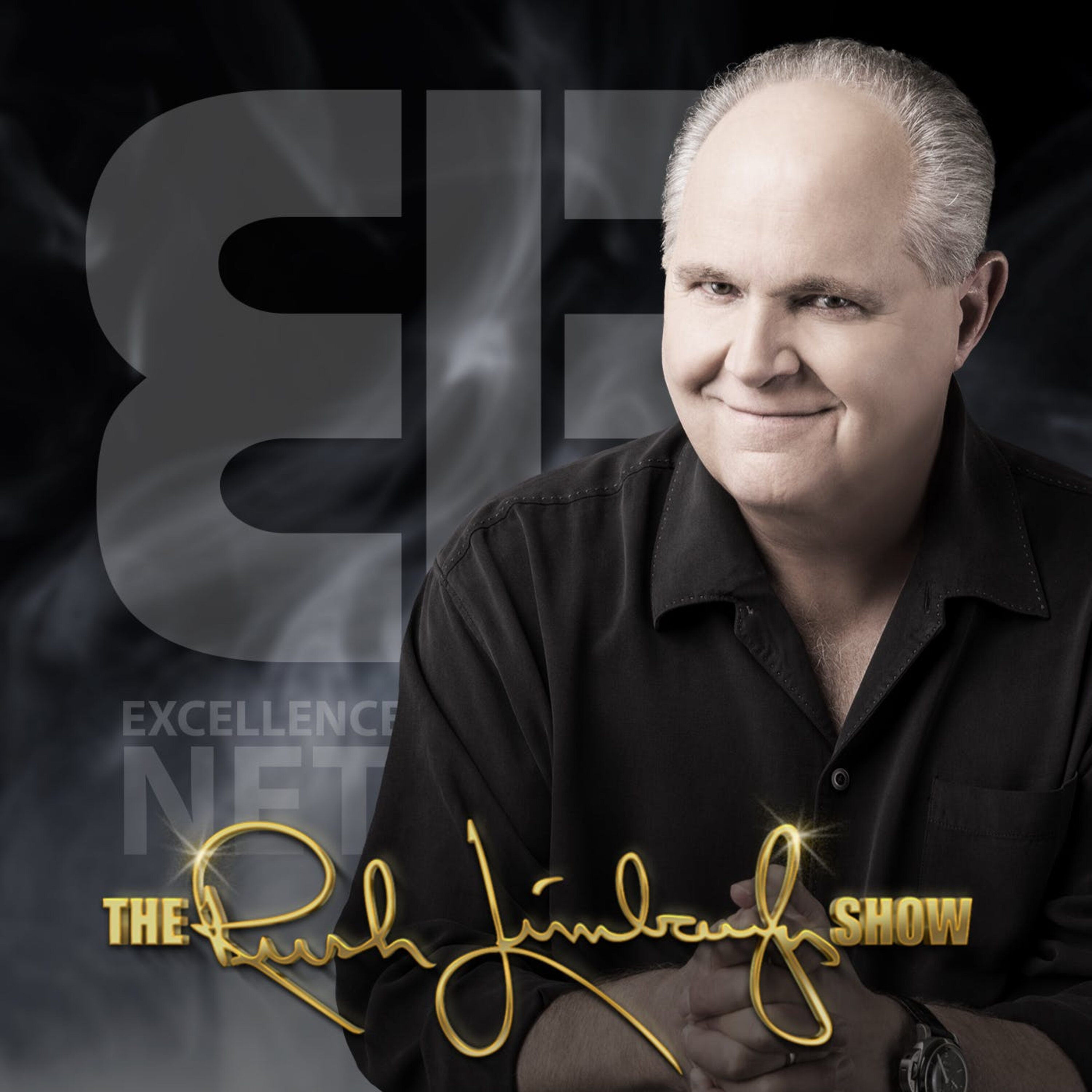
The Rush Limbaugh Show Podcast - Oct 19 2020
PODCAST SUMMARY HOUR 1:
Rush gives an update on his health: It's a roller coaster. Cancer has progressed slightly after regression. The baseball analogy: Stuck on second base, hoping to steal third and head home. Rush thanks the audience, for listernership, ratings through the roof. Rush reveals after his cancer diagnosis in January, he never thought he'd be alive in October. But now, the future looks bright. Polls tightening, Thaddeus McCotter column on Trump vs. Biden. No excitement for Biden or issues he represents, entire Democrat campaign is based on hating Trump's personality. Biden-Harris is a generic ballot. Trafalgar Group pollster Robert Cahaly predicts a Trump victory, but warns of potential for voter fraud in Pennsylvania.
PODCAST SUMMARY HOUR 2:
Campaign puts lid on Biden until the debate. Debate moderator Kristen Welker of NBC in the tank for Biden. Democrats blame Russia for Hunter Biden emails. Biden can't answer questions about what's on Hunter's computer. Fauxcahontas says Trump is a threat to life on earth. Rush in August on Biden's "listen to the scientists" argument. Harvard Law professor: Rush and Trump have shrunk the GOP base. Rush's new twitter handle: @RealRLimbaugh. Trump supporter thinks Trump has to act more presidential, less combative at the next debate or he'll lose. Rush thinks Trump will change strategy at next debate. Trump predicts victory, touts positive early voting numbers. Kristen Welker, longtime Democrat, announces topics for debate. Welker caught on tape in 2016 giving Hillary staffer questions in advance. Trump talking about Hunter's drug addiction, makes people uncomfortable. Joe runs the Biden crime family, not Hunter.
PODCAST SUMMARY HOUR 3:
Rush explains how Joe Biden used his drug-addicted son as part of his 47-year scheme to get rich in Washington. Schiff says Hunter's laptop is Russian disinformation from the Kremlin. DNI Ratcliffe says it's not Russian disinformation. Andrea Mitchell NBC News says that emails can't be verified, but they can and have been. Trump's strategy at first debate was suspect. Trump's personal attacks worked in 2016. Kristen Welker as debate moderator. Dr. Fauci: Cancel Thanksgiving. Our side is capable of fighting a legal war over ballot fraud. Did COVID impact Trump's first debate performance? New Yorker suspends Jeffrey Toobin for exposing himself on Zoom call.
Learn more about your ad-choices at https://www.iheartpodcastnetwork.com
Follow Clay & Buck on YouTube: https://www.youtube.com/c/clayandbuck
See omnystudio.com/listener for privacy information.
Available Results
Generated results are saved to your library for reuse and search.
Choose Template
Pick the result you want. You can review provider and model before generating.
A concise first-pass summary for understanding the episode quickly.
A comprehensive, source-grounded extraction of the reusable knowledge in an episode.
A comprehensive extraction focused on health practices, protocols, claims, and safety caveats.
A dedicated analysis of warnings, limitations, trade-offs, weak evidence, and uncertainty.
Repeatable methods, frameworks, mental models, processes, and systems.
A comprehensive extraction focused on opportunities, strategy, markets, and company building.
A concise first-pass summary for understanding the episode quickly.
A detailed readable summary organized by chapter or topic.
A navigable map of subjects, topic flow, and suggested chapters.
A comprehensive, source-grounded extraction of the reusable knowledge in an episode.
Reusable atomic knowledge units extracted from the episode.
A comprehensive extraction focused on health practices, protocols, claims, and safety caveats.
A comprehensive extraction focused on opportunities, strategy, markets, and company building.
Explicit actions, next steps, habits, recommendations, and things to avoid.
A dedicated inventory of concrete resources named in the episode.
A dedicated analysis of warnings, limitations, trade-offs, weak evidence, and uncertainty.
A concise first-pass summary for understanding the episode quickly.
A detailed readable summary organized by chapter or topic.
A navigable map of subjects, topic flow, and suggested chapters.
A comprehensive, source-grounded extraction of the reusable knowledge in an episode.
Reusable atomic knowledge units extracted from the episode.
A comprehensive extraction focused on health practices, protocols, claims, and safety caveats.
A comprehensive extraction focused on opportunities, strategy, markets, and company building.
Scientific findings, mechanisms, studies, hypotheses, and the limits of the evidence discussed.
Technologies, AI models, technical methods, capabilities, limitations, and adoption implications.
Investment theses, assets, catalysts, valuation reasoning, time horizons, and risks.
Chronologies, actors, causes, consequences, turning points, and competing historical interpretations.
Policies, proposals, stakeholders, arguments, implementation constraints, and predicted effects.
Career paths, skills, hiring signals, workplace decisions, transitions, and limitations of the advice.
Behavioral mechanisms, biases, motivation, habits, emotions, interventions, and evidence limitations.
Economic mechanisms, incentives, indicators, market structure, forecasts, and uncertainty.
Leadership principles, team systems, organizational design, culture, feedback, and failure modes.
Audience, positioning, messaging, acquisition, retention, experiments, metrics, and failed approaches.
Teaching methods, learning strategies, practice, feedback, assessment, and effectiveness evidence.
Theses, premises, arguments, objections, values, thought experiments, and unresolved questions.
Communication patterns, conflict, boundaries, expectations, repair methods, and contextual limitations.
Books, papers, authors, courses, and other learning resources mentioned in the episode.
Repeatable methods, frameworks, mental models, processes, and systems.
Explicit actions, next steps, habits, recommendations, and things to avoid.
Memorable statements and important claims with attribution and source context.
A dedicated inventory of concrete resources named in the episode.
Numbers, percentages, dates, quantities, benchmarks, and study results with their source context.
A dedicated analysis of warnings, limitations, trade-offs, weak evidence, and uncertainty.
Claims mapped to the support, counterarguments, uncertainty, and verification needs mentioned in the episode.
Decisions, options, arguments, constraints, trade-offs, unknowns, and speaker preferences.
Speaker positions, areas of agreement, disagreements, reasoning, and unresolved tensions.