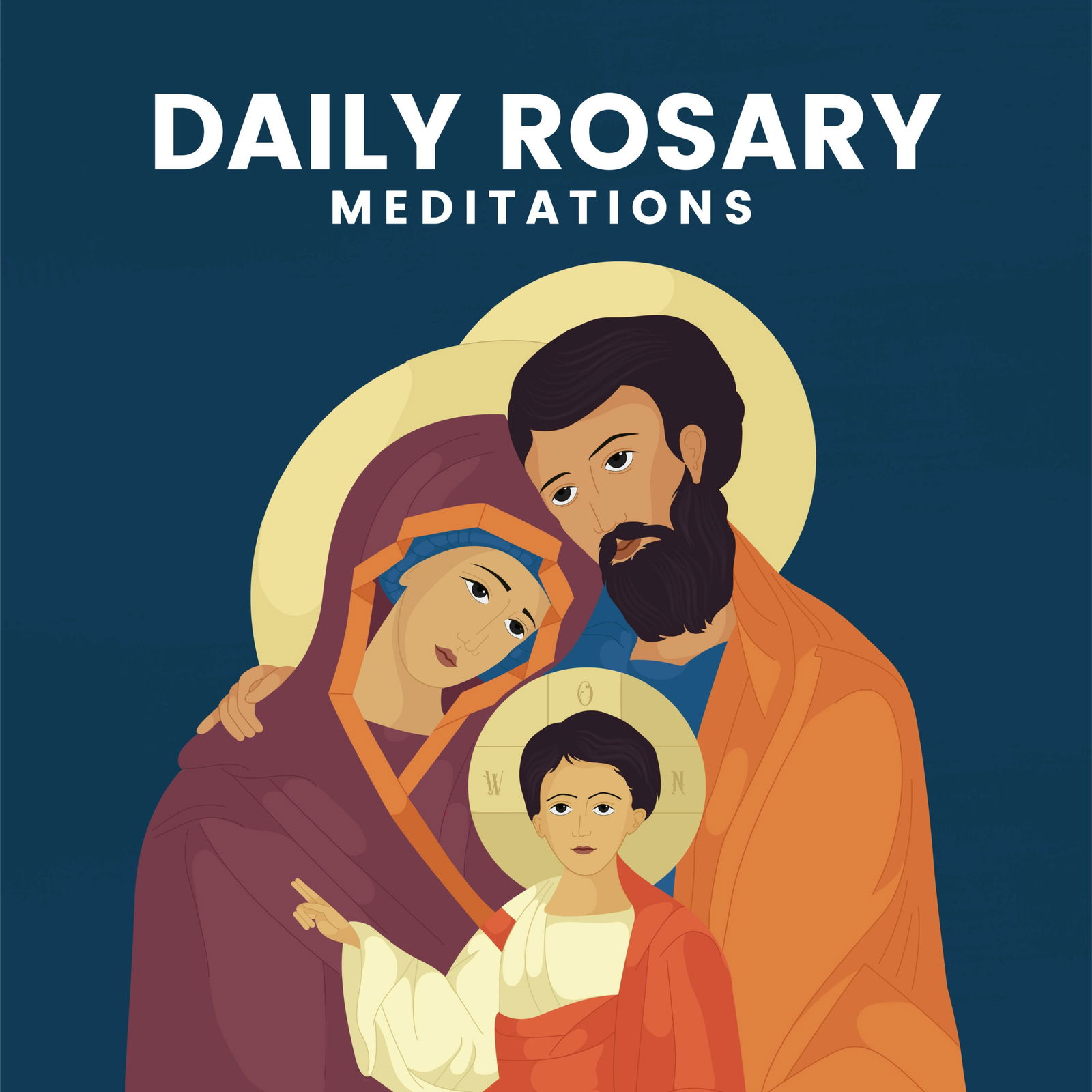
Our Lady of the Rosary
Today October 7, is the Feast of Our Lady of the Rosary, originally the Feast of Our Lady of Victory, because when the victory comes it will come through the Rosary!
Throughout the 1500s, the Muslim Ottoman Empire grew in strength, especially by means of its domination of the Mediterranean Sea. In 1571, their fleet of 300 ships was massed, just south of Greece, in the Gulf of Lepanto, poised to invade Europe and wipe out Christianity. Pope St. Pius V saw this danger looming on the horizon. In response, he begged the leaders of the West to stop fighting among themselves and unite against the force that was a threat to all. But they were too consumed with building their own kingdoms to come to the defense of the Kingdom of God. So he turned to the Christian people, asking them to take up the weapon of the Rosary and pray it daily.
Pope St. Pius V finally found support in Don Juan of Austria, who cobbled together a much smaller fleet of about 200 ships. Giovanni Andrea, a Genoese admiral, agreed to lead the Christian armada against the Islamic onslaught. He possessed one of only five copies of Our Lady of Guadalupe and had been touched to the original Tilma, a gift from the King of Spain, which he hung in his flagship. On October 6, 1571, the night before the battle, Don Juan required all his sailors and soldiers to pray the Rosary while St. Pius V himself led the rosary at the Church of Santa Maria Sopra Minerva in Rome. He knew that if Europe was to be saved, it would only be through the intervention of the Mother of God and the Rosary.
On October 7, 1571, the Christian and Muslim fleets entered into Battle in the bay, south of the town of Lepanto (Greece). The Muslim fleet, led by Ali Pasha, arranged in the formation of a massive quarter moon. The Christian fleet was arranged in the shape of a cross, divided into three squadrons: left, center, and right. The battle started badly for the Christians: the Muslim fleet broke through the left and center squadrons, heading right for Admiral Doria’s ship. Doria slipped down to his cabin, where he had hung the painting of Our Lady of Guadalupe, fell on his knees and began to pray the Rosary. At that moment, the winds shifted against the Islamic fleet and scattered it. The Christians regrouped and destroyed two-thirds of the Ottoman armada. It is said that the sea was red with blood for miles around by the end of the battle.
In Rome, Pope Pius V knew the Christians were victorious before a message could possibly have reached him. During a meeting in the Vatican the pope suddenly rose up and gazed out the window, saying “This is not a moment for business; make haste to thank God, because our fleet this moment has won a victory over the Turks.” When the official news reached Rome, Pope Pius V gave credit to the Virgin Mary. He declared October 7th the Feast of Our Lady of Victory, which we celebrate today as the Feast of Our Lady of the Rosary, because the victory came through the power of the Rosary.
At Fatima Mary promised that in the end Her Immaculate Heart would Triumph. But she made it clear the Triumph would only come IF we did our part and use the weapon she has given us: The Rosary.
At San Nicolas Mary said: “The weapon that has the greatest influence on evil is to say the Rosary."
Sister Lucia dos Santos of Fatima said, "The Most Holy Virgin in these last times in which we live has given a new efficacy to the recitation of the Rosary to such an extent that there is no problem, no matter how difficult it is, whether temporal or above all spiritual, in the personal life of each one of us, of our families…that cannot be solved by the Rosary. There is no problem, I tell you, no matter how difficult it is, that we cannot resolve by the prayer of the Holy Rosary.”
Available Results
Generated results are saved to your library for reuse and search.
Choose Template
Pick the result you want. You can review provider and model before generating.
A concise first-pass summary for understanding the episode quickly.
A comprehensive, source-grounded extraction of the reusable knowledge in an episode.
A comprehensive extraction focused on opportunities, strategy, markets, and company building.
Explicit actions, next steps, habits, recommendations, and things to avoid.
Repeatable methods, frameworks, mental models, processes, and systems.
A dedicated inventory of concrete resources named in the episode.
A concise first-pass summary for understanding the episode quickly.
A detailed readable summary organized by chapter or topic.
A navigable map of subjects, topic flow, and suggested chapters.
A comprehensive, source-grounded extraction of the reusable knowledge in an episode.
Reusable atomic knowledge units extracted from the episode.
A comprehensive extraction focused on health practices, protocols, claims, and safety caveats.
A comprehensive extraction focused on opportunities, strategy, markets, and company building.
Explicit actions, next steps, habits, recommendations, and things to avoid.
A dedicated inventory of concrete resources named in the episode.
A dedicated analysis of warnings, limitations, trade-offs, weak evidence, and uncertainty.
A concise first-pass summary for understanding the episode quickly.
A detailed readable summary organized by chapter or topic.
A navigable map of subjects, topic flow, and suggested chapters.
A comprehensive, source-grounded extraction of the reusable knowledge in an episode.
Reusable atomic knowledge units extracted from the episode.
A comprehensive extraction focused on health practices, protocols, claims, and safety caveats.
A comprehensive extraction focused on opportunities, strategy, markets, and company building.
Scientific findings, mechanisms, studies, hypotheses, and the limits of the evidence discussed.
Technologies, AI models, technical methods, capabilities, limitations, and adoption implications.
Investment theses, assets, catalysts, valuation reasoning, time horizons, and risks.
Chronologies, actors, causes, consequences, turning points, and competing historical interpretations.
Policies, proposals, stakeholders, arguments, implementation constraints, and predicted effects.
Career paths, skills, hiring signals, workplace decisions, transitions, and limitations of the advice.
Behavioral mechanisms, biases, motivation, habits, emotions, interventions, and evidence limitations.
Economic mechanisms, incentives, indicators, market structure, forecasts, and uncertainty.
Leadership principles, team systems, organizational design, culture, feedback, and failure modes.
Audience, positioning, messaging, acquisition, retention, experiments, metrics, and failed approaches.
Teaching methods, learning strategies, practice, feedback, assessment, and effectiveness evidence.
Theses, premises, arguments, objections, values, thought experiments, and unresolved questions.
Communication patterns, conflict, boundaries, expectations, repair methods, and contextual limitations.
Books, papers, authors, courses, and other learning resources mentioned in the episode.
Repeatable methods, frameworks, mental models, processes, and systems.
Explicit actions, next steps, habits, recommendations, and things to avoid.
Memorable statements and important claims with attribution and source context.
A dedicated inventory of concrete resources named in the episode.
A dedicated analysis of warnings, limitations, trade-offs, weak evidence, and uncertainty.