The Aztec Sun Stone
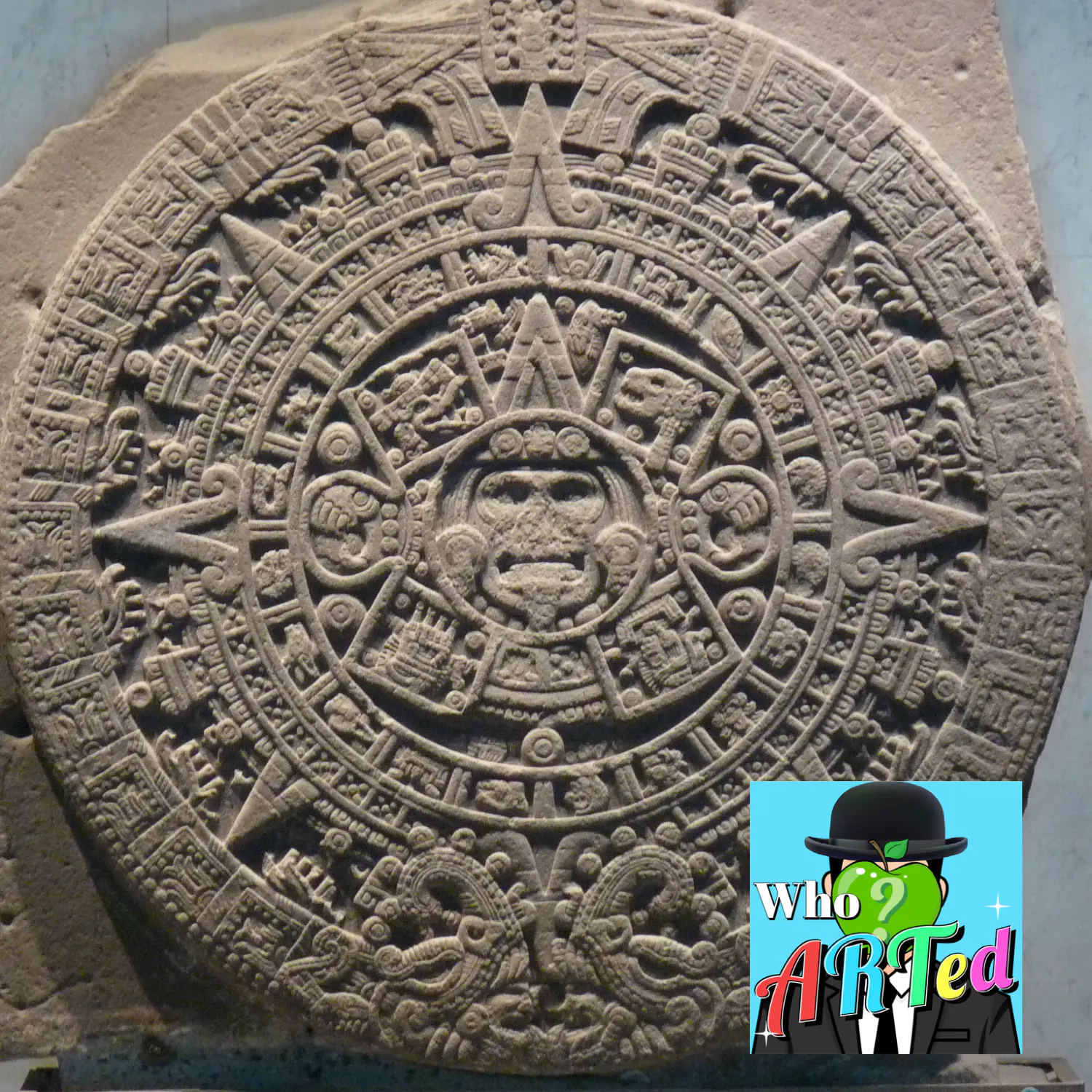
The Sun Stone is probably the first bit of Aztec art I became familiar with even before I studied art. It has been widely represented in various forms of culture from the relatively recent Mexican folk art tradition of Amate paintings to pop culture such as Legends of the Hidden Temple which I must confess was one of my favorite Nickelodeon game shows in the 90s. On its face, we see a beautiful image full of symbols laid out in radial symmetry that is just so visually satisfying, But as we look a little closer and get to know the symbols, this stone image is a lot deeper and heavier than I realized.
The Aztec Sun Stone is also often referred to as the Calendar Stone, but it wasn’t intended to function in the way we use calendars today. The image is a representation of Aztec mythology describing five consecutive worlds of the sun all carved into the elaborate radial stone glyph. While the calendar stone was not used to mark the passing of days and months, it does have a date represented at the top. 13 Reed represents the start of the fifth and final sun, as well as the year that Itzcoatl began his rule thus legitimizing his rule with a link between the divine and man in the year 1427CE
When the Sun Stone was discovered, it was flipped upside down. It is believed that the Aztecs may have flipped it upside down in order to prevent the final cataclysm, the fall of the fifth sun. Flipping the stone would have been no easy feat considering it is about 3 and a half meters wide, almost a meter thick and weighs in at 25 tons although I suppose people will do whatever they can to fend off the end of the world. Now putting this into a historical context, remember that this stone was created in the 15th century and the late 15th century is when Columbus and other European explorers began to make contact with the Americas. About 100 years after The Sun Stone was created, the Spanish conquistadors did effectively end the Aztec civilization so their apocalyptic notion of the 5th sun being the final really wasn’t so far off. While the sun didn’t fall to the earth, it was the end of their era.
Who ARTed is an Airwave Media Podcast.
Connect with me:
Website | Twitter | Instagram | Tiktok
Support the show:
Merch from TeePublic | Buy me a coffee
As always you can find images of the work being discussed at www.WhoARTedPodcast.com and of course, please leave a rating or review on your favorite podcast app. You might hear it read out on the show.
Learn more about your ad choices. Visit megaphone.fm/adchoices
Available Results
Generated results are saved to your library for reuse and search.
Choose Template
Pick the result you want. You can review provider and model before generating.
A concise first-pass summary for understanding the episode quickly.
A comprehensive, source-grounded extraction of the reusable knowledge in an episode.
Technologies, AI models, technical methods, capabilities, limitations, and adoption implications.
Repeatable methods, frameworks, mental models, processes, and systems.
A dedicated analysis of warnings, limitations, trade-offs, weak evidence, and uncertainty.
A dedicated inventory of concrete resources named in the episode.
A concise first-pass summary for understanding the episode quickly.
A detailed readable summary organized by chapter or topic.
A navigable map of subjects, topic flow, and suggested chapters.
A comprehensive, source-grounded extraction of the reusable knowledge in an episode.
Reusable atomic knowledge units extracted from the episode.
A comprehensive extraction focused on health practices, protocols, claims, and safety caveats.
A comprehensive extraction focused on opportunities, strategy, markets, and company building.
Explicit actions, next steps, habits, recommendations, and things to avoid.
A dedicated inventory of concrete resources named in the episode.
A dedicated analysis of warnings, limitations, trade-offs, weak evidence, and uncertainty.
A concise first-pass summary for understanding the episode quickly.
A detailed readable summary organized by chapter or topic.
A navigable map of subjects, topic flow, and suggested chapters.
A comprehensive, source-grounded extraction of the reusable knowledge in an episode.
Reusable atomic knowledge units extracted from the episode.
A comprehensive extraction focused on health practices, protocols, claims, and safety caveats.
A comprehensive extraction focused on opportunities, strategy, markets, and company building.
Scientific findings, mechanisms, studies, hypotheses, and the limits of the evidence discussed.
Technologies, AI models, technical methods, capabilities, limitations, and adoption implications.
Investment theses, assets, catalysts, valuation reasoning, time horizons, and risks.
Chronologies, actors, causes, consequences, turning points, and competing historical interpretations.
Policies, proposals, stakeholders, arguments, implementation constraints, and predicted effects.
Career paths, skills, hiring signals, workplace decisions, transitions, and limitations of the advice.
Behavioral mechanisms, biases, motivation, habits, emotions, interventions, and evidence limitations.
Economic mechanisms, incentives, indicators, market structure, forecasts, and uncertainty.
Leadership principles, team systems, organizational design, culture, feedback, and failure modes.
Audience, positioning, messaging, acquisition, retention, experiments, metrics, and failed approaches.
Teaching methods, learning strategies, practice, feedback, assessment, and effectiveness evidence.
Theses, premises, arguments, objections, values, thought experiments, and unresolved questions.
Communication patterns, conflict, boundaries, expectations, repair methods, and contextual limitations.
Books, papers, authors, courses, and other learning resources mentioned in the episode.
Repeatable methods, frameworks, mental models, processes, and systems.
Explicit actions, next steps, habits, recommendations, and things to avoid.
Memorable statements and important claims with attribution and source context.
A dedicated inventory of concrete resources named in the episode.
A dedicated analysis of warnings, limitations, trade-offs, weak evidence, and uncertainty.