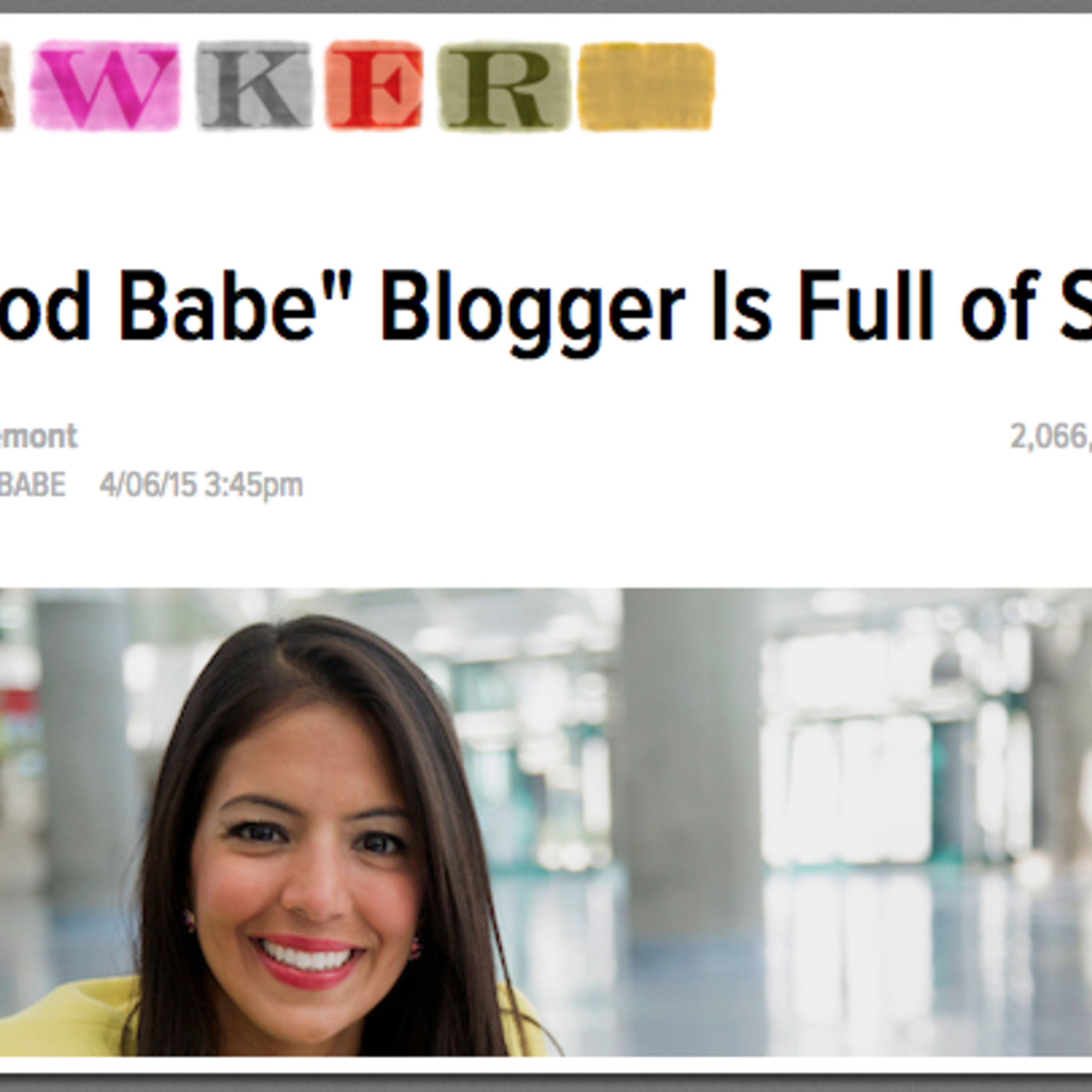
Is The Food Babe Really Full Of Sh*t?
I recently read an article on Gakwer called The "Food Babe" Blogger Is Full of Shit. It was written by today's podcast guest: Yvette d'Entremont.
Yvette, AKA "The Science Babe", has bachelor's degrees in theatre and chemistry along with a master's degree in forensic science. With a background working as an analytical chemist, she currently runs the Science Babe website full time. Her site is an interesting mix of debunking pseudoscience with humor and science. She lives in southern California with her stinky dog, Buddy (who makes a fun cameo in today's podcast).
During our controversial discussion, you'll discover: -Why Yvette thinks that chiropractic treatment is total BS... -Why Yvette, in her post on the "Bullshitproof Diet", calls Dave Asprey a Douchebag... -How Yvette thinks that the Food Babe's Starbucks Pumpkin Spice Latte was blown way out of proportion... -What Yvette thinks is the next most unproven, hyped up, dangerous or scientifically inaccurate trend or fad currently making it's way down the health pipeline... -Why living by the rule "If a third grader can't pronounce it, don't eat it" is a dangerous rule to follow... -The details behind the group on Facebook called "Banned By Food Babe" that boasts nearly 6,000 members... -And much more...
Resources we discuss during this episode: -The Gawker article The "Food Babe" Blogger Is Full of Shit -Public Library of Science (PLOS) -Science Based Medicine -TheNess Neurological Blog -The "Natural Ingredients" In A Blueberry -My article on Bulletproof Coffee Enemas
I imagine that you probably have some thoughts about this podcast. Perhaps some strong thoughts. Leave your comments, questions and feedback at BenGreenfieldFitness.com and I promise to reply!
See omnystudio.com/listener for privacy information.
Available Results
Generated results are saved to your library for reuse and search.
Choose Template
Pick the result you want. You can review provider and model before generating.
A concise first-pass summary for understanding the episode quickly.
A comprehensive, source-grounded extraction of the reusable knowledge in an episode.
A comprehensive extraction focused on health practices, protocols, claims, and safety caveats.
A dedicated analysis of warnings, limitations, trade-offs, weak evidence, and uncertainty.
Repeatable methods, frameworks, mental models, processes, and systems.
Scientific findings, mechanisms, studies, hypotheses, and the limits of the evidence discussed.
A concise first-pass summary for understanding the episode quickly.
A detailed readable summary organized by chapter or topic.
A navigable map of subjects, topic flow, and suggested chapters.
A comprehensive, source-grounded extraction of the reusable knowledge in an episode.
Reusable atomic knowledge units extracted from the episode.
A comprehensive extraction focused on health practices, protocols, claims, and safety caveats.
A comprehensive extraction focused on opportunities, strategy, markets, and company building.
Explicit actions, next steps, habits, recommendations, and things to avoid.
A dedicated inventory of concrete resources named in the episode.
A dedicated analysis of warnings, limitations, trade-offs, weak evidence, and uncertainty.
A concise first-pass summary for understanding the episode quickly.
A detailed readable summary organized by chapter or topic.
A navigable map of subjects, topic flow, and suggested chapters.
A comprehensive, source-grounded extraction of the reusable knowledge in an episode.
Reusable atomic knowledge units extracted from the episode.
A comprehensive extraction focused on health practices, protocols, claims, and safety caveats.
A comprehensive extraction focused on opportunities, strategy, markets, and company building.
Scientific findings, mechanisms, studies, hypotheses, and the limits of the evidence discussed.
Technologies, AI models, technical methods, capabilities, limitations, and adoption implications.
Investment theses, assets, catalysts, valuation reasoning, time horizons, and risks.
Chronologies, actors, causes, consequences, turning points, and competing historical interpretations.
Policies, proposals, stakeholders, arguments, implementation constraints, and predicted effects.
Career paths, skills, hiring signals, workplace decisions, transitions, and limitations of the advice.
Behavioral mechanisms, biases, motivation, habits, emotions, interventions, and evidence limitations.
Economic mechanisms, incentives, indicators, market structure, forecasts, and uncertainty.
Leadership principles, team systems, organizational design, culture, feedback, and failure modes.
Audience, positioning, messaging, acquisition, retention, experiments, metrics, and failed approaches.
Teaching methods, learning strategies, practice, feedback, assessment, and effectiveness evidence.
Theses, premises, arguments, objections, values, thought experiments, and unresolved questions.
Communication patterns, conflict, boundaries, expectations, repair methods, and contextual limitations.
Books, papers, authors, courses, and other learning resources mentioned in the episode.
Repeatable methods, frameworks, mental models, processes, and systems.
Explicit actions, next steps, habits, recommendations, and things to avoid.
Memorable statements and important claims with attribution and source context.
A dedicated inventory of concrete resources named in the episode.
A dedicated analysis of warnings, limitations, trade-offs, weak evidence, and uncertainty.