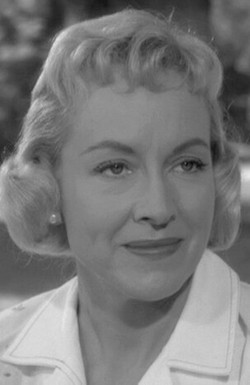
Happy Birthday, Virginia Gregg
Born March 6, 1916, Virginia Gregg could play a glamorous Park Avenue socialite, a demure Chinese woman in the old west, and everything in between. One of the most versatile and talented actresses working in radio (and later television), Virginia Gregg was a presence on so many of the wonderful programs of the radio era - a member of that incredible group of west coast radio players who delivered performances that brought characters to vivid life on the air.
She was born in Harrisburg, Illinois, but her family moved to Pasadena, California when she was five. Gregg was bound for a showbusiness career, albeit a musical one - she played the double bass with the Pasadena Symphony and Pops, and before she went into acting she was part of "The Singing Strings," a group whose performances were featured on the CBS and Mutual Networks.
But it was acting where she made her mark. It may be easier to comprise a list of the programs she didn't visit, as it seems Virginia Gregg covered most of the dial during the Golden Age of Radio. She did comedies (The Jack Benny Program), soap operas (One Man's Family), dramas (Dr. Kildare, Lux Radio Theatre), westerns (Gunsmoke, Frontier Gentleman), and detective shows.
Radio detective show fans will recognize Virginia Gregg as two of radio's best Girl Fridays. She played Claire "Brooksie" Brooks opposite Bob Bailey in Let George Do It, and Dick Powell crooned to her as Helen Asher in Richard Diamond, Private Detective. In the case of Richard Diamond, her versatility allowed her to double as other characters in the cast. Gregg married frequent Diamond director Jaime del Valle, and the two had three children before they divorced.
She appeared regularly on the 1950s and 1960s TV incarnations of Dragnet as well as the 1954 movie version. No surprise there, as Jack Webb was a huge fan, describing Gregg as "the actress' actress," and she was frequently heard on the Dragnet radio program. She made multiple appearances on Perry Mason opposite her occasional radio co-star Raymond Burr, and she was a regular presence in dozens of classic TV dramas through the 1970s - Mannix, Have Gun - Will Travel, Ironside, The Streets of San Francisco, Rawhide, Cannon (reuniting her with another old time radio vet - William Conrad), and many, many more.
Virginia Gregg worked in films as well, even though she did most of her work on the small screen. Her most famous (albeit off-screen) movie role may have been as the voice of Mrs. Bates in Alfred Hitchcock's Psycho. It was a role she shared with Paul Jasmin and Jeanette Nolan, another veteran radio player. Gregg was the sole performer for the voice in the sequels Psycho II and Psycho III; the latter would be her final credit before she passed away in 1986.
In a 1959 interview, Virginia Gregg said "I work steadily, but I have no identity." Old time radio fans would say she sold herself short. While she was rarely spotlighted in lead on-screen roles, the versatility she honed as a radio actor earned her a career that spanned five decades.
Available Results
Generated results are saved to your library for reuse and search.
Choose Template
Pick the result you want. You can review provider and model before generating.
A concise first-pass summary for understanding the episode quickly.
A comprehensive, source-grounded extraction of the reusable knowledge in an episode.
A comprehensive extraction focused on opportunities, strategy, markets, and company building.
Explicit actions, next steps, habits, recommendations, and things to avoid.
Repeatable methods, frameworks, mental models, processes, and systems.
A dedicated inventory of concrete resources named in the episode.
A concise first-pass summary for understanding the episode quickly.
A detailed readable summary organized by chapter or topic.
A navigable map of subjects, topic flow, and suggested chapters.
A comprehensive, source-grounded extraction of the reusable knowledge in an episode.
Reusable atomic knowledge units extracted from the episode.
A comprehensive extraction focused on health practices, protocols, claims, and safety caveats.
A comprehensive extraction focused on opportunities, strategy, markets, and company building.
Explicit actions, next steps, habits, recommendations, and things to avoid.
A dedicated inventory of concrete resources named in the episode.
A dedicated analysis of warnings, limitations, trade-offs, weak evidence, and uncertainty.
A concise first-pass summary for understanding the episode quickly.
A detailed readable summary organized by chapter or topic.
A navigable map of subjects, topic flow, and suggested chapters.
A comprehensive, source-grounded extraction of the reusable knowledge in an episode.
Reusable atomic knowledge units extracted from the episode.
A comprehensive extraction focused on health practices, protocols, claims, and safety caveats.
A comprehensive extraction focused on opportunities, strategy, markets, and company building.
Scientific findings, mechanisms, studies, hypotheses, and the limits of the evidence discussed.
Technologies, AI models, technical methods, capabilities, limitations, and adoption implications.
Investment theses, assets, catalysts, valuation reasoning, time horizons, and risks.
Chronologies, actors, causes, consequences, turning points, and competing historical interpretations.
Policies, proposals, stakeholders, arguments, implementation constraints, and predicted effects.
Career paths, skills, hiring signals, workplace decisions, transitions, and limitations of the advice.
Behavioral mechanisms, biases, motivation, habits, emotions, interventions, and evidence limitations.
Economic mechanisms, incentives, indicators, market structure, forecasts, and uncertainty.
Leadership principles, team systems, organizational design, culture, feedback, and failure modes.
Audience, positioning, messaging, acquisition, retention, experiments, metrics, and failed approaches.
Teaching methods, learning strategies, practice, feedback, assessment, and effectiveness evidence.
Theses, premises, arguments, objections, values, thought experiments, and unresolved questions.
Communication patterns, conflict, boundaries, expectations, repair methods, and contextual limitations.
Books, papers, authors, courses, and other learning resources mentioned in the episode.
Repeatable methods, frameworks, mental models, processes, and systems.
Explicit actions, next steps, habits, recommendations, and things to avoid.
Memorable statements and important claims with attribution and source context.
A dedicated inventory of concrete resources named in the episode.
A dedicated analysis of warnings, limitations, trade-offs, weak evidence, and uncertainty.