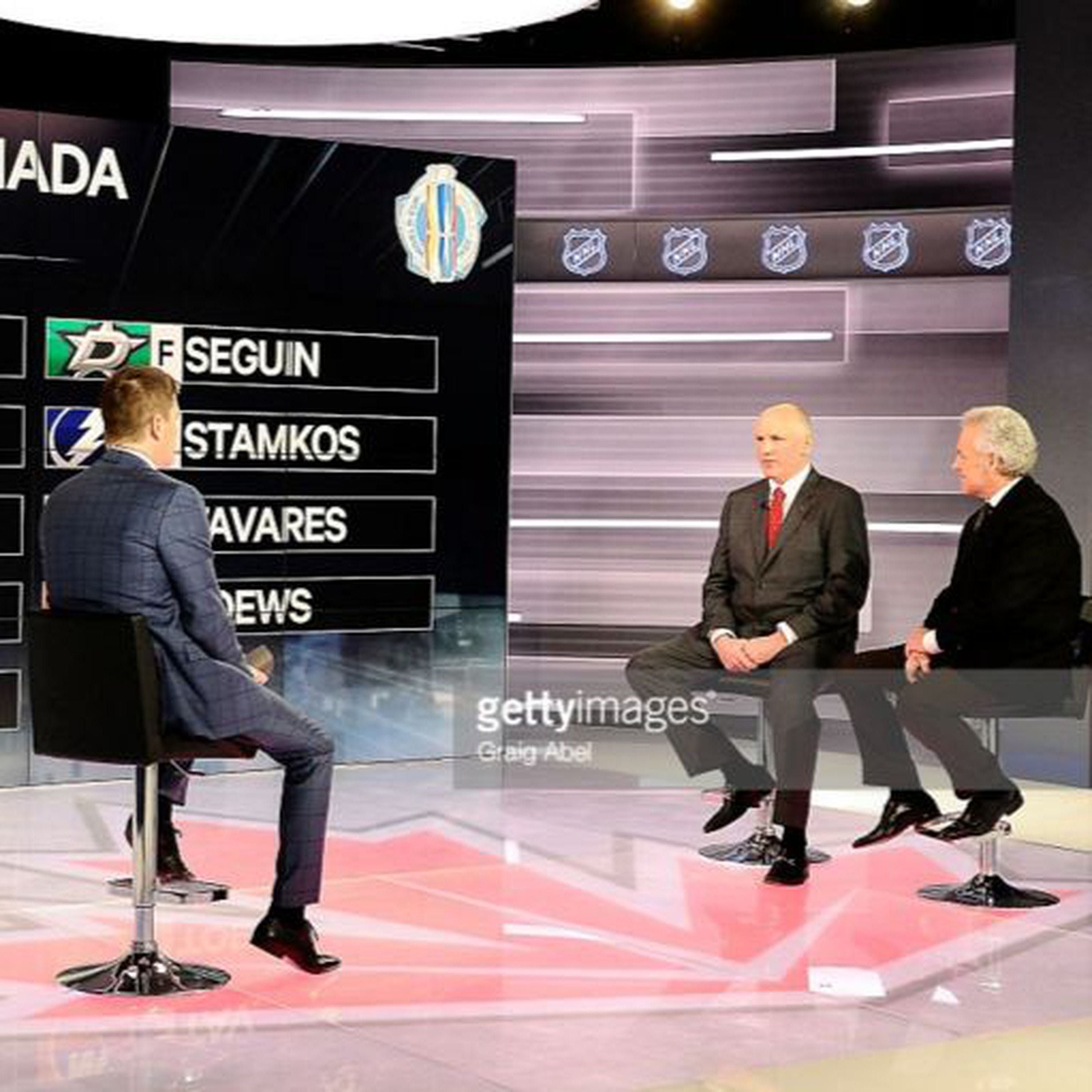
Episode 67: The World Cup of Hockey
With the preliminary rosters for the World Cup of Hockey being announced, Jeff Marek joins the show to help dissect Team Canada, Team North America, and Team Russia. Then we rang Jen Lute Costella up to discuss Team USA's roster and their chances in the tournament.
01:47 - Trade Deadline Day at the Sportsnet studio
05:29 - 'The Sochi Model' for roster construction
08:48 - Injury risk scaring off players from future participation
13:09 - Which Canadian goalie is 2nd in line behind Carey Price
15:19 - Shea Weber being picked over PK Subban
18:14 - The conservative nature of Hockey Canada
23:40 - Brent Burns' value as a defenseman vs. a forward
28:51 - The 3 remaining spots on the Canadian blueline
31:06 - The Canadian tradition of centers sliding over to the wing
32:51 - The biggest omissions from the first 16 invites
35:11 - The speed of the U23 version of Team North America
37:54 - Connor McDavid and Dylan Larkin
41:20 - Sean Couturier's inevitable breakout
42:56 - The disparity in talent between Russia's forwards and defense
46:05 - Players from the KHL being eligible
53:22 - Freshbooks Live Read
54:21 - Jen Lute Costella intro
55:00 - Team USA needing more goal scoring
59:50 - The divide between John Carlson's numbers and the eye test
1:03:43 - Jonathan Quick starting over Cory Schneider
1:09:40 - Handicapping Team USA's chances in the tournament
1:10:23 - How the Blackhawks have regained their form
*Every episode of this podcast is available on iTunes, Soundcloud, and can also be streamed from our website. Make sure to not only subscribe so that you don’t miss out on any new shows as they’re released, but also take a minute to leave us a glowing review.
*This episode is brought to you by Freshbooks, an online accounting service designed to save time and help avoid all of the stresses that come with running a small business. They’re currently offering a free 30-day trial to listeners of our show at Freshbooks.com/PDOcast (just remember to enter “Hockey PDOcast” in the ‘How You Heard About Us’ section).
*Also sponsoring today’s show is SeatGeek, which is making it easier than ever before to buy and sell sports and concert tickets. They’re giving our listeners a $20 rebate off of their first purchase. All you have to do is download the free SeatGeek app and enter the promo code PDO to get started.
Thanks for listening!
See acast.com/privacy for privacy and opt-out information.
Learn more about your ad choices. Visit podcastchoices.com/adchoices
If you'd like to gain access to the two extra shows we're doing each week this season, you can subscribe to our Patreon page here: www.patreon.com/thehockeypdocast/membership
If you'd like to participate in the conversation and join the community we're building over on Discord, you can do so by signing up for the Hockey PDOcast's server here: https://discord.gg/a2QGRpJc84
The views and opinions expressed in this podcast are those of the hosts and guests and do not necessarily reflect the position of Rogers Media Inc. or any affiliate.
Available Results
Generated results are saved to your library for reuse and search.
Choose Template
Pick the result you want. You can review provider and model before generating.
A concise first-pass summary for understanding the episode quickly.
A comprehensive, source-grounded extraction of the reusable knowledge in an episode.
A comprehensive extraction focused on opportunities, strategy, markets, and company building.
Explicit actions, next steps, habits, recommendations, and things to avoid.
Repeatable methods, frameworks, mental models, processes, and systems.
A dedicated inventory of concrete resources named in the episode.
A concise first-pass summary for understanding the episode quickly.
A detailed readable summary organized by chapter or topic.
A navigable map of subjects, topic flow, and suggested chapters.
A comprehensive, source-grounded extraction of the reusable knowledge in an episode.
Reusable atomic knowledge units extracted from the episode.
A comprehensive extraction focused on health practices, protocols, claims, and safety caveats.
A comprehensive extraction focused on opportunities, strategy, markets, and company building.
Explicit actions, next steps, habits, recommendations, and things to avoid.
A dedicated inventory of concrete resources named in the episode.
A dedicated analysis of warnings, limitations, trade-offs, weak evidence, and uncertainty.
A concise first-pass summary for understanding the episode quickly.
A detailed readable summary organized by chapter or topic.
A navigable map of subjects, topic flow, and suggested chapters.
A comprehensive, source-grounded extraction of the reusable knowledge in an episode.
Reusable atomic knowledge units extracted from the episode.
A comprehensive extraction focused on health practices, protocols, claims, and safety caveats.
A comprehensive extraction focused on opportunities, strategy, markets, and company building.
Scientific findings, mechanisms, studies, hypotheses, and the limits of the evidence discussed.
Technologies, AI models, technical methods, capabilities, limitations, and adoption implications.
Investment theses, assets, catalysts, valuation reasoning, time horizons, and risks.
Chronologies, actors, causes, consequences, turning points, and competing historical interpretations.
Policies, proposals, stakeholders, arguments, implementation constraints, and predicted effects.
Career paths, skills, hiring signals, workplace decisions, transitions, and limitations of the advice.
Behavioral mechanisms, biases, motivation, habits, emotions, interventions, and evidence limitations.
Economic mechanisms, incentives, indicators, market structure, forecasts, and uncertainty.
Leadership principles, team systems, organizational design, culture, feedback, and failure modes.
Audience, positioning, messaging, acquisition, retention, experiments, metrics, and failed approaches.
Teaching methods, learning strategies, practice, feedback, assessment, and effectiveness evidence.
Theses, premises, arguments, objections, values, thought experiments, and unresolved questions.
Communication patterns, conflict, boundaries, expectations, repair methods, and contextual limitations.
Books, papers, authors, courses, and other learning resources mentioned in the episode.
Repeatable methods, frameworks, mental models, processes, and systems.
Explicit actions, next steps, habits, recommendations, and things to avoid.
Memorable statements and important claims with attribution and source context.
A dedicated inventory of concrete resources named in the episode.
A dedicated analysis of warnings, limitations, trade-offs, weak evidence, and uncertainty.