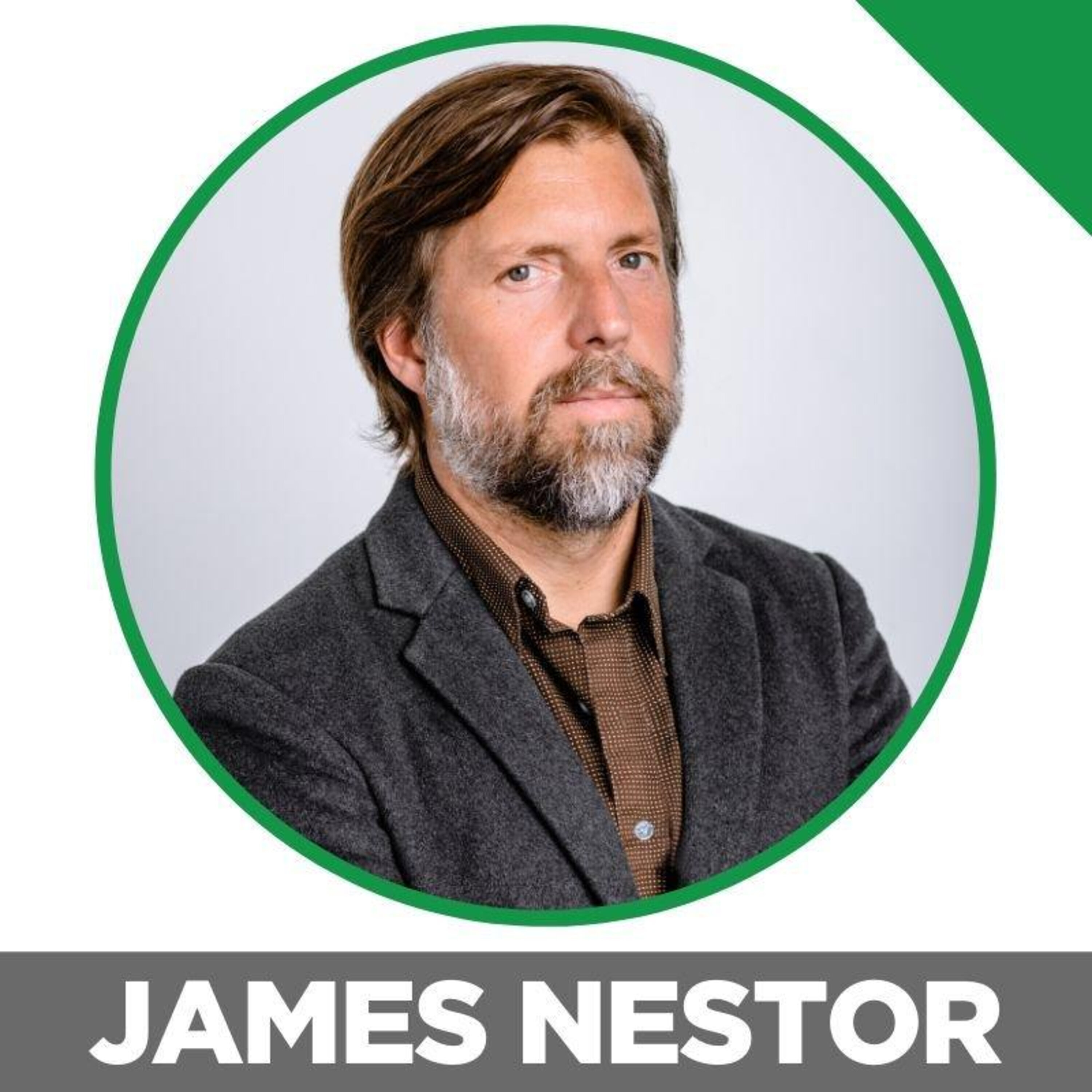
Biohack Your Breath With Nose "Boners", Carbon Dioxide Inhalation, Tibetan Longevity Stretches & Much More: How To Unlock The New Science Of A Lost Art.
bengreenfieldfitness.com/lostart
I first interviewed today's guest, immersive journalist James Nestor, about "freediving" in the episode: The Extreme Sport You’ve Probably Never Heard Of, And How You Can Use Its Renegade Techniques To Become Superhuman. It was such an exciting and intriguing show that afterwards, I wound up traveling all the way to Ft. Lauderdale to take a freediving course, which absolutely changed my life (you can learn more about that in my episode with Ted Harty: The Ultimate Guide To Freediving, Legal Blood Doping, Wim Hof Breathing, Increasing Your Breathhold Time, Underwater Ear Equalizing, Spearfishing & Much More!).
Today James is back to talk about something we all do 25,000 times a day, yet most of us do it incorrectly or haven't even begun to tap into its lost art. That's right. I'm talking about your breath.
In his new book "Breath: The New Science of a Lost Art", James travels the world to figure out what went wrong and how to fix it. The answers aren’t found in pulmonology labs, as we might expect, but in the muddy digs of ancient burial sites, secret Soviet facilities, New Jersey choir schools, and the smoggy streets of São Paulo. Nestor tracks down men and women exploring the hidden science behind ancient breathing practices like Pranayama, Sudarshan Kriya, and Tummo and teams up with pulmonary tinkerers to scientifically test long-held beliefs about how we breathe.
Modern research is showing us that making even slight adjustments to the way we inhale and exhale can jump-start athletic performance; rejuvenate internal organs; halt snoring, asthma, and autoimmune disease; and even straighten scoliotic spines. None of this should be possible, and yet it is.
Drawing on thousands of years of medical texts and recent cutting-edge studies in pulmonology, psychology, biochemistry, and human physiology, James turns the conventional wisdom of what we thought we knew about our most basic biological function on its head. You will never breathe the same again after hearing this podcast.
During our discussion, you'll discover:
-The breath work protocol James uses to begin his day...7:41
-Why James views breath as the "missing pillar" of health...9:55
-What James views as the "dis-evolution" of breathing...14:15
-The truly awful effects of mouth breathing...18:38
-The unusual connection between the clitoris and the nose...24:11
-How the left and right nostril activate the sympathetic and parasympathetic nervous systems...27:44
-Healthy breathing practices of Native American and indigenous S. American populations...30:50
-Changes James made in his lifestyle after writing his book...37:06
-What other cultures and religions can teach us regarding the ideal pace of breathing...47:08
-Tibetan "rites" that help expand the lungs and diaphragm...56:47
-The Tummo method of breathing...1:06:30
-How to biohack your breath work...1:09:55
Episode sponsors: Kion Flex, Butcher Box, Thrive Market, Comrade Socks
bengreenfieldfitness.com/lostart
See omnystudio.com/listener for privacy information.
Available Results
Generated results are saved to your library for reuse and search.
Choose Template
Pick the result you want. You can review provider and model before generating.
A concise first-pass summary for understanding the episode quickly.
A comprehensive, source-grounded extraction of the reusable knowledge in an episode.
A comprehensive extraction focused on health practices, protocols, claims, and safety caveats.
A dedicated analysis of warnings, limitations, trade-offs, weak evidence, and uncertainty.
Repeatable methods, frameworks, mental models, processes, and systems.
Scientific findings, mechanisms, studies, hypotheses, and the limits of the evidence discussed.
A concise first-pass summary for understanding the episode quickly.
A detailed readable summary organized by chapter or topic.
A navigable map of subjects, topic flow, and suggested chapters.
A comprehensive, source-grounded extraction of the reusable knowledge in an episode.
Reusable atomic knowledge units extracted from the episode.
A comprehensive extraction focused on health practices, protocols, claims, and safety caveats.
A comprehensive extraction focused on opportunities, strategy, markets, and company building.
Explicit actions, next steps, habits, recommendations, and things to avoid.
A dedicated inventory of concrete resources named in the episode.
A dedicated analysis of warnings, limitations, trade-offs, weak evidence, and uncertainty.
A concise first-pass summary for understanding the episode quickly.
A detailed readable summary organized by chapter or topic.
A navigable map of subjects, topic flow, and suggested chapters.
A comprehensive, source-grounded extraction of the reusable knowledge in an episode.
Reusable atomic knowledge units extracted from the episode.
A comprehensive extraction focused on health practices, protocols, claims, and safety caveats.
A comprehensive extraction focused on opportunities, strategy, markets, and company building.
Scientific findings, mechanisms, studies, hypotheses, and the limits of the evidence discussed.
Technologies, AI models, technical methods, capabilities, limitations, and adoption implications.
Investment theses, assets, catalysts, valuation reasoning, time horizons, and risks.
Chronologies, actors, causes, consequences, turning points, and competing historical interpretations.
Policies, proposals, stakeholders, arguments, implementation constraints, and predicted effects.
Career paths, skills, hiring signals, workplace decisions, transitions, and limitations of the advice.
Behavioral mechanisms, biases, motivation, habits, emotions, interventions, and evidence limitations.
Economic mechanisms, incentives, indicators, market structure, forecasts, and uncertainty.
Leadership principles, team systems, organizational design, culture, feedback, and failure modes.
Audience, positioning, messaging, acquisition, retention, experiments, metrics, and failed approaches.
Teaching methods, learning strategies, practice, feedback, assessment, and effectiveness evidence.
Theses, premises, arguments, objections, values, thought experiments, and unresolved questions.
Communication patterns, conflict, boundaries, expectations, repair methods, and contextual limitations.
Books, papers, authors, courses, and other learning resources mentioned in the episode.
Repeatable methods, frameworks, mental models, processes, and systems.
Explicit actions, next steps, habits, recommendations, and things to avoid.
Memorable statements and important claims with attribution and source context.
A dedicated inventory of concrete resources named in the episode.
A dedicated analysis of warnings, limitations, trade-offs, weak evidence, and uncertainty.