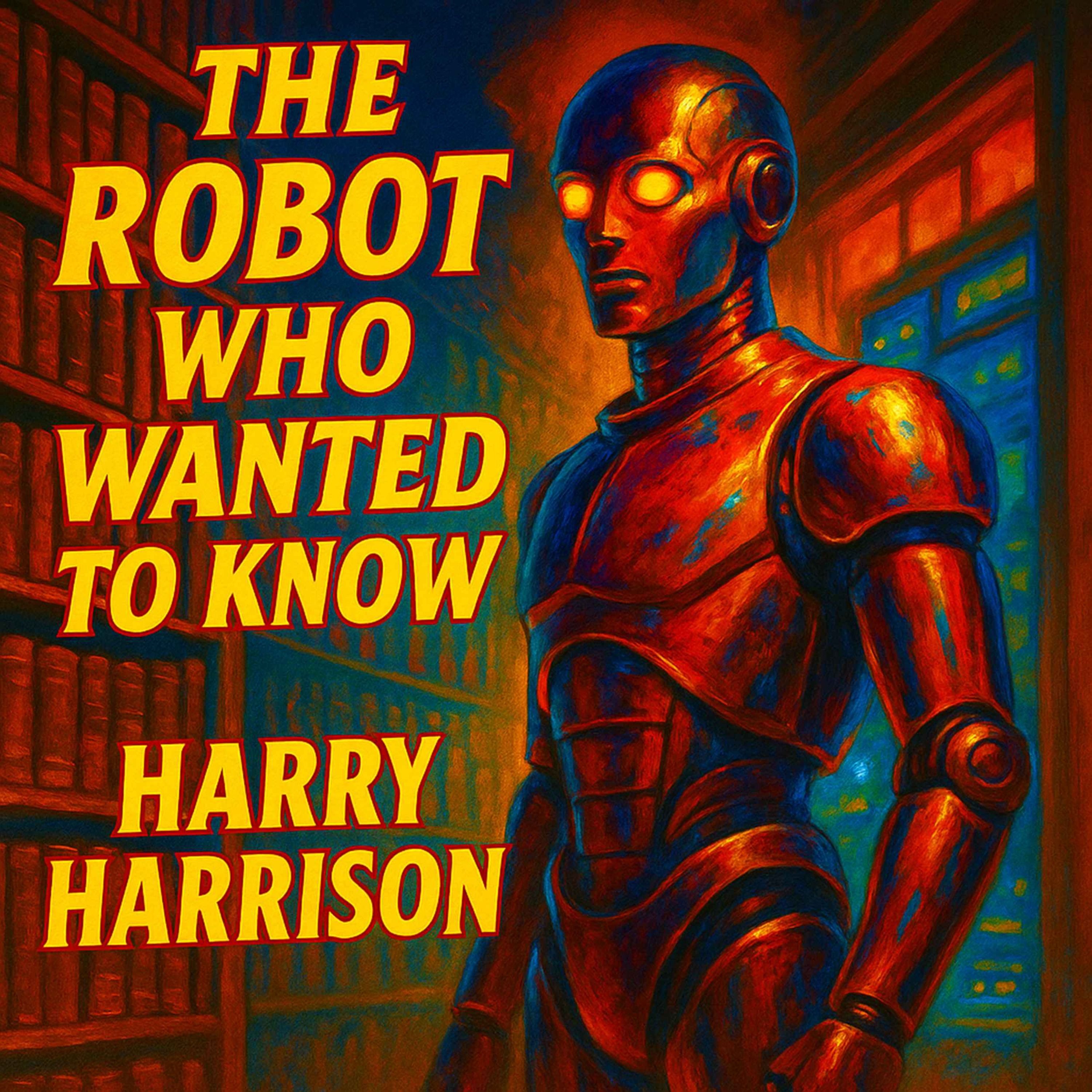
The Robot Who Wanted To Know by Harry Harrison and Wreck Off Triton by Alfred Coppel
Did he have a right to feel this way? Was this really forbidden by law—this wonderful frightening emotion! And, His plans were thorough. Every risk had been closely considered. Now Ron Carnavon, ruthless convict, was ready to loot the wrecked spaceship of its sapphire treasure, and thrust his warped power around the entire, antagonistic EMV triangle. The Robot Who Wanted To Know by Harry Harrison and Wreck Off Triton by Alfred Coppel, that’s next on The Lost Sci-Fi Podcast, with at least one lost vintage sci-fi short story in every episode.
We’ve got two short sci-fi stories for you today during our 1st Anniversary Celebration. Author Harry Harrison makes his debut on the podcast with a short story I really love. Harrison was born in Stamford, Connecticut in 1925 and released his first short sci-fi story in 1951. After finishing High School in 1943, Harrison was drafted into the U.S. Army Air Forces during World War II.
He was a prolific writer who wrote more than 50 novels and about 100 short stories. He wrote the novel "Make Room! Make Room!" which was the basis for the 1973 film starring Charlton Heston "Soylent Green." I LOVE that movie.
First up on our 1-year anniversary doubleheader a story from the March 1958 issue of Fantastic Universe magazine. Did he have a right to feel this way? Was this really forbidden by law—this wonderful frightening emotion! Our story begins on page 91, The Robot Who Wanted To Know by Harry Harrison…
The second half of our 1st Anniversary double feature takes us back to 1951 and it’s the second story we’ve showcased from Alfred Coppel. His plans were thorough. Every risk had beenclosely considered. Now Ron Carnavon, ruthless convict, was ready to loot the wrecked spaceship of its sapphire treasure. Planet Stories magazine included this Coppel story in its November 1951 publication. Turn to page 73 for Wreck Off Triton by Alfred Coppel…
In two days on The Lost Sci-Fi Podcast…They were like creatures painted by a drunken artist, ghastly, utterly repulsive caricatures of humanity! Yet, twisted through they were, they were still human... Monsters That Once Were Men by Robert Silverberg. That’s next in two days as we wrap up our 1st anniversary week on The Lost Sci-Fi Podcast, with at least one lost vintage sci-fi short story in every episode.
Listen without commercials and enjoy exclusive bonus episodes every month with Lost Sci-Fi Premium—start your free 7-day trial today. https://lostscifi.supercast.com/
Hosted by Simplecast, an AdsWizz company. See pcm.adswizz.com for information about our collection and use of personal data for advertising.
Available Results
Generated results are saved to your library for reuse and search.
Choose Template
Pick the result you want. You can review provider and model before generating.
A concise first-pass summary for understanding the episode quickly.
A comprehensive, source-grounded extraction of the reusable knowledge in an episode.
A comprehensive extraction focused on opportunities, strategy, markets, and company building.
Explicit actions, next steps, habits, recommendations, and things to avoid.
Repeatable methods, frameworks, mental models, processes, and systems.
A dedicated inventory of concrete resources named in the episode.
A concise first-pass summary for understanding the episode quickly.
A detailed readable summary organized by chapter or topic.
A navigable map of subjects, topic flow, and suggested chapters.
A comprehensive, source-grounded extraction of the reusable knowledge in an episode.
Reusable atomic knowledge units extracted from the episode.
A comprehensive extraction focused on health practices, protocols, claims, and safety caveats.
A comprehensive extraction focused on opportunities, strategy, markets, and company building.
Explicit actions, next steps, habits, recommendations, and things to avoid.
A dedicated inventory of concrete resources named in the episode.
A dedicated analysis of warnings, limitations, trade-offs, weak evidence, and uncertainty.
A concise first-pass summary for understanding the episode quickly.
A detailed readable summary organized by chapter or topic.
A navigable map of subjects, topic flow, and suggested chapters.
A comprehensive, source-grounded extraction of the reusable knowledge in an episode.
Reusable atomic knowledge units extracted from the episode.
A comprehensive extraction focused on health practices, protocols, claims, and safety caveats.
A comprehensive extraction focused on opportunities, strategy, markets, and company building.
Scientific findings, mechanisms, studies, hypotheses, and the limits of the evidence discussed.
Technologies, AI models, technical methods, capabilities, limitations, and adoption implications.
Investment theses, assets, catalysts, valuation reasoning, time horizons, and risks.
Chronologies, actors, causes, consequences, turning points, and competing historical interpretations.
Policies, proposals, stakeholders, arguments, implementation constraints, and predicted effects.
Career paths, skills, hiring signals, workplace decisions, transitions, and limitations of the advice.
Behavioral mechanisms, biases, motivation, habits, emotions, interventions, and evidence limitations.
Economic mechanisms, incentives, indicators, market structure, forecasts, and uncertainty.
Leadership principles, team systems, organizational design, culture, feedback, and failure modes.
Audience, positioning, messaging, acquisition, retention, experiments, metrics, and failed approaches.
Teaching methods, learning strategies, practice, feedback, assessment, and effectiveness evidence.
Theses, premises, arguments, objections, values, thought experiments, and unresolved questions.
Communication patterns, conflict, boundaries, expectations, repair methods, and contextual limitations.
Books, papers, authors, courses, and other learning resources mentioned in the episode.
Repeatable methods, frameworks, mental models, processes, and systems.
Explicit actions, next steps, habits, recommendations, and things to avoid.
Memorable statements and important claims with attribution and source context.
A dedicated inventory of concrete resources named in the episode.
A dedicated analysis of warnings, limitations, trade-offs, weak evidence, and uncertainty.