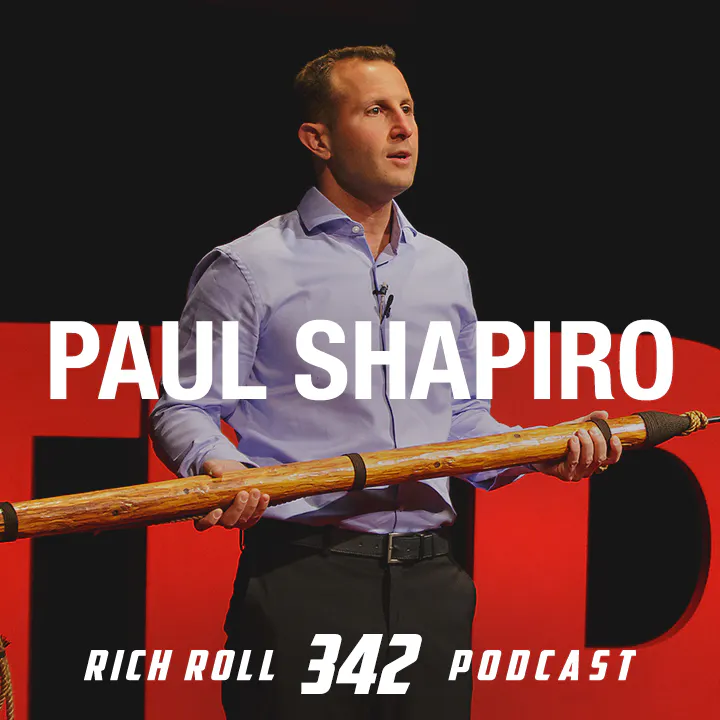
What Is “Clean Meat”? Paul Shapiro On The Future of Food
Unbeknownst to most, animal agriculture is the number one culprit when it comes to almost every single man-made environmental ill on the planet.
Untenable amounts of land, water and feed are required to raise the number of animals necessary to meet demand. Creating more greenhouse gas emissions than the entire transportation sector combined, our voracious appetite for meat and dairy products has produced the largest mass species extinction since the disappearance of the dinosaurs. Meanwhile, the primary driver of ocean acidification, water table pollution, rainforest devastation and a litany of other environmental abominations can be tracked to one primary source: our broken system of food production.
Without a doubt, it's a system that's destroying human health, irreparably damaging the planet we call home and creating unspeakable suffering in the process.
If we want to survive as a species, we need a new way forward. In my opinion, adopting a plant-based is the single most powerful and impactful thing you can possibly do as a conscious, compassionate consumer. It is the medicine that will prevent and reverse chronic lifestyle disease, preserve our planet's precious resources for future generations, and put an end to mass animal cruelty.
Vegan has indeed gone mainstream. That's awesome. But let's not be naïve. The rate at which people are adopting a plant-based lifestyle can't begin to match population growth and its concomitant demand for cheeseburgers and milk shakes.
7.5 billion people currently share this spinning blue planet we call Earth. By 2050, that number will escalate to 9.7 billion. By 2100? 11 billion.
How can we possibly feed 11 billion people sustainably?
Ask my good friend Paul Shapiro, and he will give you a two-word answer:
Clean meat.
When Paul — a long-time vegan and mainstream voice for agricultural sustainability — took his first bite of “lab-harvested” meat in 2014, more humans had gone into space than had eaten real meat grown outside an animal. But according to Paul, the clean meat revolution is upon us — and it holds the potential to save the world.
Just as we need clean energy to compete with fossil fuels, clean meat is poised to become a competitor of factory farms. Clean meat isn’t an alternative to meat; it’s real, actual meat grown (or more accurately, brewed) from animal cells, as well as other clean animal products that ditch animal cells altogether and are simply built from the molecule up.
Today we talk about it.
In addition to being among the worldʼs first clean meat consumers, Paul served as the vice president of policy engagement for the Humane Society of the United States, the worldʼs largest animal protection organization. Paul is also the founder of Compassion Over Killing, a TEDx speaker, and an inductee into the Animal Rights Hall of Fame.
Enjoy!
Rich
Learn more about your ad choices. Visit podcastchoices.com/adchoices
Available Results
Generated results are saved to your library for reuse and search.
Choose Template
Pick the result you want. You can review provider and model before generating.
A concise first-pass summary for understanding the episode quickly.
A comprehensive, source-grounded extraction of the reusable knowledge in an episode.
A comprehensive extraction focused on health practices, protocols, claims, and safety caveats.
A dedicated analysis of warnings, limitations, trade-offs, weak evidence, and uncertainty.
Repeatable methods, frameworks, mental models, processes, and systems.
A comprehensive extraction focused on opportunities, strategy, markets, and company building.
A concise first-pass summary for understanding the episode quickly.
A detailed readable summary organized by chapter or topic.
A navigable map of subjects, topic flow, and suggested chapters.
A comprehensive, source-grounded extraction of the reusable knowledge in an episode.
Reusable atomic knowledge units extracted from the episode.
A comprehensive extraction focused on health practices, protocols, claims, and safety caveats.
A comprehensive extraction focused on opportunities, strategy, markets, and company building.
Explicit actions, next steps, habits, recommendations, and things to avoid.
A dedicated inventory of concrete resources named in the episode.
A dedicated analysis of warnings, limitations, trade-offs, weak evidence, and uncertainty.
A concise first-pass summary for understanding the episode quickly.
A detailed readable summary organized by chapter or topic.
A navigable map of subjects, topic flow, and suggested chapters.
A comprehensive, source-grounded extraction of the reusable knowledge in an episode.
Reusable atomic knowledge units extracted from the episode.
A comprehensive extraction focused on health practices, protocols, claims, and safety caveats.
A comprehensive extraction focused on opportunities, strategy, markets, and company building.
Scientific findings, mechanisms, studies, hypotheses, and the limits of the evidence discussed.
Technologies, AI models, technical methods, capabilities, limitations, and adoption implications.
Investment theses, assets, catalysts, valuation reasoning, time horizons, and risks.
Chronologies, actors, causes, consequences, turning points, and competing historical interpretations.
Policies, proposals, stakeholders, arguments, implementation constraints, and predicted effects.
Career paths, skills, hiring signals, workplace decisions, transitions, and limitations of the advice.
Behavioral mechanisms, biases, motivation, habits, emotions, interventions, and evidence limitations.
Economic mechanisms, incentives, indicators, market structure, forecasts, and uncertainty.
Leadership principles, team systems, organizational design, culture, feedback, and failure modes.
Audience, positioning, messaging, acquisition, retention, experiments, metrics, and failed approaches.
Teaching methods, learning strategies, practice, feedback, assessment, and effectiveness evidence.
Theses, premises, arguments, objections, values, thought experiments, and unresolved questions.
Communication patterns, conflict, boundaries, expectations, repair methods, and contextual limitations.
Books, papers, authors, courses, and other learning resources mentioned in the episode.
Repeatable methods, frameworks, mental models, processes, and systems.
Explicit actions, next steps, habits, recommendations, and things to avoid.
Memorable statements and important claims with attribution and source context.
A dedicated inventory of concrete resources named in the episode.
A dedicated analysis of warnings, limitations, trade-offs, weak evidence, and uncertainty.