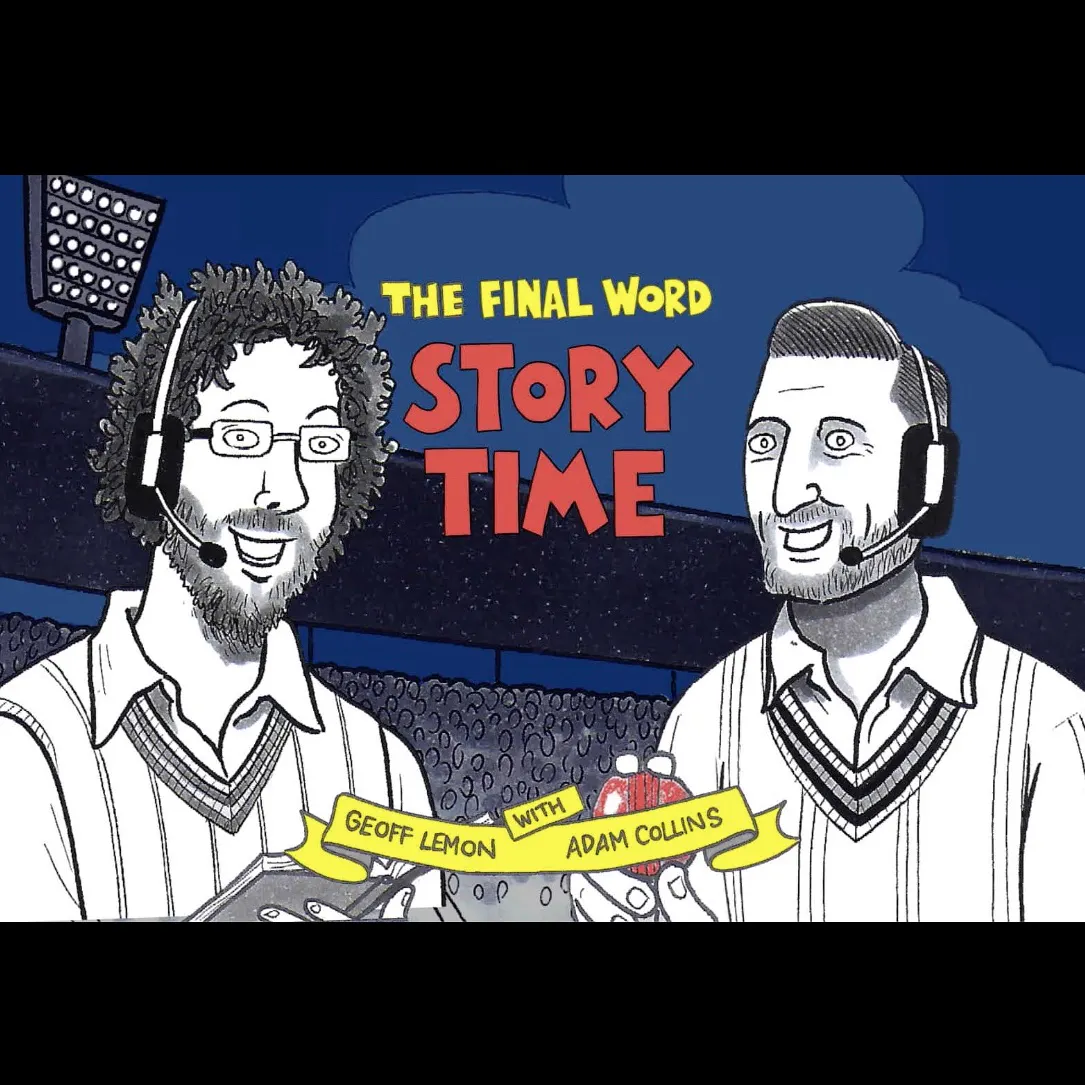
Story Time 181 – Threads of the Caribbean tapestry
It's Story Time, our walk through cricket history via your listener quiz challenges. This week, Bharat Sundaresan joins the show for what is coincidentally a great week to be an expert on West Indies teams meeting India. Famous uncles, less famous young nephews, and one of the most underrated batting greats of all. Join the dots on Story Time.
Your Nerd Pledge numbers this week:
5.60 - Bala Sivaramanan
16.24 - Dom Griffiths
4.73 - Chris Dobbins
1.17 - Ash Jayaraman
2.71 - Eric Parnis
2.00 - Toby Guyatt
Support the show with a Nerd Pledge at patreon.com/thefinalword
Get down to Westfield London and Westfield Stratford City! More extra, less ordinary.
westfield.com/united-kingdom/london
Get 10% off kit from Serious Cricket with FINALWORD24 at checkout:
And get that sweet Nord VPN discount - nordvpn.com/tfw
Donate to support our Edinburgh Marathon runners for the Lord's Taverners
All links at linktr.ee/thefinalword
Find previous episodes at finalwordcricket.com
Title track by Urthboy
Learn more about your ad choices. Visit podcastchoices.com/adchoices
Available Results
Generated results are saved to your library for reuse and search.
Choose Template
Pick the result you want. You can review provider and model before generating.
A concise first-pass summary for understanding the episode quickly.
A comprehensive, source-grounded extraction of the reusable knowledge in an episode.
Technologies, AI models, technical methods, capabilities, limitations, and adoption implications.
Repeatable methods, frameworks, mental models, processes, and systems.
A dedicated analysis of warnings, limitations, trade-offs, weak evidence, and uncertainty.
A dedicated inventory of concrete resources named in the episode.
A concise first-pass summary for understanding the episode quickly.
A detailed readable summary organized by chapter or topic.
A navigable map of subjects, topic flow, and suggested chapters.
A comprehensive, source-grounded extraction of the reusable knowledge in an episode.
Reusable atomic knowledge units extracted from the episode.
A comprehensive extraction focused on health practices, protocols, claims, and safety caveats.
A comprehensive extraction focused on opportunities, strategy, markets, and company building.
Explicit actions, next steps, habits, recommendations, and things to avoid.
A dedicated inventory of concrete resources named in the episode.
A dedicated analysis of warnings, limitations, trade-offs, weak evidence, and uncertainty.
A concise first-pass summary for understanding the episode quickly.
A detailed readable summary organized by chapter or topic.
A navigable map of subjects, topic flow, and suggested chapters.
A comprehensive, source-grounded extraction of the reusable knowledge in an episode.
Reusable atomic knowledge units extracted from the episode.
A comprehensive extraction focused on health practices, protocols, claims, and safety caveats.
A comprehensive extraction focused on opportunities, strategy, markets, and company building.
Scientific findings, mechanisms, studies, hypotheses, and the limits of the evidence discussed.
Technologies, AI models, technical methods, capabilities, limitations, and adoption implications.
Investment theses, assets, catalysts, valuation reasoning, time horizons, and risks.
Chronologies, actors, causes, consequences, turning points, and competing historical interpretations.
Policies, proposals, stakeholders, arguments, implementation constraints, and predicted effects.
Career paths, skills, hiring signals, workplace decisions, transitions, and limitations of the advice.
Behavioral mechanisms, biases, motivation, habits, emotions, interventions, and evidence limitations.
Economic mechanisms, incentives, indicators, market structure, forecasts, and uncertainty.
Leadership principles, team systems, organizational design, culture, feedback, and failure modes.
Audience, positioning, messaging, acquisition, retention, experiments, metrics, and failed approaches.
Teaching methods, learning strategies, practice, feedback, assessment, and effectiveness evidence.
Theses, premises, arguments, objections, values, thought experiments, and unresolved questions.
Communication patterns, conflict, boundaries, expectations, repair methods, and contextual limitations.
Books, papers, authors, courses, and other learning resources mentioned in the episode.
Repeatable methods, frameworks, mental models, processes, and systems.
Explicit actions, next steps, habits, recommendations, and things to avoid.
Memorable statements and important claims with attribution and source context.
A dedicated inventory of concrete resources named in the episode.
A dedicated analysis of warnings, limitations, trade-offs, weak evidence, and uncertainty.