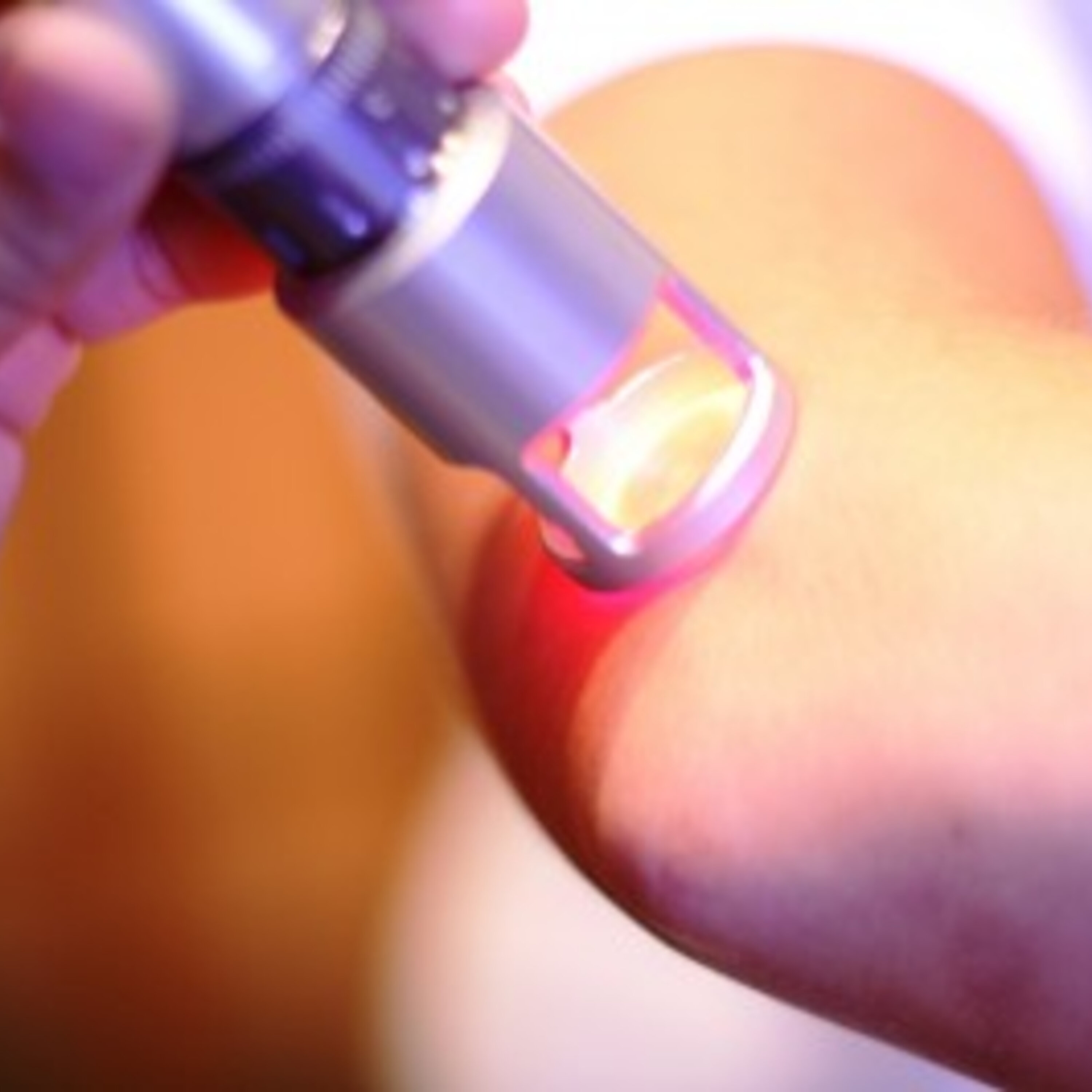
How You Can Use Lasers To Heal Injuries, Enhance Recovery and Increase Performance.
Until today's podcast episode, I didn't realize lasers were so darn cool, and effective for so many issues.
The laser was invented in 1960 and the biological stimulation properties of laser light were discovered shortly after than, in 1967. Even though therapy lasers have been used in Europe much longer than in the United States, in 2002, the FDA cleared therapy lasers for treating injuries and enhancing recovery.
Now, multiple researchers throughout the world are finding enormous therapeutic application of different laser infrared wavelengths like red, green, and blue wavelengths and their effects on tissues. New high-power laser therapy systems penetrate deep into tissue and deliver physiological benefits that no other modality like electrical muscle stimulation or ultrasound can deliver. By stimulating adenosine triphosphate (ATP) production and enhancing cell membrane permeability, lasers can actually helps injuries heal and speed up recovery from workouts, rather than just masking pain.
Today's podcast guest, Dr. Phil Harrington, has over 10 years of clinical experience using lasers for healing, and is a national and international author and lecturer on laser therapy. During our discussion you'll discover: -How laser treatments work... -What conditions can benefit from laser treatments... -Whether those little handheld laser units you can buy online work... -Which elite athletes are currently using laster treatments.... -What other modalities or treatments can be used with laster... -Why your body won't just heal itself from injury... -The difference between laser and other things like ultrasound or electrical muscle stimulation... -How to find a K-Laser provider in your area...
Do you have questions about how you can use lasers to heal injuries, enhance recovery and increase performance, or questions about the K-Laser? Leave your comments at BenGreenfieldFitness.com.
See omnystudio.com/listener for privacy information.
Available Results
Generated results are saved to your library for reuse and search.
Choose Template
Pick the result you want. You can review provider and model before generating.
A concise first-pass summary for understanding the episode quickly.
A comprehensive, source-grounded extraction of the reusable knowledge in an episode.
A comprehensive extraction focused on health practices, protocols, claims, and safety caveats.
A dedicated analysis of warnings, limitations, trade-offs, weak evidence, and uncertainty.
Repeatable methods, frameworks, mental models, processes, and systems.
Scientific findings, mechanisms, studies, hypotheses, and the limits of the evidence discussed.
A concise first-pass summary for understanding the episode quickly.
A detailed readable summary organized by chapter or topic.
A navigable map of subjects, topic flow, and suggested chapters.
A comprehensive, source-grounded extraction of the reusable knowledge in an episode.
Reusable atomic knowledge units extracted from the episode.
A comprehensive extraction focused on health practices, protocols, claims, and safety caveats.
A comprehensive extraction focused on opportunities, strategy, markets, and company building.
Explicit actions, next steps, habits, recommendations, and things to avoid.
A dedicated inventory of concrete resources named in the episode.
A dedicated analysis of warnings, limitations, trade-offs, weak evidence, and uncertainty.
A concise first-pass summary for understanding the episode quickly.
A detailed readable summary organized by chapter or topic.
A navigable map of subjects, topic flow, and suggested chapters.
A comprehensive, source-grounded extraction of the reusable knowledge in an episode.
Reusable atomic knowledge units extracted from the episode.
A comprehensive extraction focused on health practices, protocols, claims, and safety caveats.
A comprehensive extraction focused on opportunities, strategy, markets, and company building.
Scientific findings, mechanisms, studies, hypotheses, and the limits of the evidence discussed.
Technologies, AI models, technical methods, capabilities, limitations, and adoption implications.
Investment theses, assets, catalysts, valuation reasoning, time horizons, and risks.
Chronologies, actors, causes, consequences, turning points, and competing historical interpretations.
Policies, proposals, stakeholders, arguments, implementation constraints, and predicted effects.
Career paths, skills, hiring signals, workplace decisions, transitions, and limitations of the advice.
Behavioral mechanisms, biases, motivation, habits, emotions, interventions, and evidence limitations.
Economic mechanisms, incentives, indicators, market structure, forecasts, and uncertainty.
Leadership principles, team systems, organizational design, culture, feedback, and failure modes.
Audience, positioning, messaging, acquisition, retention, experiments, metrics, and failed approaches.
Teaching methods, learning strategies, practice, feedback, assessment, and effectiveness evidence.
Theses, premises, arguments, objections, values, thought experiments, and unresolved questions.
Communication patterns, conflict, boundaries, expectations, repair methods, and contextual limitations.
Books, papers, authors, courses, and other learning resources mentioned in the episode.
Repeatable methods, frameworks, mental models, processes, and systems.
Explicit actions, next steps, habits, recommendations, and things to avoid.
Memorable statements and important claims with attribution and source context.
A dedicated inventory of concrete resources named in the episode.
A dedicated analysis of warnings, limitations, trade-offs, weak evidence, and uncertainty.