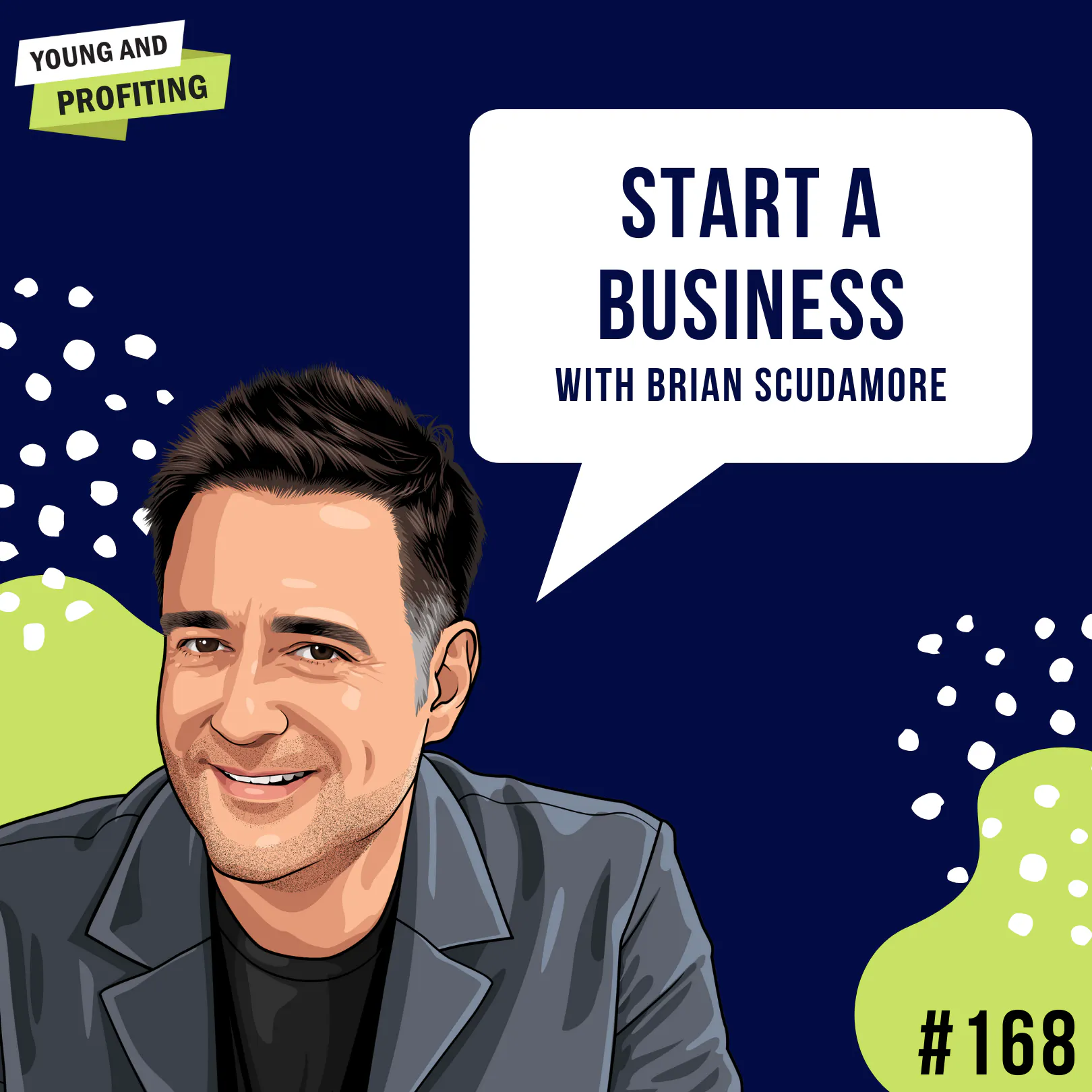
Brian Scudamore: Start A Business | E168
This week on YAP, author and serial entrepreneur Brian Scudamore is back to talk about his new book, BYOB: Build Your Own Business, Be Your Own Boss. Do you want to own your own business, but don’t know where to start? There are two main paths to starting your own business, blank slate and franchising. But which is right for you? In this episode, Hala and Brian dive deep into the two paths to owning your own business, discuss Brian’s new book BYOB: Build Your Own Business, Be Your Own Boss, cover the 4 H’s of business success, and chat about what Brian has learned about the entrepreneurial journey along the way.
Topics Include:
- Brian’s background in entrepreneurship
- Why he became an author
- Summary of Brian’s new book BYOB
- Two paths to owning your own business
- Flywheel of Business
- What Brian means by a “Painted Picture”
- Getting on Oprah and the importance of human capital
- The entrepreneurial myth
- The importance of failure
- How to decide which entrepreneurial path to take?
- 3 necessary traits for a Blank sheet businesses
- Brian’s failure with “You Move Me”
- Rapid Fire about types of entrepreneurs
- The 4 H’s applied to franchising
- What to look for in a franchise system?
- Brian’s Actionable Advice
- Brian’s Secret to Profiting in Life
- And other topics…
Brian Scudamore is the founder and CEO of O2E Brands, the parent company of 1-800-GOT-JUNK?, WOW 1 DAY PAINTING, and Shack Shine. Each brand has franchise locations in every major metro city in North America and Australia.
Brian is the author of the books WTF?! (Willing to Fail): How Failure Can Be Your Key to Success, BYOB: Build Your Own Business, Be Your Own Boss. He is also a regular contributor to Forbes, writing about small business ownership, franchising, and building corporate culture.
His companies have appeared on major media outlets including ABC Nightline, Good Morning America, Dr. Phil, CNN, The Today Show, Oprah, and CNBC. His story has been featured in Fortune Magazine, The New York Times, Huffington Post, and The Wall Street Journal.
Sponsored By:
ExpressVPN - Visit my exclusive link ExpressVPN.com/yap and get an extra 3 months FREE on a one-year package.
Jordan Harbinger - Check out jordanharbinger.com/start for some episode recommendations
Wise - Join 13 million people and businesses who are already saving, and try Wise for free at Wise.com/yap
Credit Karma Personal Loans - Go to creditkarma.com/loanoffers to find the loan for you
Resources Mentioned:
YAP Episode: #76: From Trash to Cash with Brian Scudamore
https://www.youngandprofiting.com/76-from-trash-to-cash-with-brian-scudamore/
The E Myth by Michael E. Gerber: https://www.amazon.com/Myth-Most-Businesses-Dont-About/dp/0887303625
Brian’s Books: https://www.amazon.com/Brian-Scudamore/e/B07HYJ8FSS?ref=sr_ntt_srch_lnk_1&qid=1650302541&sr=1-1
Brian’s Website: https://www.o2ebrands.com
Brian’s Linkedin: https://www.linkedin.com/in/scudamore/
Brian’s Instagram: https://www.instagram.com/brianscudamore/
Brian’s Twitter: https://twitter.com/brianscudamore
Brian’s Facebook: https://www.facebook.com/bscudamore/
Connect with Young and Profiting:
YAP’s Instagram: https://www.instagram.com/youngandprofiting/
Hala’s LinkedIn: https://www.linkedin.com/in/htaha/
Hala’s Instagram:https://www.instagram.com/yapwithhala/
Hala’s Twitter: https://twitter.com/yapwithhala
Clubhouse: https://www.clubhouse.com/@halataha
Website: https://www.youngandprofiting.com/
Text Hala: https://youngandprofiting.co/TextHala or text “YAP” to 28046
Available Results
Generated results are saved to your library for reuse and search.
Choose Template
Pick the result you want. You can review provider and model before generating.
A concise first-pass summary for understanding the episode quickly.
A comprehensive, source-grounded extraction of the reusable knowledge in an episode.
A comprehensive extraction focused on opportunities, strategy, markets, and company building.
Explicit actions, next steps, habits, recommendations, and things to avoid.
Repeatable methods, frameworks, mental models, processes, and systems.
A dedicated inventory of concrete resources named in the episode.
A concise first-pass summary for understanding the episode quickly.
A detailed readable summary organized by chapter or topic.
A navigable map of subjects, topic flow, and suggested chapters.
A comprehensive, source-grounded extraction of the reusable knowledge in an episode.
Reusable atomic knowledge units extracted from the episode.
A comprehensive extraction focused on health practices, protocols, claims, and safety caveats.
A comprehensive extraction focused on opportunities, strategy, markets, and company building.
Explicit actions, next steps, habits, recommendations, and things to avoid.
A dedicated inventory of concrete resources named in the episode.
A dedicated analysis of warnings, limitations, trade-offs, weak evidence, and uncertainty.
A concise first-pass summary for understanding the episode quickly.
A detailed readable summary organized by chapter or topic.
A navigable map of subjects, topic flow, and suggested chapters.
A comprehensive, source-grounded extraction of the reusable knowledge in an episode.
Reusable atomic knowledge units extracted from the episode.
A comprehensive extraction focused on health practices, protocols, claims, and safety caveats.
A comprehensive extraction focused on opportunities, strategy, markets, and company building.
Scientific findings, mechanisms, studies, hypotheses, and the limits of the evidence discussed.
Technologies, AI models, technical methods, capabilities, limitations, and adoption implications.
Investment theses, assets, catalysts, valuation reasoning, time horizons, and risks.
Chronologies, actors, causes, consequences, turning points, and competing historical interpretations.
Policies, proposals, stakeholders, arguments, implementation constraints, and predicted effects.
Career paths, skills, hiring signals, workplace decisions, transitions, and limitations of the advice.
Behavioral mechanisms, biases, motivation, habits, emotions, interventions, and evidence limitations.
Economic mechanisms, incentives, indicators, market structure, forecasts, and uncertainty.
Leadership principles, team systems, organizational design, culture, feedback, and failure modes.
Audience, positioning, messaging, acquisition, retention, experiments, metrics, and failed approaches.
Teaching methods, learning strategies, practice, feedback, assessment, and effectiveness evidence.
Theses, premises, arguments, objections, values, thought experiments, and unresolved questions.
Communication patterns, conflict, boundaries, expectations, repair methods, and contextual limitations.
Books, papers, authors, courses, and other learning resources mentioned in the episode.
Repeatable methods, frameworks, mental models, processes, and systems.
Explicit actions, next steps, habits, recommendations, and things to avoid.
Memorable statements and important claims with attribution and source context.
A dedicated inventory of concrete resources named in the episode.
A dedicated analysis of warnings, limitations, trade-offs, weak evidence, and uncertainty.