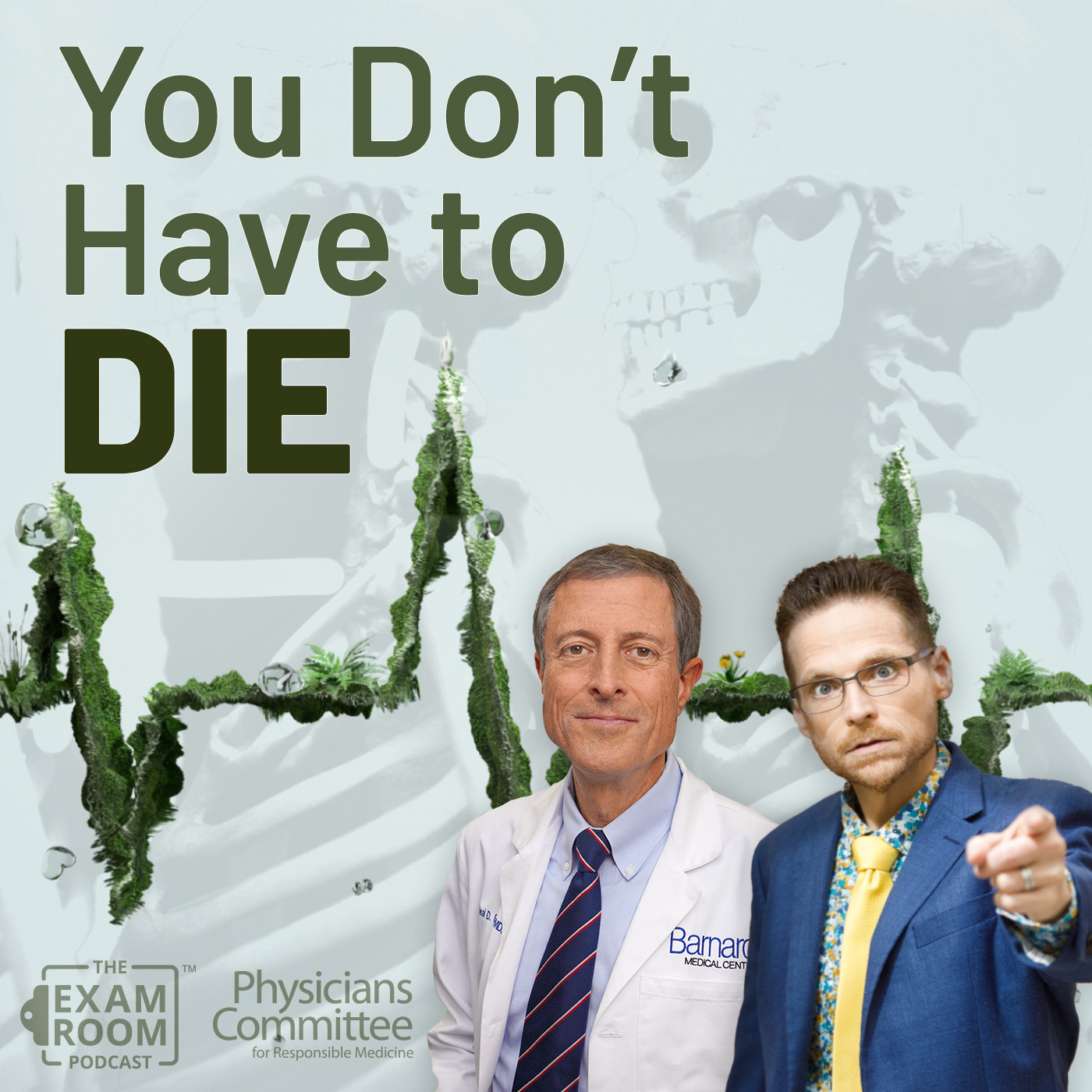
Eating to Save Your Life: High-Risk Cardiovascular Disease | Dr. Neal Barnard Live Q&A
The power of food is extraordinary. Every 33 seconds in the U.S. someone will die of cardiovascular disease, but you do not have to be a statistic.
For the first time, groundbreaking research is proving definitively that even patients who already have the disease, as well as those who are at high risk of developing it, can dramatically improve their heart health.
Dr. Neal Barnard and "The Weight Loss Champion" Chuck Carroll discuss the analysis of nearly 2,000 patients and the effect that an infusion of nonanimal foods had on their cardiometabolic function.
The results point directly to the benefit of vegan and vegetarian diets to both prevent and, in many cases, reverse heart disease.
Topic Discussed
- How these findings differ from previous heart disease research
- Alcohol's effect on blood pressure
- Which foods are healthiest for the heart
- The effect of animal protein on heart function
- And more
Dr. Barnard will be speaking at the 2023 International Conference on Nutrition in Medicine.
This episode of The Exam Room™ Podcast is sponsored by The Gregory J. Reiter Memorial Fund, which supports organizations like the Physicians Committee that carry on Greg's passion and love for animals through rescue efforts, veganism, and wildlife conservation.
— — SHOW LINKS — —
PCRM Donation Matching
Donate: https://www.pcrm.org/match
— — —
Gregory J. Reiter Memorial Fund
— — UPCOMING EVENTS — —
International Conference on Nutrition in Medicine
Tickets and speakers: https://www.pcrm.org/icnm
When: Aug. 10-12
Where: Washington, DC
— — FOLLOW US — —
Dr. Neal Barnard
Twitter: https://www.twitter.com/drnealbarnard
Instagram: https://www.instagram.com/drnealbarnard
Facebook: http://bit.ly/DrBarnardFB
Your Body In Balance: https://amzn.to/2UvAfxW
— — —
Chuck Carroll
Instagram: https://www.instagram.com/ChuckCarrollWLC
Twitter: https://www.twitter.com/ChuckCarrollWLC
Facebook: http://wghtloss.cc/ChuckFacebook
— — —
Physicians Committee
Instagram: https://www.instagram.com/physicianscommittee
Facebook: https://www.facebook.com/PCRM.org
Twitter: https://www.twitter.com/pcrm
— — —
5-Star Success: Share Your Story
Apple: https://apple.co/2JXBkpy
Spotify: https://spoti.fi/2pMLoY3
— — —
Share the Show
Please subscribe and give the show a 5-star rating on Apple Podcasts, Spotify, or many other podcast providers. Don't forget to share it with a friend for inspiration!
Available Results
Generated results are saved to your library for reuse and search.
Choose Template
Pick the result you want. You can review provider and model before generating.
A concise first-pass summary for understanding the episode quickly.
A comprehensive, source-grounded extraction of the reusable knowledge in an episode.
A comprehensive extraction focused on health practices, protocols, claims, and safety caveats.
A dedicated analysis of warnings, limitations, trade-offs, weak evidence, and uncertainty.
Repeatable methods, frameworks, mental models, processes, and systems.
Scientific findings, mechanisms, studies, hypotheses, and the limits of the evidence discussed.
A concise first-pass summary for understanding the episode quickly.
A detailed readable summary organized by chapter or topic.
A navigable map of subjects, topic flow, and suggested chapters.
A comprehensive, source-grounded extraction of the reusable knowledge in an episode.
Reusable atomic knowledge units extracted from the episode.
A comprehensive extraction focused on health practices, protocols, claims, and safety caveats.
A comprehensive extraction focused on opportunities, strategy, markets, and company building.
Explicit actions, next steps, habits, recommendations, and things to avoid.
A dedicated inventory of concrete resources named in the episode.
A dedicated analysis of warnings, limitations, trade-offs, weak evidence, and uncertainty.
A concise first-pass summary for understanding the episode quickly.
A detailed readable summary organized by chapter or topic.
A navigable map of subjects, topic flow, and suggested chapters.
A comprehensive, source-grounded extraction of the reusable knowledge in an episode.
Reusable atomic knowledge units extracted from the episode.
A comprehensive extraction focused on health practices, protocols, claims, and safety caveats.
A comprehensive extraction focused on opportunities, strategy, markets, and company building.
Scientific findings, mechanisms, studies, hypotheses, and the limits of the evidence discussed.
Technologies, AI models, technical methods, capabilities, limitations, and adoption implications.
Investment theses, assets, catalysts, valuation reasoning, time horizons, and risks.
Chronologies, actors, causes, consequences, turning points, and competing historical interpretations.
Policies, proposals, stakeholders, arguments, implementation constraints, and predicted effects.
Career paths, skills, hiring signals, workplace decisions, transitions, and limitations of the advice.
Behavioral mechanisms, biases, motivation, habits, emotions, interventions, and evidence limitations.
Economic mechanisms, incentives, indicators, market structure, forecasts, and uncertainty.
Leadership principles, team systems, organizational design, culture, feedback, and failure modes.
Audience, positioning, messaging, acquisition, retention, experiments, metrics, and failed approaches.
Teaching methods, learning strategies, practice, feedback, assessment, and effectiveness evidence.
Theses, premises, arguments, objections, values, thought experiments, and unresolved questions.
Communication patterns, conflict, boundaries, expectations, repair methods, and contextual limitations.
Books, papers, authors, courses, and other learning resources mentioned in the episode.
Repeatable methods, frameworks, mental models, processes, and systems.
Explicit actions, next steps, habits, recommendations, and things to avoid.
Memorable statements and important claims with attribution and source context.
A dedicated inventory of concrete resources named in the episode.
A dedicated analysis of warnings, limitations, trade-offs, weak evidence, and uncertainty.