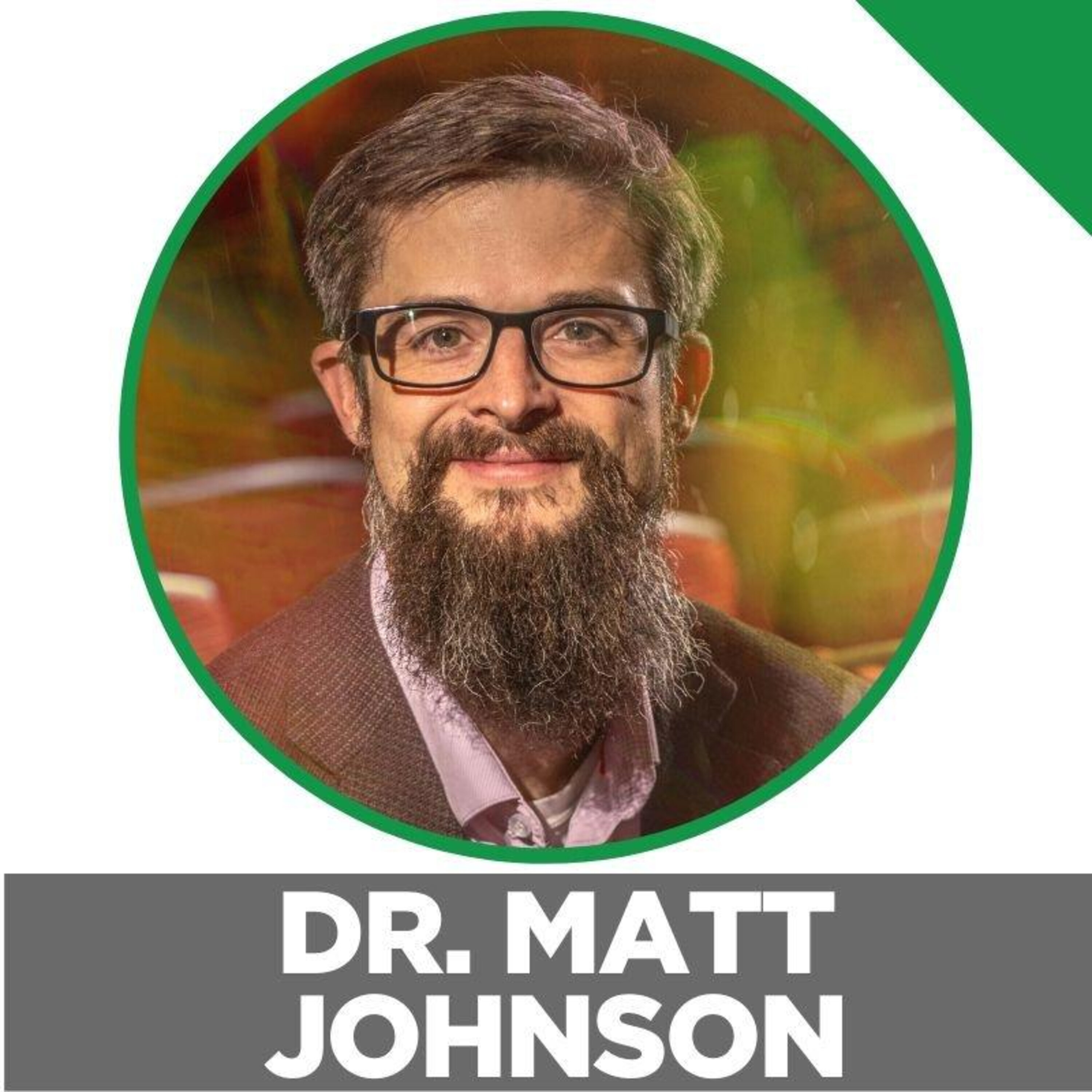
What Happens During A Psychedelic Journey: Dr. Matthew Johnson On Psychedelic Treatment Room, The State Of Psychedelic Research & Future of Psychedelic Therapy.
bengreenfieldfitness.com/psychedelics
My guest on today's show, Dr. Matthew W. Johnson, Ph.D., is a professor of psychiatry and behavioral sciences at Johns Hopkins University.
He also happens to be one of the world’s most published scientists on the topic of the effects of psychedelics on humans and has conducted seminal research on the behavioral economics of drug use, addiction, and risk behavior.
The MAPS Capstone Challenge will help provide the funds—$30 million total—needed to complete the studies required for FDA approval of MDMA-assisted psychotherapy for PTSD. MAPS has already raised $10 million. If another $10 million are raised by September 10th, this will unlock a $10 million challenge pledge that Tim Ferriss has helped put together, alongside PSFC. Half of the pledge comes from the Steven & Alexandra Cohen Foundation (@cohengive), and the rest is split equally between Tim; James Bailey from Bail Capital; Peter Rahal, the founder of RXBAR (@peterrahal); Blake Mycoskie, the founder of TOMS (@blakemycoskie); and an anonymous donor.
This challenge pledge is all or nothing. If MAPS fails to raise $10 million by September 10th, they do not receive the $10 million challenge pledge. There is no partial credit, and there is a real urgency. This $10M challenge pledge was announced in Tim's recent interview with Rick Doblin, the founder of MAPS. Every dollar matters, so if the spirit moves you, please consider giving what you can by clicking here. If you can contribute $100,000 or more over two years, please get in touch with Rick and his team by emailing capstone@maps.org.
In this conversation with Dr. Matt Johnson, you'll discover:
-The major announcement made at Johns Hopkins regarding psychedelic research...14:15
-How to explain the efficacy of psychedelics to "healthy normal" people...19:00
-The gold standard on microdosing for enhanced productivity...23:05
-Matt's response to the suggestion that he's just in it for the drugs...32:40
-How psychedelics are used to treat addiction to tobacco...38:35
-How to handle participants who experience anxiety during the session...53:07
-The dark side of MDMA and other psychedelics...1:04:30
Episode sponsors: Kion Aminos, Organifi Gold, Joovv, Water and Wellness
bengreenfieldfitness.com/psychedelics
See omnystudio.com/listener for privacy information.
Available Results
Generated results are saved to your library for reuse and search.
Choose Template
Pick the result you want. You can review provider and model before generating.
A concise first-pass summary for understanding the episode quickly.
A comprehensive, source-grounded extraction of the reusable knowledge in an episode.
A comprehensive extraction focused on health practices, protocols, claims, and safety caveats.
A dedicated analysis of warnings, limitations, trade-offs, weak evidence, and uncertainty.
Repeatable methods, frameworks, mental models, processes, and systems.
A comprehensive extraction focused on opportunities, strategy, markets, and company building.
A concise first-pass summary for understanding the episode quickly.
A detailed readable summary organized by chapter or topic.
A navigable map of subjects, topic flow, and suggested chapters.
A comprehensive, source-grounded extraction of the reusable knowledge in an episode.
Reusable atomic knowledge units extracted from the episode.
A comprehensive extraction focused on health practices, protocols, claims, and safety caveats.
A comprehensive extraction focused on opportunities, strategy, markets, and company building.
Explicit actions, next steps, habits, recommendations, and things to avoid.
A dedicated inventory of concrete resources named in the episode.
A dedicated analysis of warnings, limitations, trade-offs, weak evidence, and uncertainty.
A concise first-pass summary for understanding the episode quickly.
A detailed readable summary organized by chapter or topic.
A navigable map of subjects, topic flow, and suggested chapters.
A comprehensive, source-grounded extraction of the reusable knowledge in an episode.
Reusable atomic knowledge units extracted from the episode.
A comprehensive extraction focused on health practices, protocols, claims, and safety caveats.
A comprehensive extraction focused on opportunities, strategy, markets, and company building.
Scientific findings, mechanisms, studies, hypotheses, and the limits of the evidence discussed.
Technologies, AI models, technical methods, capabilities, limitations, and adoption implications.
Investment theses, assets, catalysts, valuation reasoning, time horizons, and risks.
Chronologies, actors, causes, consequences, turning points, and competing historical interpretations.
Policies, proposals, stakeholders, arguments, implementation constraints, and predicted effects.
Career paths, skills, hiring signals, workplace decisions, transitions, and limitations of the advice.
Behavioral mechanisms, biases, motivation, habits, emotions, interventions, and evidence limitations.
Economic mechanisms, incentives, indicators, market structure, forecasts, and uncertainty.
Leadership principles, team systems, organizational design, culture, feedback, and failure modes.
Audience, positioning, messaging, acquisition, retention, experiments, metrics, and failed approaches.
Teaching methods, learning strategies, practice, feedback, assessment, and effectiveness evidence.
Theses, premises, arguments, objections, values, thought experiments, and unresolved questions.
Communication patterns, conflict, boundaries, expectations, repair methods, and contextual limitations.
Books, papers, authors, courses, and other learning resources mentioned in the episode.
Repeatable methods, frameworks, mental models, processes, and systems.
Explicit actions, next steps, habits, recommendations, and things to avoid.
Memorable statements and important claims with attribution and source context.
A dedicated inventory of concrete resources named in the episode.
A dedicated analysis of warnings, limitations, trade-offs, weak evidence, and uncertainty.